
The Snowflake advanced data engineer certification, earned through the DEA-C02 exam, signals that you can build, tune, and govern production data pipelines on the Snowflake Data Cloud. Formally titled Snowflake SnowPro Advanced: Data Engineer, this credential sits above the SnowPro Core level and targets practitioners who already work with Snowflake every day. It validates hands-on skill across ingestion, transformation, performance tuning, and data protection rather than surface familiarity. This guide breaks down what the role demands, how the DEA-C02 exam is weighted, which Snowflake features you must master, and a realistic path from working practitioner to certified expert.
Table of Contents
- What Does a Snowflake Advanced Data Engineer Actually Do?
- What Is the DEA-C02 Exam and Who Should Take It?
- How Is the DEA-C02 Syllabus Structured?
- Which Skills Matter Most for Data Movement and Transformation?
- How Do You Optimize Performance and Protect Data in Snowflake?
- Why Does Data Governance Carry Weight on the DEA-C02?
- How Should You Prepare for the Snowflake Advanced Data Engineer Exam?
- What Career Growth Follows the Credential?
- Frequently Asked Questions
- Conclusion
What Does a Snowflake Advanced Data Engineer Actually Do?
A Snowflake advanced data engineer designs the pipelines that move raw data into the platform, transform it into analytics-ready models, and keep it fast, secure, and governed. The DEA-C02 credential certifies this exact scope. Day to day, the role blends SQL, Snowpark development, pipeline automation, and cost-aware performance tuning across structured, semi-structured, and unstructured data sources.
Engineers comparing warehouse and lakehouse platforms often weigh this against a lakehouse engineering credential to decide which architecture their career should follow.
Unlike an analyst who mainly queries data, the engineer owns how data arrives and how reliably it flows. That ownership spans several recurring responsibilities: The analyst side has its own advanced credential, and the SnowPro advanced data analyst shows how its domains are weighted.
- Ingesting batch and streaming data through stages, Snowpipe, and connectors
- Building continuous pipelines with tasks, streams, and dynamic tables
- Writing user-defined functions and stored procedures in SQL, Python, Java, or Scala
- Tuning virtual warehouses and clustering to balance speed against credit spend
- Applying masking, row-access policies, and tagging to protect sensitive data
Because the exam mirrors real production work, candidates who operate Snowflake in a live environment tend to recognise the scenarios immediately. Engineers who have passed this exam often note that practical pipeline experience matters more than memorising syntax.
What Is the DEA-C02 Exam and Who Should Take It?
The DEA-C02 is the current version of the Snowflake SnowPro Advanced: Data Engineer exam. It contains 65 questions, runs for 115 minutes, and requires a scaled score of 750 on a 0 to 1000 range to pass. The exam costs $375 USD and is delivered through Pearson VUE, either at a test center or via online proctoring, making it an advanced-tier commitment.
Snowflake positions this credential for engineers who already hold or could pass the SnowPro Core level and have roughly two years of practical Snowflake experience. It suits data engineers, platform engineers, and ETL developers who build on the platform rather than newcomers exploring it. If you want to gauge question style before booking, a timed DEA-C02 practice test mirrors the format closely.
| Exam Attribute | Detail |
|---|---|
| Exam name | Snowflake SnowPro Advanced: Data Engineer |
| Exam code | DEA-C02 |
| Number of questions | 65 |
| Duration | 115 minutes |
| Passing score | 750 (scaled 0 to 1000) |
| Exam cost | $375 USD |
| Delivery provider | Pearson VUE |
Passing the earlier SnowPro Core exam is a strong signal of readiness. If you are still weighing the entry credential, this breakdown of the SnowPro Core exam essentials shows how the foundation maps into advanced topics.
How Is the DEA-C02 Syllabus Structured?
The DEA-C02 syllabus divides into five weighted domains, with Data Movement carrying the largest share at 28 percent and Data Transformation close behind at 25 percent. Performance Optimization accounts for 19 percent, while Storage and Data Protection and Data Governance each contribute 14 percent. Together these weightings tell you exactly where to concentrate study time for the Snowflake advanced data engineer exam.
More than half the exam sits in the two pipeline-building domains, so ingestion and transformation deserve the deepest preparation. The remaining domains reward operational maturity: keeping queries fast, data recoverable, and access controlled.
| Domain | Weighting | Core Focus |
|---|---|---|
| Data Movement | 28% | Loading, ingestion mechanics, continuous pipelines, connectors, data sharing |
| Data Transformation | 25% | UDFs, stored procedures, Snowpark, semi-structured and unstructured data |
| Performance Optimization | 19% | Query tuning, warehouse sizing, clustering, pipeline monitoring |
| Storage & Data Protection | 14% | Time Travel, Fail-safe, cloning, replication, micro-partitions |
| Data Governance | 14% | Tagging, classification, masking, row access, clean rooms |
Treat these percentages as a study budget. A candidate who masters movement and transformation but ignores governance leaves nearly a third of the score on the table.
Which Skills Matter Most for Data Movement and Transformation?
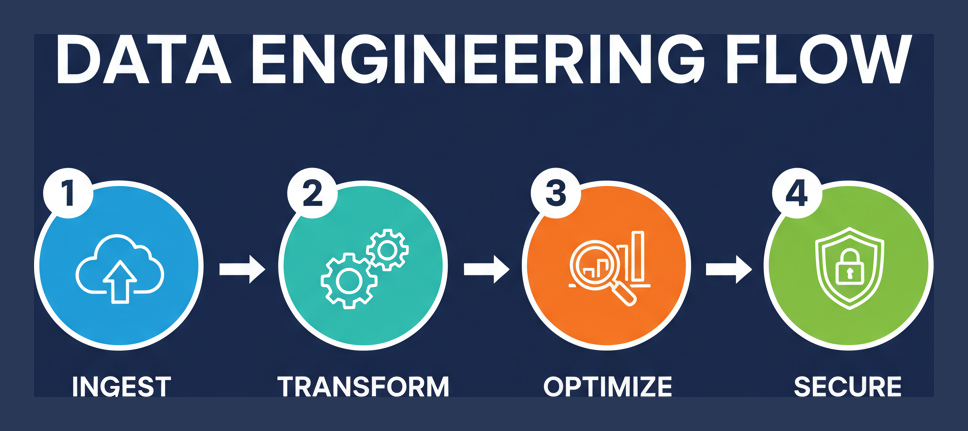
Data Movement and Data Transformation together make up 53 percent of the DEA-C02, so ingestion and reshaping skills dominate the exam. Movement covers how data enters Snowflake and flows through pipelines, while transformation covers how you convert and enrich it once inside. Strong candidates can reason about both the mechanics and the trade-offs of each approach.
Data Movement Skills
This domain tests how you load and route data at scale. Expect scenario questions on file formats, schema detection with INFER_SCHEMA, and staging strategies. You should know when to reach for each ingestion tool.
- Batch loading with stages, file formats, and the COPY command
- Continuous ingestion via Snowpipe, Snowpipe Streaming, and the Kafka connector
- Pipeline orchestration using tasks, streams, and dynamic tables
- Data sharing through listings, the Marketplace, secure views, and clones
Official guidance on ingestion patterns lives in the Snowflake data loading documentation, and the Snowpipe introduction clarifies auto-ingest versus REST triggering.
Data Transformation Skills
Transformation questions probe how you process data programmatically. Snowpark is central here, alongside SQL scripting and procedural logic. You need fluency with functions that reshape both tabular and nested data.
- User-defined functions and table functions in Python, Java, Scala, and SQL
- Stored procedures and transaction management
- Traversing and flattening semi-structured formats such as JSON and Parquet
- Reading columnar layouts, where the Parquet file format explains why projection and predicate pushdown work
- Snowpark DataFrame operations and Cortex-driven workflows
The Snowpark developer guide is the reference to internalise before exam day.
How Do You Optimize Performance and Protect Data in Snowflake?
Performance Optimization at 19 percent and Storage and Data Protection at 14 percent together reward operational discipline on the DEA-C02. These domains test whether you can keep pipelines fast and affordable while ensuring data can be recovered after mistakes. The questions are scenario-driven, asking you to pick the right lever for a described symptom.
Tuning for Speed and Cost
Performance topics separate engineers who guess from those who diagnose. You must read query profiles, spot the root cause of slow runs, and choose between scaling up and scaling out. Key levers include:
- Virtual warehouse sizing, multi-cluster settings, and Snowpark-optimized warehouses
- Micro-partition pruning, clustering keys, and the search optimization service
- Result and metadata caching, plus the query acceleration service
- Resource monitors and ACCOUNT_USAGE metrics to control credit consumption
Protecting and Recovering Data
Data protection covers the features that make Snowflake forgiving. Time Travel lets you query or restore past states, Fail-safe adds a recovery window, and zero-copy cloning spins up development environments without duplicating storage. Cross-region and cross-cloud replication support continuity. Knowing the retention boundaries of each feature is frequently tested.
Why Does Data Governance Carry Weight on the DEA-C02?
Data Governance holds 14 percent of the DEA-C02 because Snowflake engineers increasingly own how sensitive data is classified, masked, and audited. The exam expects you to enforce protection without breaking access for legitimate users. Governance is no longer a security team afterthought; it is engineered directly into pipelines and sharing solutions.
This domain blends policy and implementation. You should be able to translate a compliance requirement into concrete Snowflake objects and DDL. Core capabilities include:
- Object tagging and data classification to monitor sensitive columns
- Dynamic Data Masking combined with role-based access control
- Row access policies and aggregation policies for fine-grained control
- Data lineage, object dependency tracking, and data quality metrics
- Snowflake Data Clean Rooms for privacy-preserving collaboration
Governance questions often pair with data-sharing scenarios, so expect to reason about masking and row filtering in the same breath as Marketplace listings. Treating security as part of pipeline design, rather than a separate task, reflects how the exam frames the domain.
How Should You Prepare for the Snowflake Advanced Data Engineer Exam?
Preparing for the DEA-C02 works best when study effort mirrors the domain weightings and leans heavily on hands-on practice. Because the exam rewards production experience, reading alone rarely suffices. A structured plan that alternates concept review with building real pipelines in a Snowflake trial account gives the strongest results for most candidates.
Follow a sequence that front-loads the heaviest domains:
- Confirm your foundation by reviewing SnowPro Core topics and closing any gaps.
- Spend the most time on Data Movement and Data Transformation, building live pipelines with Snowpipe, tasks, streams, and Snowpark.
- Work through performance scenarios using query profiles and warehouse metrics on your own workloads.
- Practice governance by applying masking policies, tags, and row access rules in a sandbox.
- Take timed practice questions to build exam stamina and expose weak areas.
- Review every missed question against official documentation until the concept is solid.
Candidates already holding a related advanced track find the pipeline concepts transfer well. The tips in this SnowPro Advanced preparation walkthrough apply directly to exam-day strategy. Official exam details and the current outline are published on the Snowflake certifications page.
What Career Growth Follows the Credential?
Earning the Snowflake advanced data engineer credential positions you for senior pipeline, platform, and analytics engineering roles as enterprises consolidate on the Snowflake Data Cloud. Because the certification proves production-grade skill rather than introductory knowledge, it carries weight with hiring managers filling roles that own critical data infrastructure.
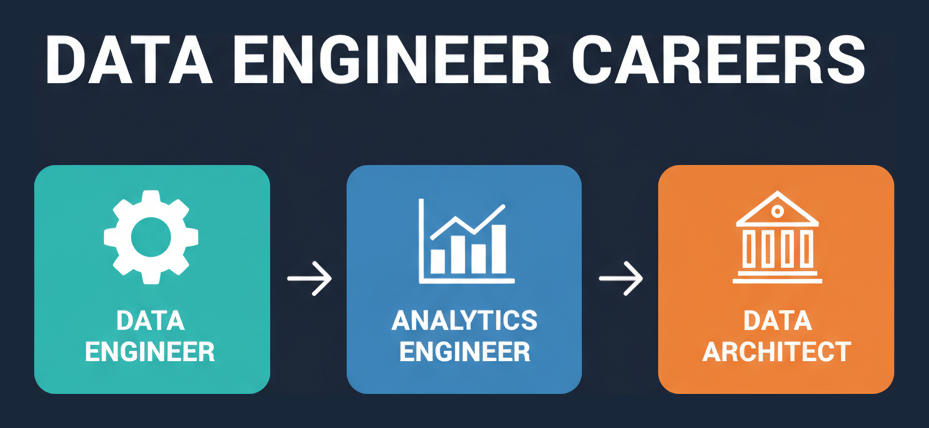
Demand tracks Snowflake’s enterprise adoption. Data engineering remains one of the fastest-growing technical specialisms, and platform-specific proof of skill helps candidates stand out in a crowded market. Typical roles that value this credential include:
- Senior data engineer and Snowflake platform engineer
- Analytics engineer and ETL or ELT developer
- Data pipeline architect and cloud data specialist
In the United States, experienced data engineers frequently report six-figure compensation, and Snowflake-specialised roles often sit at the upper end of that range. The credential also builds a foundation for adjacent Snowflake advanced tracks, letting you deepen into data science or administration over time.
Frequently Asked Questions
What is the difference between SnowPro Core and the DEA-C02?
SnowPro Core validates foundational Snowflake knowledge, while the DEA-C02 certifies advanced data engineering skill. The advanced exam goes deeper into pipelines, Snowpark, performance tuning, and governance, and it assumes you already understand the platform basics that Core covers.
How many questions are on the DEA-C02 exam?
The DEA-C02 contains 65 questions delivered over 115 minutes through Pearson VUE. Question types include multiple choice and multiple select, and the format rewards candidates who can reason through applied pipeline and optimization scenarios rather than recall definitions.
What score do I need to pass the Snowflake advanced data engineer exam?
You need a scaled score of 750 on a range of 0 to 1000 to pass the DEA-C02. Snowflake uses scaled scoring, so the raw number of correct answers required can vary slightly depending on the difficulty of your specific question set.
How much does the DEA-C02 exam cost?
The DEA-C02 exam costs $375 USD. That advanced-tier price reflects its depth compared with the SnowPro Core exam. Retakes require paying the fee again, so thorough preparation before your first attempt protects both time and budget.
Do I need SnowPro Core before taking the DEA-C02?
Snowflake recommends but does not strictly mandate holding SnowPro Core first. Most successful candidates pass Core beforehand because it establishes the platform fundamentals that the advanced exam builds upon, especially around architecture, warehouses, and access control.
Which domain carries the most weight on the exam?
Data Movement carries the most weight at 28 percent, followed by Data Transformation at 25 percent. Together these ingestion and processing domains make up more than half the exam, so pipeline construction should receive the largest share of your study time.
How much experience should I have before attempting the exam?
Snowflake suggests around two years of hands-on data engineering experience with the platform. The exam scenarios mirror production work, so candidates who regularly build ingestion pipelines, tune warehouses, and apply governance policies find the questions far more intuitive.
Is Snowpark tested on the DEA-C02?
Yes. Snowpark features prominently in the Data Transformation domain. You should understand its architecture, DataFrame operations, and how to build UDFs and stored procedures in Python, Java, or Scala using the Snowpark library for scalable data processing.
How long is the Snowflake advanced data engineer certification valid?
Snowflake certifications are valid for two years. To maintain the credential, you either retake the current version of the exam or complete an approved recertification path before the expiry date to keep your certified status active.
Conclusion
The DEA-C02 turns everyday Snowflake work into a recognised professional credential. By weighting Data Movement and Data Transformation most heavily, the exam confirms that you can build and run real pipelines, not just describe them. Add solid performance tuning, data protection, and governance skills, and you cover the full picture the Snowflake advanced data engineer role demands. Map your study time to the five domain weightings, build as much as you read, and rehearse with realistic questions. When you are ready to test your readiness under exam conditions, a focused DEA-C02 practice set is the logical next step toward earning the credential.


