Social network analysis and natural language processing together carry more of D-AA-OP-23 than MapReduce and the Hadoop ecosystem put together. The Dell Data Science Optimize exam, part of the Dell Proven Professional programme, runs 60 questions in 90 minutes, asks for 63 percent to pass, and costs $230 through Pearson VUE. Six topics share the paper, and the two that look least like Dell subjects carry the most marks.
Social network analysis takes 23 percent and natural language processing 20 percent. Together that is 43 percent, more than MapReduce and the Hadoop ecosystem put together. A candidate who prepares this as a big data platform exam will walk into a paper where graph theory and language modelling decide almost half the outcome. This article works through all six topics in weight order, separates this credential from the Dell exam it is routinely confused with, and sets out a study sequence that follows the numbers.
What Does the Dell Data Science Optimize Credential Certify?
It certifies advanced analytical method, not platform administration. Dell positions D-AA-OP-23 as the level above Data Science Foundations, covering social network analysis, natural language processing, the Hadoop ecosystem, data science theory, and visualisation. The stated purpose is being able to reach conclusions and communicate recommendations that solve business problems.
That is a broader remit than the exam code suggests. Nothing here is about storage arrays or infrastructure. The subject matter is closer to an applied analytics syllabus than to the rest of the Dell certification catalogue, which is why it surprises candidates who arrive expecting an infrastructure paper.
Who the credential is aimed at
Dell describes the audience as aspiring data scientists continuing to expand their skill set. In practice that means analysts and engineers who already have statistical grounding and now need method breadth: how to model a network, how to process text, and how to present multivariate results so a non technical reader can act on them.
Why Do Graphs and Language Outweigh the Hadoop Topics?
Because the exam is about analytical technique and treats the platform as the place technique runs. MapReduce and the Hadoop ecosystem take 15 percent each, 30 percent combined. Social network analysis and natural language processing take 23 and 20 percent, 43 percent combined. The methods outweigh the machinery by a comfortable margin.
Read that as a statement about what Dell thinks separates a foundations-level analyst from an optimize-level one. Anyone can learn where HDFS stores a block. Rather fewer can look at a communication graph and say which community structure explains the behaviour in it.
What the split means for preparation
A candidate with a strong platform background and no graph theory has roughly 55 percent of the paper available to them, which is below the 63 percent pass mark. The reverse candidate, strong on method and weak on Hadoop, has around 70 percent available. If you have to be weak somewhere, be weak on the platform half.
How Are the 60 Questions Distributed Across Six Topics?
Social network analysis leads on 23 percent, natural language processing follows on 20 percent, and MapReduce, the Hadoop ecosystem, and data science theory each take 15 percent. Visualisation takes the remaining 12 percent. Dell states that these percentages reflect the approximate distribution of the total question set, so the arithmetic below is sound.
| Topic | Weight | Approximate questions | Objectives named |
|---|---|---|---|
| Social Network Analysis | 23% | 14 | SNA and graph theory, communities, network problems and SNA tools |
| Natural Language Processing | 20% | 12 | The four main categories of ambiguity, text preprocessing, language modeling |
| MapReduce | 15% | 9 | MapReduce framework in Hadoop, HDFS, YARN |
| Hadoop Ecosystem and NoSQL | 15% | 9 | Pig, Hive, NoSQL, HBase, Spark |
| Data Science Theory and Methods | 15% | 9 | Simulation, random forests, multinomial logistic regression and maximum entropy |
| Data Visualization | 12% | 7 | Perception and visualization, visualization of multivariate data |
Passing needs 38 of the 60 questions. Notice that no single topic can carry you and no single topic can sink you, which makes this a breadth exam rather than a depth one. The full topic listing sits alongside the question format on the money site’s Dell Data Science Optimize overview.
What Does Social Network Analysis Cover at 23 Percent?
Three objectives, worth roughly 14 questions between them: social network analysis and graph theory, communities, and network problems together with SNA tools. It is the heaviest topic on the paper and the one most candidates have never formally studied, which makes it the single best return on preparation time.
Graph theory here means the working vocabulary rather than the proofs. Nodes and edges, directed against undirected relationships, degree, paths and distance, density, and what centrality is trying to measure. Expect to be asked what a measure means and when it is the right one, not to compute it by hand.
Communities and the problems they solve
Community detection asks which subsets of a network are more connected to each other than to the rest. That single idea underpins fraud ring detection, recommendation, influence mapping, and churn modelling, and the exam frames it through those network problems rather than abstractly.
The tools objective is worth taking literally. Dell names SNA tools as examinable content, and the academic reference implementations most commonly used are collected in the Stanford Network Analysis Project. For the conceptual grounding underneath the tooling, the social network analysis overview covers the measures the objectives assume.
Which NLP Concepts Does the Exam Name?
Three, and one of them is unusually specific: NLP and the four main categories of ambiguity, text preprocessing, and language modeling. At 20 percent that is around 12 questions, and the phrasing of the first objective tells you the exam expects a named, countable answer rather than a general appreciation of the field.
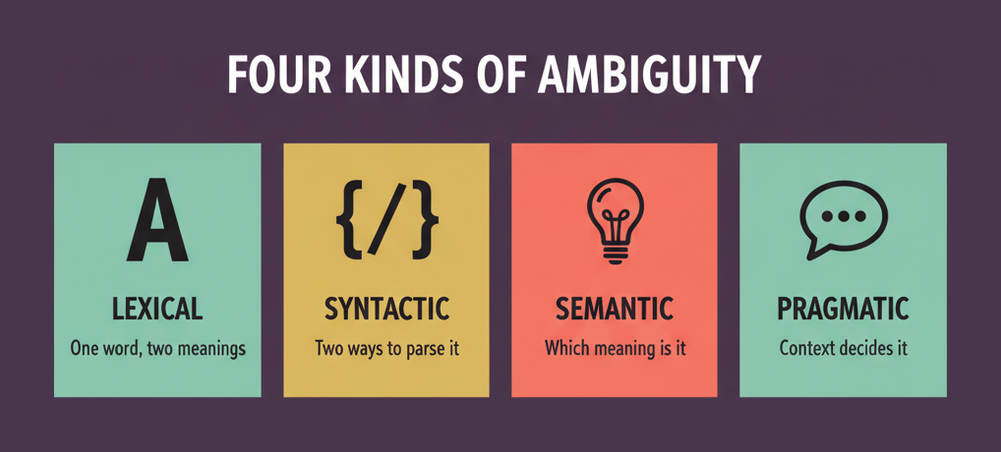
Ambiguity is the organising idea of the whole topic. Language is ambiguous at the level of individual words, of sentence structure, of meaning, and of context, and every preprocessing decision you make is an attempt to reduce one of those without destroying the others.
Preprocessing and language modelling
Text preprocessing covers the standard pipeline: tokenisation, case normalisation, stop word handling, stemming against lemmatisation, and how each choice changes what a downstream model can see. Language modelling covers how probability is assigned to sequences, which is the bridge from counting words to predicting them.
The practical exam advice here is to learn the four ambiguity categories as a named set first, then hang the preprocessing steps off them. Questions in this topic tend to describe a text problem and ask which category of ambiguity it illustrates.
How Much Hadoop and NoSQL Do You Actually Need?
Enough to explain the architecture, not enough to operate a cluster. The MapReduce topic covers the framework and its Hadoop implementation, HDFS, and YARN. The ecosystem topic covers Pig, Hive, NoSQL, HBase, and Spark. Thirty percent across the two, about 18 questions, and all of it conceptual.
MapReduce as an idea matters more than MapReduce as a job you would write today. The exam wants you to understand how work is split across a cluster, how intermediate results are shuffled, and why the model suits some problems and suits others badly.
What the ecosystem topic is really testing
- Pig and Hive as two different abstractions over the same underlying processing
- NoSQL as a family of data models rather than a single product
- HBase as the wide column store, and what a wide column store is good at
- Spark as the in memory alternative, and where that changes the performance picture
HDFS and YARN each get named individually, which suggests direct questions on block storage, replication, and resource negotiation. The Apache MapReduce tutorial is the primary source for all three.
What Do Theory, Methods and Visualization Add?
Data science theory and methods takes 15 percent and names three techniques: simulation, random forests, and multinomial logistic regression with maximum entropy. Visualisation takes 12 percent across perception and visualization and the visualization of multivariate data. Together they are 27 percent, roughly 16 questions.
The three named methods are a deliberate selection rather than a survey. Simulation covers generating data to test a hypothesis when observation is impractical. Random forests covers ensembles and why averaging many weak learners beats tuning one strong one. Multinomial logistic regression with maximum entropy covers multi class prediction and the principle behind it.
Why perception is examined alongside visualisation
Pairing “perception and visualization” as one objective is the syllabus telling you that chart choice is a claim about how humans read. Position is read more accurately than length, length more accurately than area, and area more accurately than colour intensity. Multivariate visualisation then asks how to show more than two dimensions without exceeding what a reader can decode.
Candidates who want the objective list in its original form will find it reproduced alongside worked topics on BigDataRise’s D-AA-OP-23 topic breakdown.
Do You Need Data Science Foundations First?
Not formally. Dell states two requirements for the credential: sufficient knowledge through hands on experience or the recommended training, and a pass on the exam. There is no prerequisite certification. Dell does describe D-AA-OP-23 as building on skills developed in Data Science Foundations, so the earlier credential is assumed knowledge rather than a gate.
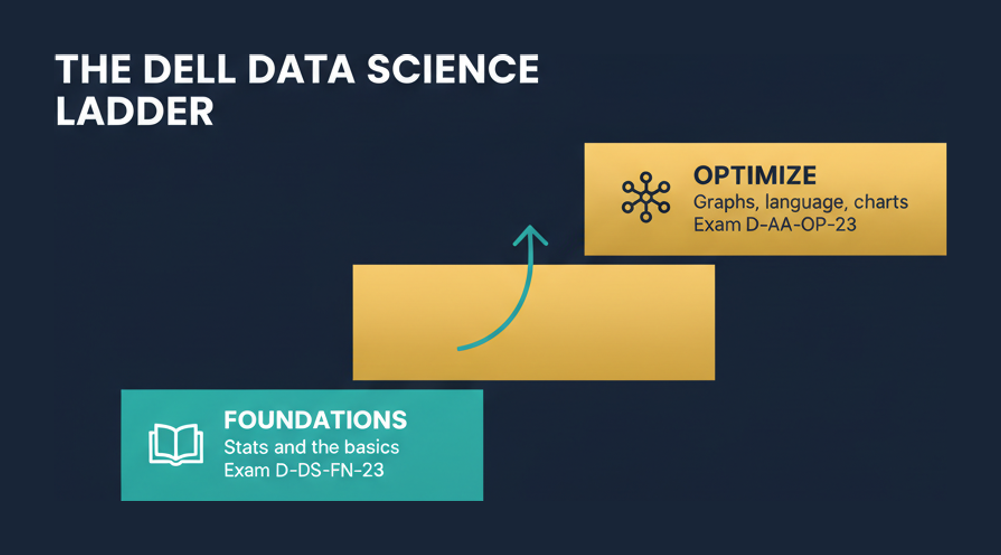
That distinction matters in practice. The Optimize exam does not re-test descriptive statistics, hypothesis testing, or the analytics lifecycle, but it does assume you have them. Someone arriving without that grounding will find the theory and methods topic much harder than its 15 percent weighting suggests.
The other Dell Optimize exam
There is a second, easily confused credential: D-DS-OP-23, Data Engineering Optimize. It shares the Optimize naming and the 2023 vintage but examines a different discipline. If a study resource is talking about pipelines and ingestion rather than graphs and language, it is written for the other exam.
Dell also notes for its partners that holding a certification validates capability without by itself authorising service delivery, which requires a separate Services Competency. The wider programme structure is set out on the Dell certification overview.
What Is the Exam Format and Cost?
Sixty questions in 90 minutes, a 63 percent pass mark, and a $230 USD fee, delivered through Pearson VUE. Ninety seconds per question is workable for definitional items and tight for anything that describes a scenario and asks which method fits, which is the style the SNA and NLP topics favour.
| Specification | Detail |
|---|---|
| Exam name | Dell Data Science Optimize |
| Exam code | D-AA-OP-23 |
| Questions | 60 |
| Duration | 90 minutes |
| Passing score | 63% |
| Price | $230 USD |
| Registration | Pearson VUE |
Dell publishes one recommended course for the exam, Advanced Methods in Data Science and Big Data Analytics, delivered as video instructor led training. The vendor’s own specification is set out in the official certification description, whose topic weightings match the money site exactly.
How Should You Order Your Study?
Start where the marks are and where your existing knowledge is thinnest, which for most candidates is the same place. Social network analysis and natural language processing are 43 percent of the paper and the two subjects least likely to be covered by day to day work. The platform topics are familiar to most people in this audience and can be revised rather than learned.
- Begin with social network analysis, learning the graph vocabulary first and community detection second, because at 23 percent it is the heaviest topic and the one where a beginner gains the most marks per hour.
- Move to natural language processing and commit the four categories of ambiguity to memory as a named set, then attach text preprocessing and language modelling to them rather than studying them separately.
- Take data science theory and methods third, concentrating on simulation, random forests, and multinomial logistic regression, since these are three specific techniques rather than a field to survey.
- Revise MapReduce, HDFS, and YARN next, aiming for architectural fluency rather than operational detail, because the questions are conceptual.
- Finish with the Hadoop ecosystem and visualisation together, treating Pig, Hive, HBase, NoSQL, and Spark as a comparison exercise and visualisation as a set of rules about how people read charts.
Set aside a session near the end for the arithmetic of the paper. Knowing that 38 correct answers pass, and that SNA plus NLP alone are worth 26 of them, changes how you spend the last fortnight. Readers surveying the wider Dell catalogue will find the other tracks on the Dell certification hub.
Frequently Asked Questions
How many questions are on the D-AA-OP-23 exam?
60 questions in 90 minutes, which is roughly 90 seconds each. The pass mark of 63 percent means you need 38 correct answers.
Which topic is worth the most on the Dell Data Science Optimize exam?
Social network analysis, at 23 percent or about 14 questions. Natural language processing is second at 20 percent, so the two together decide 43 percent of the paper.
How much does D-AA-OP-23 cost?
$230 USD, booked through Pearson VUE. Dell’s own certification description does not publish a price, so this figure comes from the exam listing rather than the vendor document.
Is Data Science Foundations a prerequisite?
No. Dell requires only sufficient knowledge, through experience or the recommended training, plus a pass on the exam. Foundations is described as the level this credential builds on, so it is assumed knowledge rather than a formal gate.
What is the difference between D-AA-OP-23 and D-DS-OP-23?
D-AA-OP-23 is Data Science Optimize, covering graphs, language, and analytical method. D-DS-OP-23 is Data Engineering Optimize, a different discipline. Search results frequently mix the two, so check the code on any study material.
Which NLP topics does the exam name?
Three: NLP and the four main categories of ambiguity, text preprocessing, and language modeling. The ambiguity objective is phrased to expect a specific named set rather than a general answer.
How deep does the Hadoop content go?
Conceptual rather than operational. MapReduce, HDFS, and YARN take 15 percent, and Pig, Hive, NoSQL, HBase, and Spark another 15 percent. You need to explain the architecture, not administer a cluster.
What training does Dell recommend?
One course is listed: Advanced Methods in Data Science and Big Data Analytics, delivered as video instructor led training. Dell also accepts equivalent hands on experience in place of formal training.
Does the exam test statistical theory directly?
Only three named techniques: simulation, random forests, and multinomial logistic regression with maximum entropy. Broader statistical grounding is assumed from Data Science Foundations rather than re-examined here.
Why does data visualization get its own topic?
Because Dell frames the credential around communicating conclusions, not just producing them. The 12 percent covers perception and visualization plus the visualization of multivariate data, so chart choice is treated as a decision about how readers decode information.
Conclusion
D-AA-OP-23 is an analytical methods exam that happens to carry a Dell code. Graph theory and language processing decide 43 percent of it, the platform topics are conceptual, and the visualisation section is about human perception rather than tooling. That combination makes it genuinely broad and unusually transferable.
The efficient path is to invest early in social network analysis, learn the NLP ambiguity categories as a named set, and revise rather than relearn the Hadoop material. Check the current topic list and question format on the money site before booking, and let the six weightings, not the syllabus order, decide your schedule.


