There is no model training anywhere in the NCP-AI syllabus. No loss curves, no fine-tuning runs, no dataset preparation. Nutanix Certified Professional – Artificial Intelligence is an infrastructure exam wearing an AI name badge, and what it actually measures is whether you can stand up Nutanix Enterprise AI, publish a large language model behind an endpoint, keep that endpoint fast, and work out which layer of the stack broke when it is not.
That framing decides everything about how you prepare. Seventy five questions in 120 minutes for $200, scored on a scale that runs from 1000 to 6000 with 3000 to pass. Five sections, no published weightings, and roughly fifty granular objectives underneath them. This article walks all five, assembles the endpoint lifecycle that runs across three of them, sets out the experience Nutanix openly assumes you already have, and explains what a scaled score actually means when you cannot convert it into a number of questions.
What Does the NCP-AI Certification Actually Prove?
It proves you can run Nutanix Enterprise AI as production infrastructure. The exam measures installation, configuration, optimisation and troubleshooting of NAI, plus the integration of generative AI applications and agents with it. Every objective is an operator’s objective. None of them asks you to build a model, choose an architecture, or reason about training data.
The distinction is not pedantic. Enterprise AI infrastructure has split into two disciplines that share a vocabulary and almost nothing else. One builds models. The other serves them, at scale, to applications that expect an OpenAI-compatible API and a predictable latency. NCP-AI belongs entirely to the second.
“Contrary to AI infrastructure for model training that was optimized to run ‘one big job,’ production Agentic AI infrastructure needs to handle scale and high rates of change for thousands of AI services, agents, and concurrent users and developers.”
Where the product sits
Nutanix Enterprise AI runs on Kubernetes, on top of Nutanix infrastructure, and its job is to take a model you have imported and expose it as an endpoint that an application can call. Around that sit GPU scheduling, storage classes, certificates, role-based access, API keys and observability. The exam is essentially a tour of that surface, and it was extended again in 2026 by Nutanix Agentic AI.
How Are the Five NCP-AI Sections Arranged?
NCP-AI publishes five sections and, unusually for a 75-question exam, no percentage weightings at all. What it publishes instead is an objective list, and that list is very uneven: Configure and Troubleshoot are far larger than Connect Applications, which carries only two objectives against a dozen or more elsewhere.
| Section | Top-level objectives | What it is really testing |
|---|---|---|
| Deploy a Nutanix Enterprise AI Environment | 3 | Prerequisites and limits, NKP against non-NKP installation, dark site installs, storage classes, FQDN and certificates |
| Configure a Nutanix Enterprise AI Environment | 5 | User and admin roles, importing models, sizing and creating endpoints, API keys, delivering endpoints to consumers |
| Perform Day 2 Operations | 4 | Connecting an app, observability metrics, latency and throughput remedies, key monitoring, model output quality |
| Troubleshoot a Nutanix Enterprise AI Environment | 7 | GPU utilisation, cluster health checks, model import failures, CSI connectivity, tokens, allocatable compute, KServe |
| Connect Applications to a Nutanix Enterprise AI Environment | 2 | Validating an application against an endpoint, and correlating application usage with endpoint metrics |
Without weightings, the objective count is the only signal available, and it should be read as an indication of surface area rather than of marks. Even so, the shape is informative: nearly half the published objectives sit in Configure and Troubleshoot combined, and those are the two sections that reward hands-on time over reading. The full NCP-AI objective list is worth reading line by line, because the section names conceal how granular the sub-objectives get.
What Does Deploying a Nutanix Enterprise AI Environment Involve?
Three objectives: validate installation prerequisites, install the NAI components, and configure DNS, the URL and certificates. It is the section that looks like ordinary platform work, and it is where the exam sets up vocabulary that the later sections assume you already have, particularly around NAI’s own architecture.
The most testable distinction here is NKP against non-NKP. Installing into a Nutanix Kubernetes Platform environment, where the app catalog does part of the work, is a different procedure from installing into a Kubernetes cluster you brought yourself. Version compatibility between the prerequisite layer and the NAI components is called out separately, which usually means questions about which combinations are supported.
Dark site installation is not a footnote
The syllabus names dark site installation explicitly. An air-gapped deployment cannot pull container images or models from the internet, so everything about repositories, keys and image availability changes. If you have only ever installed against a connected network, this is the objective most likely to catch you, and it reappears in the troubleshooting section as a cause of failed model downloads.
Certificates round the section off. An FQDN, a secure certificate on it, and a validated login to the user interface. That is a small objective with a large failure surface, and it is the sort of thing that produces a question phrased as a symptom rather than as a definition.
Why Is the Configure Section Where the Exam Really Lives?
Five objectives, and between them they describe the whole reason NAI exists: onboard users, import large language models, create endpoints, create and apply API keys, and deliver those endpoints to consumers. Read them in order and you have the endpoint lifecycle, which is the single most useful thing to hold in your head walking into this exam.
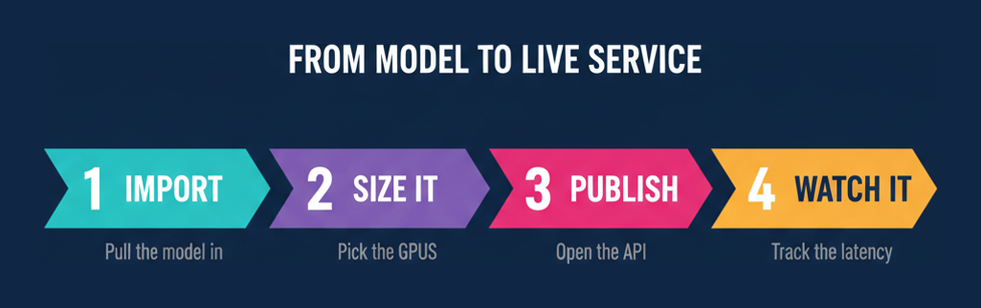
Model import is where external dependencies arrive. The syllabus names HuggingFace and NVIDIA NGC as repositories, requires you to obtain repo keys for them, and requires you to know where those keys go in the interface and how a manual import works when a repository is not an option. Anyone who has pulled a model from the Hugging Face model hub will recognise the shape of it immediately.
Endpoint creation is a sizing exercise
This is the objective that separates candidates. Creating an endpoint means deciding which downloaded model to expose, then determining the number and type of GPUs it needs, then determining how many instances are required to hit a throughput target, then choosing vCPU, memory and an inference engine for a given optimisation scenario. Those are four judgement calls, not four settings, and the exam frames them as scenarios.
API keys follow, and they are more interesting than they sound. You need to know where keys are generated and managed, where to view the keys attached to an endpoint, how to deactivate one, and how to add one to an endpoint that already exists. Delivery closes the loop: the endpoint URI, the model-specific parameters and the key are what a consumer actually receives, and the syllabus asks you to distinguish tool-calling from non-tool-calling curl commands.
What Does Day 2 Operations Ask You to Optimise?
Four objectives covering the life of an endpoint after handover: preparing an application to connect, interpreting performance detail and acting on it, monitoring access for outliers, and choosing the right model to improve output quality. It is the section that turns NAI from an installation into a service somebody depends on.
Performance work here has a specific shape. You identify the observability metrics that matter, then decide which resource-allocation change fixes the symptom. Latency and throughput are named separately because they have different remedies: more instances usually helps throughput, while a different inference engine or a different GPU class is more likely to move latency.
Output quality is an operations problem too
The last objective is the one people do not expect on an infrastructure exam. It asks you to evaluate accuracy by comparing prompt input against model output per endpoint using human feedback, then to improve quality by technique or by model choice, then to apply guardrails for safety, then to apply rerank models to get the results you want. That is applied inference tuning, and it is squarely in the operator’s job now.
Access monitoring is the quieter objective and an easy source of marks. Know where to see the top five API keys by usage, where the endpoint dashboard lists assigned keys, when a key should be deactivated, and how to read audit events. It is a small, concrete list, and it is exactly the sort of thing that gets skipped.
Troubleshooting Means Naming the Layer That Broke
Seven objectives, more than any other section, and one recurring instruction: determine which layer of the stack is causing the failure. NAI sits on Kubernetes, which sits on Nutanix infrastructure, with GPUs, storage and external repositories attached. A symptom in the user interface can originate in any of them.
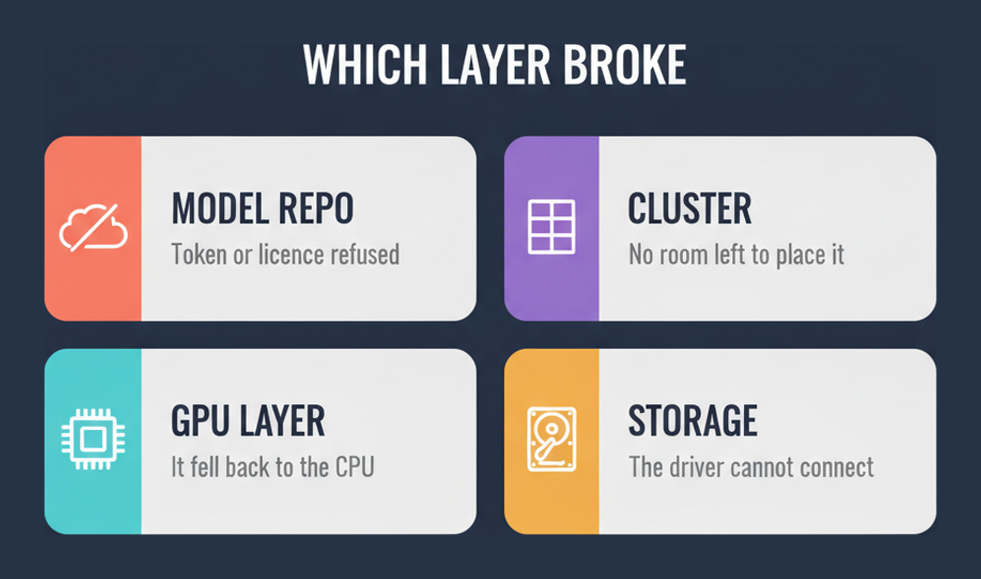
GPU diagnosis comes first. You need to find infrastructure performance views, filter by GPU nodes, read a utilisation graph to see which GPUs are working hardest, and establish whether an endpoint is on a GPU at all, which type it is on, and whether it is falling back to CPU-based acceleration. An endpoint that quietly landed on CPU is a classic latency complaint with an infrastructure cause.
Health checks, scheduling and the things that block them
Cluster health check failures get their own objective chain: debug the failure from the NAI interface, know which components can cause one, analyse the Kubernetes system resources behind NAI, work out the responsible layer, and choose a course of action. Scheduling problems sit alongside them, and the syllabus is explicit that you should be able to determine allocatable CPU, memory, GPUs and Kubernetes node scheduling constraints such as taints that could stop an endpoint being placed at all.
Model import failures round it out, and they are refreshingly concrete. Misconfigured or restricted networks. A CSI driver that cannot connect. A HuggingFace or NVIDIA token that has expired. A Llama model whose licence agreement was never accepted. Prerequisites such as KServe that did not install cleanly. Container images that will not download onto the nodes. Each is a checkable fact rather than a judgement, which makes this the most learnable part of the section.
How Does an Application Actually Reach an NAI Endpoint?
Through an OpenAI-compatible API, which is the whole point of the final section. Two objectives: configure and validate an application against an endpoint, and check the endpoint metrics that correspond to that application’s usage. It is the smallest section by objective count and the one that ties the other four together.
The practical content is narrow and specific. You should be able to tell model types and endpoint types apart and say which an application should consume, explain what each model type is for, issue a simple query against the API in Python or with curl, and investigate an integration that is not working. The sample request inside the NAI application is named directly as the starting point.
The metrics objective closes the circle back to Day 2. Latency and request counts per endpoint are how you connect a complaint from an application team to something you can actually see, and the syllabus asks you to correlate the two deliberately rather than to guess.
What Is the Exam Format, and What Does a Score of 3000 Mean?
NCP-AI is 75 multiple choice questions in 120 minutes at $200 per attempt, scheduled through Nutanix directly. The pass mark is 3000 on a scale that runs from 1000 to 6000. That is a scaled score, not a percentage, and it cannot be turned into a number of correct answers.
| Field | Value |
|---|---|
| Exam code | NCP-AI, currently version 6.10 |
| Questions | 75 |
| Duration | 120 minutes |
| Passing score | 3000 on a scale of 1000 to 6000 |
| Price | $200 per attempt |
| Languages | English and Japanese |
| Related course | Nutanix Enterprise AI Administration (NAIA) |
| Scheduling | Nutanix |
Scaled scoring exists so that different forms of the same exam can be compared fairly when their questions are not identically difficult. The practical consequence for you is that 3000 out of a 1000 to 6000 band is not “50 percent”, and nobody outside Nutanix can tell you how many of the 75 you need. Plan as though every question counts, because you cannot compute a safety margin.
Ninety six seconds per question is the real time budget. That is tight for a sizing scenario that asks how many instances a throughput target needs, and generous for a question about where API keys are managed, so the useful exam-day skill is recognising which kind of question you are looking at quickly.
Are You Ready for It? The Experience Nutanix Assumes
Nutanix is unusually explicit about this, and the bar is high. Successful candidates are expected to have at least three years of virtual infrastructure experience and one year working with cloud native technologies and the Linux command line, plus knowledge of virtual machines, hypervisors, virtual networking, the NCI cloud, cloud-based IaaS, GPUs and Nutanix Unified Storage.
Then comes the line that should decide your timing: candidates are expected to hold a Certified Kubernetes Administrator level of knowledge. Not the certificate itself, but that depth. Given how much of the troubleshooting section is about node resources, taints, system resources and container images, that is a fair statement rather than a marketing one. The official NCP-AI blueprint sets all of this out and publishes a downloadable guide.
Where it sits in the Nutanix ladder
NCP-AI is a professional-tier credential and a specialisation rather than a step on a single ladder. If you are earlier in your Nutanix journey, the associate-level Nutanix NCA credential is the more sensible starting point, and it covers the platform fundamentals that NCP-AI assumes without teaching.
Who should actually take it: platform and virtualisation engineers whose organisations are standing up private inference, infrastructure teams supporting data science rather than doing it, and consultants deploying NAI for customers. If your job is to make a model answer quickly and keep answering, this credential describes it.
How Should You Sequence Your Preparation?
Build the endpoint lifecycle first, because it spans three of the five sections and everything else attaches to it. Reading the syllabus top to bottom puts installation first, which is the least transferable part and the easiest to look up. Work in the order the marks are most likely to fall instead.
- Start by importing one model end to end, obtaining a repository key, adding it in the interface, accepting any licence the model requires, and watching what happens when the token is wrong.
- Create an endpoint from that model and deliberately size it more than once, changing the GPU type, the instance count and the inference engine, so that the sizing objectives become something you have felt rather than read.
- Generate an API key, attach it, deactivate it, and then add a second key to the existing endpoint, since every one of those four actions is a named objective.
- Call the endpoint from a real application using curl and then Python against the OpenAI-compatible API, and try both a tool-calling and a non-tool-calling request so the difference is concrete.
- Break it on purpose, taking the GPU away, letting a token expire, and restricting the network, then trace each symptom back to the layer that caused it before looking at the answer.
- Finish with the observability surface, finding the endpoint dashboard, the top five API keys by usage, the audit events and the latency figures, and practise correlating an application complaint with the metric that explains it.
If you have Kubernetes depth already, this is a fortnight of evenings. If you do not, close that gap first, because the troubleshooting section will otherwise read as a list of unfamiliar nouns.
Frequently Asked Questions
How many questions are on the NCP-AI exam?
Seventy five multiple choice questions in 120 minutes. That is 96 seconds per question on average, which is tight for the sizing scenarios and generous for the recall items.
What is the passing score for NCP-AI?
3000 on a scale that runs from 1000 to 6000. It is a scaled score rather than a percentage, so it cannot be converted into a number of correct answers, and you should plan as though every question matters.
How much does the NCP-AI certification cost?
$200 per attempt. The exam is scheduled through Nutanix rather than through a third party test centre, and it is offered in English and Japanese.
Does NCP-AI test machine learning or model training?
No. There is no training, tuning or data science content in the syllabus. Every objective is about deploying, configuring, operating and troubleshooting Nutanix Enterprise AI as infrastructure that serves models to applications.
What experience does Nutanix expect before NCP-AI?
At least three years of virtual infrastructure experience, one year with cloud native technologies and the Linux command line, and a Certified Kubernetes Administrator level of Kubernetes knowledge, along with familiarity with GPUs and Nutanix Unified Storage.
Do you need a Kubernetes certification to take NCP-AI?
The certificate itself is not required, but that depth of knowledge is assumed. Much of the troubleshooting section deals with node resources, taints, allocatable compute, system resources and container images, none of which is explained for you.
Which model repositories does the exam cover?
HuggingFace and NVIDIA NGC are both named in the objectives. You are expected to obtain repository keys for them, know where those keys are added, understand the manual import route, and recognise when a Llama model licence has not been accepted.
Are the NCP-AI sections weighted?
No percentage weightings are published for this exam. The five sections are listed with their objectives only, so objective count is the only available signal and it should be read as surface area rather than as marks.
What is a dark site installation and why does it matter?
It is an installation into an environment with no internet access. It is named directly in the deploy objectives and it changes how models, container images and repository keys reach the platform, which is why it reappears as a cause of import failures in troubleshooting.
Which version of NCP-AI is current?
Version 6.10, which awards the NCP-AI 6 certification. The recommended preparation course is Nutanix Enterprise AI Administration, and a downloadable exam blueprint guide is published in English and Japanese.
Conclusion
NCP-AI is the credential for the person who keeps inference running, not the person who builds the model. Five sections, roughly fifty objectives, no weightings, 75 questions in 120 minutes at $200, and a scaled pass mark of 3000 that hides how much margin you actually have.
Prepare by building the endpoint lifecycle rather than by reading it: import a model, size it properly, key it, call it from an application, then break it and trace the fault to a layer. Close any Kubernetes gap before you start, because the assumed depth is real and the troubleshooting section will not forgive it. If you want to see how the professional tier compares with the expert one, the Nutanix NCX-MCI guide covers the other end of the ladder. Then book it.


