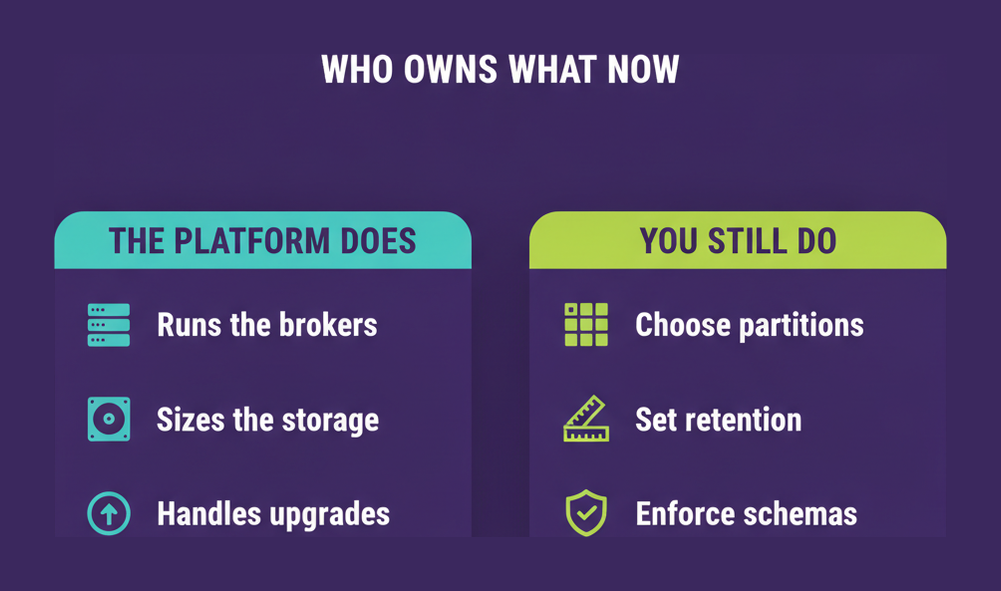
You do not patch the brokers. You do not size the disks, plan the rolling upgrade, or get paged when a JVM heap fills at three in the morning. On a fully managed service all of that belongs to somebody else, and a Kafka operator who moves to Confluent Cloud loses about half the job they used to do.
The Confluent Cloud certification is about the half that stays. CCAC weights seven sections across core concepts, Kafka operations, static and dynamic cloud operations, streaming pipelines, data governance and resilience, and none of them is about keeping a cluster alive by hand. This walkthrough covers what each weighted section governs, how the exam differs from the two Kafka credentials beside it, and what Confluent itself publishes about the mechanics.
What Is the Confluent Cloud Certification?
The Confluent Cloud certification, exam code CCAC, is the Confluent Cloud Certified Operator credential. It is a 90 minute proctored exam covering seven weighted sections: Confluent Cloud core concepts, Kafka operations, static operations, dynamic operations, streaming pipelines, data governance and resilience. Confluent describes it as validating expertise in managing multi cloud and global Apache Kafka architectures.
The word operator in the title is doing precise work. This is not a developer credential and it is not the self managed administrator credential either. It sits with the person who owns a Confluent Cloud environment: the clusters inside it, the topics and connectors running on them, the schemas being enforced, and the failure behaviour when a region has a bad day.
Confluent names the features it expects you to be fluent in: Cluster Linking, Stream Governance, fully managed connectors and stream processing. Those four map directly onto four of the seven weighted sections, which is the clearest signal available about what the paper actually asks.
How Does CCAC Differ From CCAAK and CCDAK?
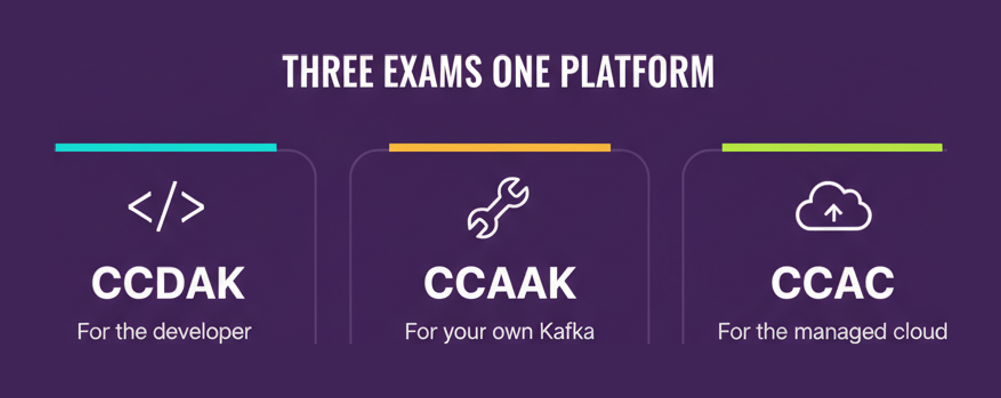
Confluent publishes three certifications. CCDAK is the developer credential and is about building applications that produce and consume. CCAAK is the administrator credential and is about running Apache Kafka yourself. CCAC is the cloud operator credential and is about running a managed Confluent Cloud environment. All three are current and none is marked retired.
The line between CCAAK and CCAC is the one worth getting right before you book. An administrator exam has to test the things a managed service removes: broker configuration, storage planning, upgrade sequencing. A cloud operator exam cannot test those, because you no longer perform them, so it tests the decisions that replace them instead. Cluster type selection, networking, quota and capacity management, governance enforcement and multi region design.
Confluent sets the three side by side on its own certification programme page, which is also the only official source for the delivery mechanics.
For a team that has already migrated, CCAC is the credential that matches the current job. For a team still running Kafka on its own hardware, CCAAK is, and taking CCAC first would mean studying a platform you do not operate.
What Are the CCAC Exam Details?
CCAC carries 60 questions in 90 minutes, costs 150 US dollars, and is reported as pass or fail rather than a percentage. It is delivered as a remote proctored exam through Honorlock, it is available in English, and the certification expires after two years. Booking runs through the Confluent training portal rather than a test centre network.
| Field | Value |
|---|---|
| Exam name | Confluent Cloud Certified Operator |
| Exam code | CCAC |
| Number of questions | 60 |
| Duration | 90 minutes |
| Result | Pass or fail, no published percentage |
| Price | 150 US dollars |
| Delivery | Remote proctored through Honorlock, English |
| Validity | Two years |
At 150 US dollars this is the cheapest exam of its tier in the streaming space, and the two year expiry is the detail most likely to catch people out. A credential that lapses in twenty four months is a commitment to keep current with a platform that ships changes continuously, which is arguably the point.
Remote proctoring through Honorlock rather than Pearson VUE means the environment check happens on your own machine, so the practical preparation includes a quiet room and a working camera. Rehearsing against CCAC practice questions under the same 90 minute constraint is the closest simulation available. Scheduling itself runs through the Confluent training portal.
How Is CCAC Weighted Across Seven Sections?
CCAC publishes seven weighted sections: Confluent Cloud Core Concepts at 17 percent, Kafka Operations at 17 percent, Dynamic Operations at 16 percent, Static Operations at 14 percent, Data Governance at 13 percent, Streaming Pipelines at 11 percent and Resilience at 11 percent. The published figures total 99 percent, which is rounding rather than a missing eighth section.
| Section | Weight | What it governs |
|---|---|---|
| Confluent Cloud Core Concepts | 17% | The shape of the platform and its objects |
| Kafka Operations | 17% | The Kafka work that survives the move to managed |
| Confluent Cloud Dynamic Operations | 16% | What changes while the platform is running |
| Confluent Cloud Static Operations | 14% | What is decided when the environment is built |
| Confluent Cloud Data Governance | 13% | Schemas, contracts and control over data shape |
| Confluent Cloud Streaming Pipelines | 11% | Connectors and processing between systems |
| Confluent Cloud Resilience | 11% | Behaviour when something fails |
One thing to be clear about before planning study time: the weights are the whole of the published granularity. Confluent does not release a sub objective list for this exam, and neither does the syllabus page, so anything claiming to enumerate the objectives underneath these seven names is guessing. What the weights do tell you is the balance, and the balance is unusually flat.
No section is worth more than 17 percent and none less than 11. Across 60 questions that is roughly ten questions for the largest and about seven for the smallest, a spread of three questions between the biggest and smallest topics on the paper. There is no domain to prioritise and none to abandon.
What Do Core Concepts and Kafka Operations Cover Together?
Core Concepts and Kafka Operations are the two joint largest sections at 17 percent each, which is 34 percent of the paper between them, or roughly twenty questions. Together they cover the shape of a Confluent Cloud environment and the Kafka work that a managed service does not take away from you.
Core concepts is the vocabulary section. Environments, clusters, cluster types, topics, partitions, principals and the relationships between them are the objects every other section manipulates, and getting them wrong makes the rest of the paper harder than it needs to be. The Confluent Cloud documentation is the reference for exactly how those objects nest.
Kafka Operations is the more interesting half, because it is the section that answers the question this article opened with. Partition counts, consumer group behaviour, offset management, retention, compaction and throughput reasoning are all still yours on a managed platform. Confluent runs the brokers; it does not decide how many partitions your topic needs or why your consumer group is lagging. The behaviour underneath all of it is defined by the Apache Kafka documentation, which remains the authority regardless of who operates the cluster.
For readers arriving from a different data background, the platform’s history and design are summarised neutrally in the Apache Kafka overview, which is worth twenty minutes before the exam material rather than during it.
What Is the Difference Between Static and Dynamic Operations?
Static Operations at 14 percent and Dynamic Operations at 16 percent split the operator’s work by when the decision is made. Static operations are the choices baked in when an environment is built. Dynamic operations are the changes made while it is serving traffic, without stopping anything.
The split is unusual and it is the most useful structural idea in the blueprint. Most certifications organise by feature; this one organises by whether a change is reversible in flight. That framing rewards a candidate who has actually run a platform, because the difference between a decision you can revisit next Tuesday and one you are stuck with is exactly the sort of thing you only learn by being stuck with it.
Dynamic carries slightly more weight than static, which fits a managed service. Scaling, quota changes, access adjustments and connector reconfiguration all happen while the platform runs, and a cloud operator spends far more time doing those than they do standing new environments up.
In practical study terms, work through each Confluent Cloud setting and ask one question about it: can this be changed on a running environment, and what happens to in flight traffic if it is. That single question covers 30 percent of the paper.
How Much of the Exam Is Data Governance?
Data Governance is 13 percent of CCAC, roughly eight questions, and it sits above both streaming pipelines and resilience in the weighting. Confluent names Stream Governance directly in its description of what the credential validates, which makes it one of the few sections whose scope is confirmed by the vendor rather than inferred from a section title.
Governance on a streaming platform means control over the shape of data rather than over who may read it. Schema management is the centre of it: what a message is allowed to look like, what happens when a producer changes that shape, and which compatibility rules let a consumer keep working while the producer moves on.
That is a genuinely operational subject on a shared platform, and it is where a cloud operator’s job differs most from a self managed administrator’s. When several teams publish into the same environment, the governance configuration is what stops one team’s deployment from breaking another team’s consumers.
Streaming Pipelines at 11 percent sits beside it and covers the connectors and processing that move data in and out. Confluent names fully managed connectors and stream processing in the same scope statement, so the two sections are best studied as one subject: what enters the platform, what shape it must arrive in, and what happens to it on the way through.
What Does the Resilience Section Expect You to Have Designed?
Resilience is 11 percent of CCAC, the joint smallest section, and it is the one most closely tied to the phrase Confluent uses to describe the whole credential: managing multi cloud and global Kafka architectures. Cluster Linking is named directly in that scope statement, and it is the mechanism by which data exists in more than one place.
The questions this section can ask are about design consequences rather than commands. What is the recovery position if a region becomes unavailable, what does a linked cluster hold and when, and what does a consumer see during a failover are the shapes it takes. None of them has a single correct answer without a stated requirement, which is why they read as scenarios.
Eleven percent is around seven questions, and it is the section a candidate is least likely to have hands on experience of, because most operators have never actually failed a region over. That combination, low weight and low familiarity, makes it the best value revision on the paper.
Our earlier walkthrough of the CCAC key topics covers the same section list from the practice side, which is useful once the concepts are in place.
How Should You Prepare for the CCAC Exam?
Preparation for CCAC has an unusual constraint: there is no published objective list to work through, only seven weighted section names. That makes the platform itself the syllabus, and the most reliable route is to work through Confluent Cloud feature by feature, mapping each one onto the section it belongs to.
- Stand up a Confluent Cloud environment and build the object model by hand, so environments, clusters, cluster types, topics and principals are things you have created rather than read about.
- Work the Kafka operations that the managed service does not take over, choosing partition counts, watching a consumer group lag, and changing retention on a live topic.
- Go through every setting you can find and classify it as static or dynamic, asking in each case whether it can change on a running environment and what happens to traffic if it does.
- Register schemas and deliberately break compatibility, so the governance rules are something you have watched reject a producer rather than a policy you have read.
- Run a fully managed connector end to end, then a piece of stream processing on top of it, since streaming pipelines and governance are effectively one subject.
- Read the Cluster Linking material carefully even without a lab, because resilience is the section most candidates have never performed and it is worth around seven questions.
- Rehearse the whole thing in 90 minutes across all seven sections, since the weights are flat enough that no section can be skipped.
The wider Confluent credential map, including how the developer and administrator papers differ, is collected on our Confluent certification hub.
Frequently Asked Questions
How many questions are on the CCAC exam?
Sixty questions in 90 minutes. Confluent publishes the duration on its own certification page; the question count comes from the exam syllabus.
What is the passing score for the Confluent Cloud certification?
The result is reported as pass or fail. No percentage pass mark is published for CCAC, so there is no target score to calculate against.
How much does the CCAC exam cost?
150 US dollars, booked through the Confluent training portal rather than a third party test centre network.
How long is the Confluent certification valid?
Two years. Confluent states that the certification expires after two years, which applies across its certification programme.
How is the exam proctored?
Remotely, through Honorlock, on your own machine. All Confluent exams are delivered in English, with an accommodation request process available.
Which CCAC section carries the most weight?
Core Concepts and Kafka Operations are joint largest at 17 percent each. Dynamic Operations follows at 16 percent, then Static Operations at 14, Data Governance at 13, and Streaming Pipelines and Resilience at 11 each.
Does Confluent publish objectives under each section?
No. The seven section names and their weights are the full published granularity for this exam. Any list claiming to enumerate objectives beneath them is not sourced from Confluent or from the exam syllabus.
Should you take CCAC or CCAAK?
CCAC if your team runs Confluent Cloud, CCAAK if you run Apache Kafka yourself. The administrator exam covers work a managed service removes, so taking it for a cloud role means studying tasks you will not perform.
Does the exam cover Cluster Linking?
Confluent names Cluster Linking in its own description of what the credential validates, alongside Stream Governance, fully managed connectors and stream processing. The resilience section is where it belongs in the weighting.
Do the published weights add up to 100 percent?
They add up to 99. The seven figures are 17, 17, 16, 14, 13, 11 and 11, which is rounding rather than a missing section.
Conclusion
The Confluent Cloud certification is an operator exam for a platform that has taken the infrastructure work away. Sixty questions in 90 minutes, 150 US dollars, pass or fail, remotely proctored through Honorlock, valid for two years, and weighted almost flat across seven sections from 17 percent down to 11.
Because no sub objectives are published, the platform is the syllabus. Build an environment, classify every setting as static or dynamic, break a schema on purpose, run a connector end to end, and read the Cluster Linking material even if you cannot lab it. The flat weighting means nothing can be abandoned, and the two year expiry means the reading does not stop when you pass.


