
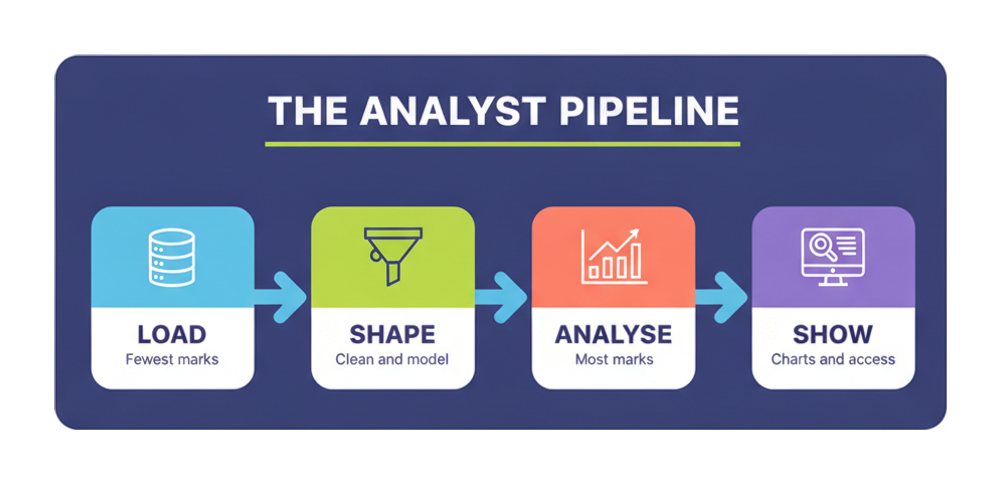
Load the data. Shape it. Analyse it. Show it. Those four steps are the four DAA-C01 domains, in that order, and their weightings climb as you move along the pipeline: 17 percent, 23 percent, 32 percent, 28 percent.
The step most people associate with Snowflake, getting data in, is the smallest domain on the paper. The step most people do not associate with it at all, building charts and dashboards, is worth 28 percent. That is the shape of the SnowPro Advanced Data Analyst exam, code DAA-C01: 65 questions in 115 minutes at 375 US dollars, scored on a 0 to 1000 scale with 750 to pass. It assumes you can already load a file and asks instead whether you can interrogate what you loaded and present the answer to someone who will act on it.
What Does the SnowPro Advanced Data Analyst Exam Cover?
DAA-C01 covers four weighted domains: data ingestion and preparation at 17 percent, data transformation and modelling at 23 percent, data analysis at 32 percent, and data presentation and visualisation at 28 percent. It follows an analyst’s working day from source file to finished dashboard, inside Snowflake rather than in a separate BI stack. For the equivalent first step on Google Cloud, the GCP-ADP entry exam covers the same four stages at associate level.
The objectives are unusually concrete for an advanced exam. They name six categories of Snowflake function, three file formats, two modelling approaches, four chart types and a specific set of governance features. Very little is left to interpretation about what you are expected to have used.
The one thing the domain names understate
Analysis here does not stop at descriptive work. The 32 percent domain covers descriptive analysis, diagnostic analysis and forecasting, with an objective that asks you to use statistics and built-in functions to make predictions. An analyst who summarises and never projects is prepared for two thirds of the largest domain.
What Are the DAA-C01 Exam Details?
DAA-C01 is 65 questions in 115 minutes, priced at 375 US dollars per attempt and delivered through Pearson VUE. Scoring is scaled from 0 to 1000 with 750 required to pass. It sits in the SnowPro Advanced series, one tier above the Core credential.
| Field | Value |
|---|---|
| Exam name | Snowflake SnowPro Advanced – Data Analyst |
| Exam code | DAA-C01 |
| Questions | 65 |
| Duration | 115 minutes |
| Passing score | 750, scaled from 0 to 1000 |
| Price | $375 USD per attempt |
| Delivery | Pearson VUE |
| Published domains | 4, weighted, totalling 100% |
Snowflake confirms the fee on its own certification page: the SnowPro Advanced series is 375 US dollars per attempt, and each registration requires the full amount. That page now lives on the Snowflake learning portal rather than on the main site, where the old certification URLs no longer resolve.
One hundred and fifteen minutes across 65 questions is about 106 seconds each. That is more generous than most exams in this tier, and it needs to be, because several objectives are written as scenarios that supply a dataset or a use case before asking anything.
Why Do the DAA-C01 Weightings Climb Down the Pipeline?
Getting data into Snowflake is 17 percent. Transforming and modelling it is 23 percent. Analysing it is 32 percent. Presenting it is 28 percent. The exam puts almost twice as much weight on what you do with the data as on getting it there, which tells you exactly what Snowflake means by analyst rather than engineer.
| Domain | Weight | Representative objectives |
|---|---|---|
| Data Analysis | 32% | SQL extensibility with UDFs, stored procedures and views; descriptive analysis in Snowsight; diagnostic analysis of anomalies; forecasting with built-in functions |
| Data Presentation and Data Visualization | 28% | Building and maintaining Snowsight dashboards, choosing chart types, row access policies and Dynamic Data Masking, connecting BI tools, sharing and subscriptions |
| Data Transformation and Data Modeling | 23% | Handling CSV, JSON and Parquet; cleaning anomalies; analytic functions and casting; dimensional and Data Vault modelling; query performance and caching |
| Data Ingestion and Data Preparation | 17% | Collection systems, data discovery, Marketplace enrichment, integrity structures, processing solutions, loading with Snowsight and stages |
Read as a budget, analysis and presentation together are 60 percent of the paper. A candidate who prepares by rehearsing loads and merges has covered 17 percent and left the majority untouched.
The ingestion domain is small but not trivial, and it hides the Marketplace objective: finding external datasets that correlate with your own, joining them through data shares, and creating tables and views on the result. That is a genuinely distinctive Snowflake skill and it sits in the smallest domain, where it is easily missed. Working DAA-C01 sample questions across all four domains is the quickest way to find out which end of the pipeline your preparation has neglected.
Which Snowflake Functions Does DAA-C01 Expect You to Know?
One objective names six categories outright: scalar, aggregate, window, table, system and geospatial functions. Others add analytic functions, casting, ranking, grouping, randomisation and classification. Function fluency is not a background assumption on this exam, it is examinable content with its own objective.
| Function category | What an exam question tends to require |
|---|---|
| Scalar | Row-level transformation, often combined with casting to make types consistent |
| Aggregate | Summarising a group, and knowing what happens to nulls |
| Window | Ranking, running totals and comparisons within a partition without collapsing rows |
| Table | Returning a set from a function call, including flattening semi-structured data |
| System | Interrogating the platform itself rather than the data |
| Geospatial | Working with location data types and relationships |
Window functions deserve the most attention. They appear in the function objective, again inside the analytic functions objective, and again implicitly in ranking and pre-math calculations. Geospatial is the opposite case: named once, easy to skip, and the sort of gap that costs a question or two on an exam decided by a scaled threshold.
The extensibility material sits one level up. User-defined functions, stored procedures and the difference between regular, secure and materialized views are all named in the 32 percent domain, so knowing when a secure view is required is worth as much as writing the query inside it.
How Much Semi-Structured Data Work Does the Exam Include?
More than the domain names suggest. CSV, JSON and Parquet are named together in the transformation domain, and a separate objective covers built-in functions for traversing, flattening and nesting semi-structured data. Loading different types of data appears again in the ingestion domain, so the topic spans two of the four domains.
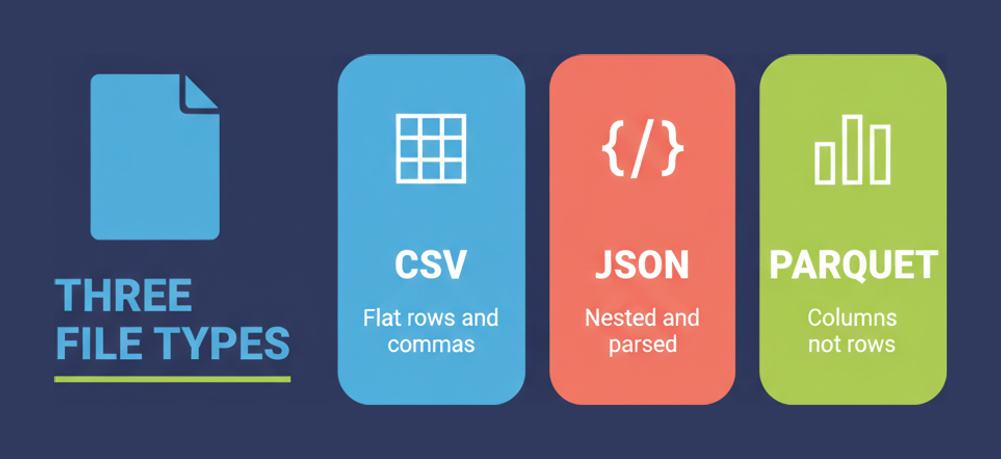
JSON is the one to work hardest. The objective says query and parse rather than load, which means the exam expects you to reach into a nested structure and produce something relational from it, not simply put a file in a table. The JSON data interchange format defines the structures you will be traversing, and Snowflake’s own semi-structured data concepts documentation covers how the platform stores and addresses them.
Parquet behaves differently and the exam treats it as a peer of the other two rather than as a special case. It is a columnar format maintained by the Apache Parquet project, and knowing why a columnar file loads and scans differently from a row-oriented CSV is the sort of reasoning the transformation domain rewards.
Alongside the formats sit the platform features that make analyst work reversible: Time Travel, cloning, and using clones for specific use cases. Those appear in the cleaning objective, which is a hint about how they are examined. The question is usually not what cloning does but when an analyst should reach for it.
What Does the Presentation Domain Actually Ask For?
Data presentation and visualisation is 28 percent of DAA-C01 and it covers three objectives: creating reports and dashboards for a business requirement, maintaining them, and incorporating visualisations. It is squarely about Snowsight, and it brings governance with it rather than treating charts as decoration.
Governance sits inside the charting objective
Row access policies and Dynamic Data Masking are named in the same objective as chart types. That pairing is deliberate: a dashboard shows different rows and different values to different viewers, and an analyst who builds one without understanding those controls has built something that leaks or misleads. Expect to be asked what a given viewer sees.
Chart choice is examinable
The objective names bar charts, scatter plots, heat grids and scorecards and asks you to compare and contrast them. That is a design question with a defensible right answer for a given dataset, not a matter of taste, and it is unusual to find it inside a platform certification.
The maintenance objective is the one candidates overlook entirely. It covers automated and repeatable tasks, operationalising data, storing and updating it, managing and sharing Snowsight dashboards, and configuring subscriptions and updates. In other words, what happens to a dashboard after it is built and someone else starts depending on it.
How Should You Prepare for the DAA-C01 Exam?
Prepare in the opposite order to the pipeline. Analysis and presentation are 60 percent of the marks, so they should get most of the study time even though they come last in the workflow. The exam assumes working Snowflake experience rather than a taught course, and no readable prerequisite is published.
- Start with the analysis domain, the largest at 32 percent, and practise diagnostic work: finding the cause of an anomaly in historical data rather than only reporting that it exists.
- Add forecasting explicitly, using built-in statistical functions to make a prediction, because it is a named objective and the one analysts skip most often.
- Build a real Snowsight dashboard for a stated business requirement, then choose deliberately between a bar chart, a scatter plot, a heat grid and a scorecard for each panel.
- Apply a row access policy and Dynamic Data Masking to that dashboard and check what a second user actually sees, since governance is examined inside the charting objective.
- Work the six function categories in turn, spending the most time on window functions and making sure geospatial is not a blank.
- Parse a nested JSON document into a relational result, then load the same data as Parquet and compare how the two behave.
- Read a Query Profile for a slow query, identify the expensive step, and fix it using pruning, caching or a materialized view.
- Finish with the ingestion domain and give the Marketplace objective real attention, joining an external dataset to your own through a data share.
The DAA-C01 exam topics resource on this site lists the objectives in full if you want a checklist to work against.
Should You Sit DAA-C01 or Stay With SnowPro Core?
They answer different questions about you. Core establishes that you understand the Snowflake platform. DAA-C01 establishes that you can do an analyst’s job inside it, from cleaning a messy dataset through to a governed dashboard somebody else relies on. Core is also considerably cheaper, at 175 US dollars against 375.
The practical test is what your week looks like. If you spend it writing window functions, parsing JSON, tuning a slow query and rebuilding a dashboard, the advanced exam matches your work and Core will feel like an exercise in platform trivia. If you are still learning what a virtual warehouse is, the order is the other way round.
There is also a scope argument. DAA-C01 spends 28 percent of its marks on presentation, which means it certifies something most database credentials do not touch at all. For an analyst whose output is a dashboard rather than a table, that is the part of the credential worth having. Our SnowPro Core exam guide covers the tier below in the same detail if you are still deciding.
Frequently Asked Questions
How many questions are on the DAA-C01 exam?
65 questions in 115 minutes, which works out at roughly 106 seconds each. Several objectives supply a dataset or a use case before asking anything, so the scenario items take longer than that average.
What is the passing score for SnowPro Advanced Data Analyst?
750 on a scaled range from 0 to 1000. Scaled scoring means the number of questions needed varies slightly with the form of the exam, so treat 750 as the bar rather than converting it to a percentage.
How much does DAA-C01 cost?
375 US dollars per attempt. Snowflake states that the whole SnowPro Advanced series is priced at that figure and that each registration requires the full amount, with no partial or bundled pricing.
Which DAA-C01 domain is worth the most?
Data analysis at 32 percent, followed by data presentation and visualisation at 28 percent. Together they are 60 percent of the paper, against 17 percent for data ingestion and preparation.
Does the exam really test dashboards?
Yes. More than a quarter of the marks sit in a domain about building and maintaining Snowsight dashboards, choosing between chart types, and applying row access policies and Dynamic Data Masking to what viewers see.
Which Snowflake functions should I study for DAA-C01?
Scalar, aggregate, window, table, system and geospatial functions are all named in a single objective. Window functions recur across several objectives and deserve the most attention; geospatial is named once and is easily skipped.
Is JSON tested on the SnowPro Advanced Data Analyst exam?
Yes, and the objective says query and parse rather than load. You are expected to traverse, flatten and nest semi-structured data, and CSV and Parquet are named alongside it.
Does DAA-C01 cover forecasting?
One objective covers it directly, asking you to use statistics and built-in functions to make predictions from data. It sits inside the 32 percent analysis domain alongside descriptive and diagnostic work.
How does DAA-C01 compare with SnowPro Core?
Core certifies platform understanding at 175 US dollars. DAA-C01 certifies analyst capability across the full pipeline at 375. The advanced exam assumes the platform knowledge Core establishes and tests what you do with it.
What performance tuning does the exam expect?
Reading the Query Profile and the execution plan, troubleshooting a slow query, using result, metadata and virtual warehouse caching, partition pruning, and knowing when a materialized view is the right answer.
Conclusion
The most useful number on this blueprint is 28. That is the share of a Snowflake certification given over to charts, dashboards and who is allowed to see which row.
Plan around it. Analysis and presentation together carry 60 percent of the marks, so preparation that concentrates on loading and merging covers the smallest domain and leaves the majority of the paper unrehearsed. Work diagnostic analysis until you can explain why an anomaly happened rather than only that it did, add forecasting because it is named and routinely skipped, then build a governed Snowsight dashboard and check what a second viewer actually sees. Fill in the function categories with window functions first and geospatial not left blank, parse a nested JSON document properly, and read a Query Profile until the expensive step is obvious. Then work questions across all four domains, because the one you find uncomfortable is almost certainly the one carrying the marks.


