A marketing team asks for one customer profile stitched together from six systems that have never agreed on a customer ID. Someone has to decide which records are the same person, what happens to the ones that nearly match, and who is allowed to see the result. That request, in its entirety, is what Data-Con-101 examines.
The Salesforce Certified Data 360 Consultant credential is the consultant tier exam for the platform Salesforce previously shipped as Data Cloud. Sixty five questions, 105 minutes, 70 percent to pass, and six weighted domains that follow the data from ingestion through unification to activation.
Table of Contents
- What does the Data 360 Consultant credential prove?
- Data Cloud and Data 360 are the same platform
- How is the Data-Con-101 exam structured?
- Which six domains does the syllabus weight, and how?
- How do the six domains trace one pipeline?
- Why does harmonization and unification trip people up?
- Why is activation the single heaviest domain?
- Where do data ethics and governance appear?
- How should a data professional prepare for Data-Con-101?
- Who this credential actually suits
- Frequently Asked Questions
- Conclusion
What does the Data 360 Consultant credential prove?
The Salesforce Certified Data 360 Consultant credential proves you can design and deliver a working customer data implementation on Salesforce Data 360, from connecting sources through to activating segments in downstream systems. It is a consultant tier exam, so the questions are framed as client situations rather than as feature definitions, and Salesforce lists it on its own Data 360 Consultant credential page.
What separates it from an administrator credential is the decision content. You are not asked whether a setting exists; you are asked which of several defensible configurations fits a described business, and what the consequences of the wrong one would be. That shows up most sharply in unification and in activation, which together carry more than a third of the paper.
It sits in the consultant family alongside the other Salesforce implementation credentials, and it assumes working familiarity with the platform rather than teaching it. Candidates who have never modelled data in Salesforce find the exam very hard, regardless of how much general data engineering they have done. Another member of that consultant family is covered in our guide to the CRM Analytics certification, which tests analytics delivery on the same platform.
Data Cloud and Data 360 are the same platform
Salesforce renamed Data Cloud to Data 360, and the certification name moved with it. This matters practically rather than cosmetically, because the search demand has not caught up: far more people still look for the Data Cloud certification than for the Data 360 one, which means most of the study material a candidate finds is filed under the older name.
Three consequences worth knowing before you start revising:
- Older study notes and community threads written under the Data Cloud name are still relevant, provided they postdate the current exam blueprint
- Salesforce documentation is in the middle of the transition, so the official Salesforce help documentation still carries the older identifier in places
- The exam code, Data-Con-101, is stable and is the reliable thing to search on
If you are checking whether a piece of material is current, check it against the domain list below rather than against the product name on the cover.
How is the Data-Con-101 exam structured?
Data-Con-101 is 65 questions in 105 minutes with a 70 percent pass mark, which works out at roughly 46 correct answers. Registration is USD 200 and a retake is USD 100, and the exam is delivered through Kryterion Webassessor or Pearson VUE.
| Field | Value |
|---|---|
| Credential name | Salesforce Certified Data 360 Consultant |
| Exam code | Data-Con-101 |
| Questions | 65 |
| Duration | 105 minutes |
| Passing score | 70 percent |
| Registration fee | USD 200 |
| Retake fee | USD 100 |
| Delivery | Kryterion Webassessor or Pearson VUE |
| Domains | Six, all weighted |
A hundred and five minutes across 65 questions is about 97 seconds each, which is generous by Salesforce standards and appropriate to the question style. Consultant tier items are scenario paragraphs rather than one line questions, so a good part of that time goes on reading rather than deciding. Candidates who run short are almost always re reading scenarios instead of trusting the first parse, and a Data-Con-101 practice test taken under a clock is the cheapest way to find out whether that is you.
The retake fee at half the registration fee is worth noting in planning. It makes a slightly early attempt less punishing than on exams where a retake costs full price, though it is still USD 100 you would rather not spend.
Which six domains does the syllabus weight, and how?
The Data-Con-101 syllabus publishes six domains with a weighting against each, and the spread is unusually even. The largest, Data Activations and Utilization, is 20 percent; the smallest, Data 360 Setup and Administration, is 13 percent. There is no domain you can safely ignore and none that dominates.
| Domain | Objectives | Weight |
|---|---|---|
| Data Activations and Utilization | Define basic concepts of segmentation and use cases; manage segments within Data 360; publish Activations within Data 360; act on data; use Data 360 in Salesforce flows | 20% |
| Data Source Connection and Ingestion | Explain data transformation capabilities within Data 360; describe processes and considerations for data ingestion from varied sources into Data 360; describe Data 360’s data collaboration capabilities, including Zero-Copy | 18% |
| Data Enhancements, Sharing, and Analysis | Demonstrate how to enhance data and build insights on unified data; explain how to reference Data 360 data from other systems; view and build reports and dashboards using Data 360; apply predictive and generative AI tooling capabilities of Data 360 to customer scenarios | 18% |
| Harmonization and Unification | Define the purpose, process, and supported use cases of unification; model data in Data 360 | 17% |
| Solution Positioning | Describe Data 360’s key terminology and business value; articulate Data 360’s foundational role in generative and predictive AI; identify initial use cases for Data 360; describe the principles of data ethics and governance | 14% |
| Data 360 Setup and Administration | Configure Data 360 permissions, permission sets, and organization-wide settings; apply data governance requirements to platform configuration; manage the development lifecycle with available tooling; use tooling to diagnose and troubleshoot common issues | 13% |
Converted to question counts on a 65 item paper, the domains land at roughly 13, 12, 12, 11, 9 and 8. The practical reading is that this is a breadth exam. A candidate who is excellent at ingestion and weak at segmentation loses around 13 questions, which is most of the margin the 70 percent bar allows.
How do the six domains trace one pipeline?
The domain list looks like six separate topics and behaves like one continuous process. Data arrives, it is harmonised into a model, matching records are unified into a single profile, insights and AI are built on top, segments are cut from the result, and those segments are published to somewhere that acts on them. Setup and governance run underneath all of it.
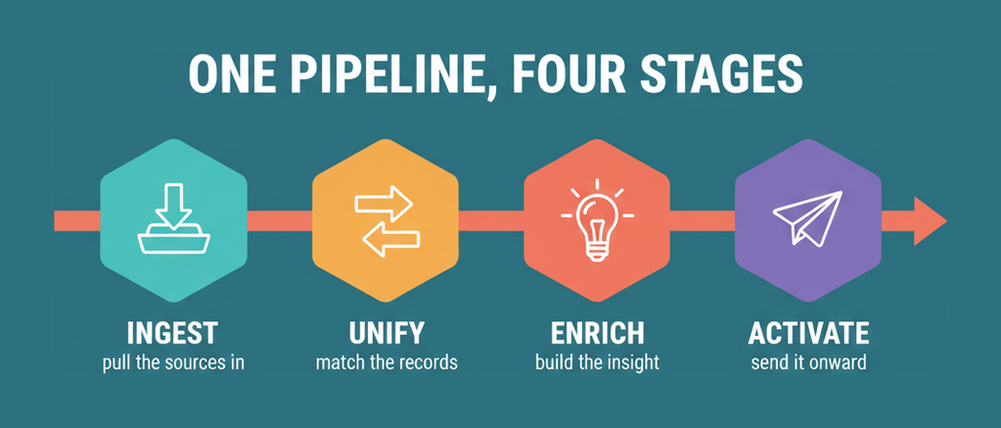
Reading the syllabus as a pipeline rather than a checklist changes how the scenarios look. A question that appears to be about segmentation is frequently testing whether you understood what unification produced upstream, because a segment can only be as good as the profile it filters. The exam exploits that dependency deliberately.
Why does harmonization and unification trip people up?
Harmonization and unification is 17 percent of the paper and the domain where experienced data engineers most often lose marks. The reason is that it has only two objectives, which reads as small, while both are conceptually dense and specific to how Salesforce models data rather than to general data modelling practice.
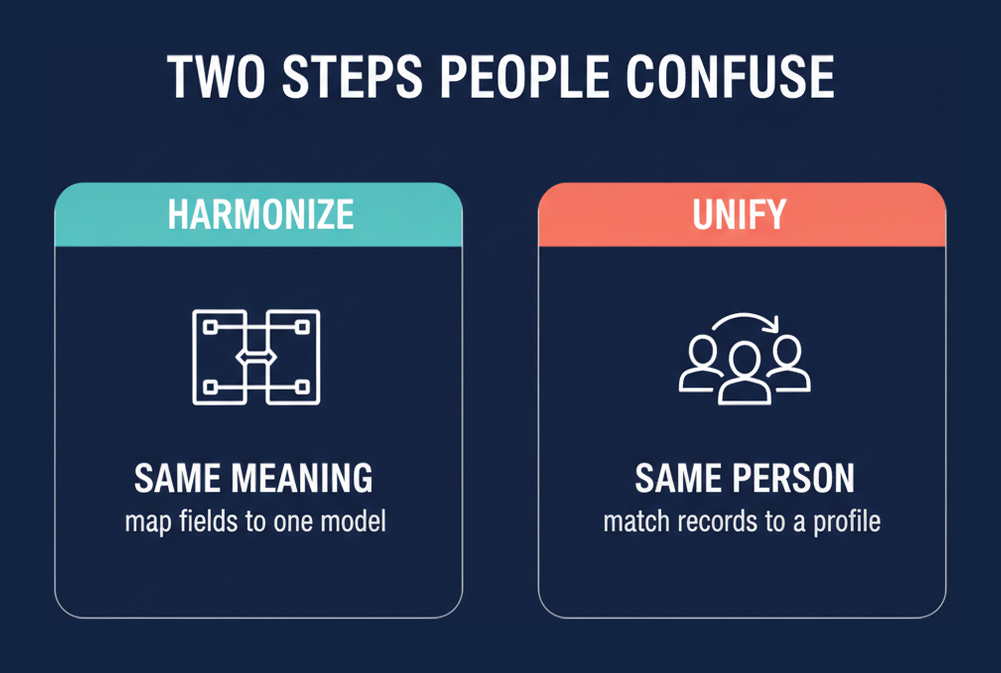
Harmonisation is mapping incoming source data onto a common model so that fields from different systems mean the same thing. Unification is the matching step that decides which records across those sources represent the same individual. The exam expects you to know the difference cold, because scenarios routinely describe a symptom of one and invite you to fix the other.
The three things worth rehearsing
Rather than reading about unification, work through these in a development org. Each maps onto a scenario type that recurs.
- Map two sources that disagree on field naming and granularity, so you see what harmonisation is actually doing
- Introduce records that nearly match and watch what the matching step does with them, which is where the supported use cases objective bites
- Trace a unified profile back to its contributing source records, because scenarios frequently ask what went wrong upstream
Why is activation the single heaviest domain?
Data Activations and Utilization carries 20 percent, the largest share, because it is the domain where the platform stops being a data project and starts producing business outcomes. Its five objectives cover segmentation concepts, managing segments, publishing activations, acting on data, and using Data 360 inside Salesforce flows.
That last objective is the one candidates from a pure data background underestimate. Using Data 360 within flows is Salesforce platform work rather than data work, and it assumes you know how flows behave. If your experience is in warehouses and pipelines rather than in the Salesforce platform, this is the objective to give disproportionate time to.
The other recurring theme is direction. Activation is about getting a computed audience out to a system that will do something with it, so scenarios often hinge on where the segment is going and what that destination needs, rather than on how the segment was defined. Reporting on unified data sits in a different domain entirely, and if you are strengthening that side, our guide to the Tableau Server Administrator exam covers the analytics layer these activations are frequently measured in.
Where do data ethics and governance appear?
Governance appears twice, in two different domains, and that split is easy to miss. Solution Positioning asks you to describe the principles of data ethics and governance in the abstract. Setup and Administration asks you to apply data governance requirements to platform configuration, which is the concrete counterpart.
A question in the first group wants the principle; a question in the second wants the permission set. Candidates who revise governance once, in one mode, tend to answer half of them well. The distinction is worth making explicit in your notes.
Because this credential deals with unified personal data at scale, the principles side is not decorative. Frameworks such as the NIST Privacy Framework set out the same ideas the exam expects you to recognise, in vendor neutral language, and reading one of them makes the abstract questions considerably easier to parse.
How should a data professional prepare for Data-Con-101?
An experienced Salesforce professional needs roughly four weeks; someone arriving from a data engineering background outside the Salesforce ecosystem should plan on six, with most of the extra time going to the platform specific material. The sequence below follows the pipeline, which is also how the scenarios are constructed.
- Start with Solution Positioning and terminology, so that the vocabulary the scenarios use is settled before anything technical begins
- Build an ingestion exercise next, connecting at least two genuinely different sources so that transformation and collaboration concepts are concrete
- Spend the largest single block on harmonization and unification, deliberately introducing records that nearly match
- Move on to enhancements, reporting and the AI tooling objectives, building an insight on top of a unified profile you produced yourself
- Finish with segmentation, activation and Salesforce flows, publishing a segment end to end to a destination
- Cover setup, permissions and governance last, then sit full length timed sets until 65 scenario questions inside 105 minutes is comfortable
The most common preparation mistake is treating the two 18 percent domains as interchangeable. Ingestion and analysis sit at opposite ends of the pipeline and share almost no content; revising them together produces a vague sense of both.
Who this credential actually suits
Data-Con-101 suits people who are already implementing on Salesforce and are being pulled into customer data work, and it suits consultancies that need a demonstrable bench for it. It is a genuinely poor fit for a data engineer with no Salesforce exposure, because roughly half the paper assumes platform knowledge the exam does not teach.
The adjacent skill that pays off most is integration. Getting data into Data 360 from systems that were never designed to share it is the practical bottleneck on most implementations, and candidates who already understand integration architecture find the ingestion domain straightforward. Our walkthrough of the MuleSoft Platform Architect exam covers that neighbouring ground in the same Salesforce family.
On the commercial side, consultant tier Salesforce credentials sit in a market that independent salary sources track separately from administrator roles, and PayScale Salesforce consultant data is a reasonable benchmark that does not come from a certification vendor. The honest framing is that this credential opens a specialism rather than raising a band on its own.
Frequently Asked Questions
How many questions are on the Data-Con-101 exam?
Sixty five questions within 105 minutes. That works out at roughly 97 seconds per question, which is appropriate given that consultant tier items are scenario paragraphs rather than short questions.
What is the passing score for the Salesforce Data 360 Consultant exam?
Seventy percent, which is about 46 correct answers from 65. That leaves a margin of roughly 19 wrong answers across six domains.
How much does the Data 360 Consultant certification cost?
Registration is USD 200 and a retake is USD 100. The half price retake makes an early attempt less costly than on exams that charge full price a second time.
Is Data 360 the same thing as Salesforce Data Cloud?
Yes. Salesforce renamed Data Cloud to Data 360 and the credential name moved with it. Search demand still favours the older name, so most existing study material is filed under Data Cloud even where it describes the current platform.
Which Data-Con-101 domain carries the most marks?
Data Activations and Utilization at 20 percent, roughly 13 questions. Data Source Connection and Ingestion and Data Enhancements, Sharing, and Analysis follow at 18 percent each.
Do you need Salesforce experience to pass Data-Con-101?
In practice, yes. Roughly half the paper assumes working familiarity with the Salesforce platform, including flows and permission sets, and the exam does not teach that background. A data engineer with no Salesforce exposure should plan on significantly longer preparation.
Where is the exam delivered?
Through Kryterion Webassessor or Pearson VUE. Both routes lead to the same exam and the same credential.
What is the difference between harmonization and unification?
Harmonisation maps incoming source data onto a common model so fields from different systems mean the same thing. Unification is the matching step that decides which records across those sources describe the same individual. Scenarios frequently describe a symptom of one and invite you to fix the other.
Does the exam cover generative AI?
Yes, in two places. Solution Positioning asks you to articulate the platform’s foundational role in generative and predictive AI, and Data Enhancements, Sharing, and Analysis asks you to apply its predictive and generative AI tooling to customer scenarios.
How much of the exam is governance?
Governance is not a domain of its own. It appears as one objective inside Solution Positioning, framed as principles, and again inside Data 360 Setup and Administration, framed as platform configuration. Revising it in only one of those two modes leaves marks on the table.
Conclusion
Data-Con-101 is a breadth exam with an unusually flat weighting: 20, 18, 18, 17, 14 and 13 percent across six domains, with no domain small enough to skip. Sixty five questions, 105 minutes, 70 percent to pass, USD 200 to register and USD 100 to retake.
Prepare by following the pipeline the domains describe rather than the order they are listed in, and give harmonisation and unification more time than their 17 percent suggests, because they determine whether the downstream domains make sense at all. If you are coming from outside the Salesforce platform, budget the extra weeks for flows and permissions honestly rather than discovering the gap during the exam. And search on the exam code, not the product name, or half of what you find will describe a platform under its previous label.


