Running Cloudera on somebody else’s infrastructure turns out to be a different job from running it on a rack in your own building, and CDP-5001 is built entirely around that difference. Nearly a quarter of it is not about Cloudera at all.
The Cloudera public cloud certification, exam code CDP-5001, is 60 questions in 90 minutes at a 60 percent pass mark, and its four weighted domains put 22 percent of the marks into cloud provider concepts before the Cloudera platform is even mentioned. Administrators comparing cloud data platforms often start with the Google associate data credential on the Google side.
Table of Contents
- What is the Cloudera public cloud certification?
- Why is administering Cloudera on cloud a different job?
- How is the CDP-5001 exam delivered and scored?
- Where do the marks sit across the four domains?
- The onboarding domain is mostly not about Cloudera
- Environments and data lakes carry the largest share
- What does the identity management domain expect?
- Does the on-premises exam prepare you for this one?
- How should you prepare for CDP-5001?
- Frequently Asked Questions
- Conclusion
What is the Cloudera public cloud certification?
The Cloudera public cloud certification is the vendor’s role-based credential for administrators who run the Cloudera platform on a cloud provider rather than on owned hardware. It carries the exam code CDP-5001, runs to 60 questions across four weighted domains, and covers cloud onboarding, environments and data lakes, data hubs and services, and identity management.
Cloudera itself is a hybrid data platform: storage, processing, warehousing, streaming and machine learning services that run together over a shared governance layer. The public cloud edition puts all of that on a cloud provider’s compute, network and storage, with a Cloudera control plane sitting above it.
One naming detail is worth clearing up before anything else, because it causes real confusion. Cloudera’s own catalogue now calls this exam Cloudera Administrator Cloud while the exam code keeps the older CDP form. Both names refer to the same credential, and material written at different times will use one or the other.
Why is administering Cloudera on cloud a different job?
On-premises, the platform sits on hardware somebody else in your organisation already owns and has already networked. In the public cloud, the administrator creates that substrate themselves, which means virtual networks, subnets, security groups, storage classes, key management and identity policies all become part of the job rather than someone else’s department.
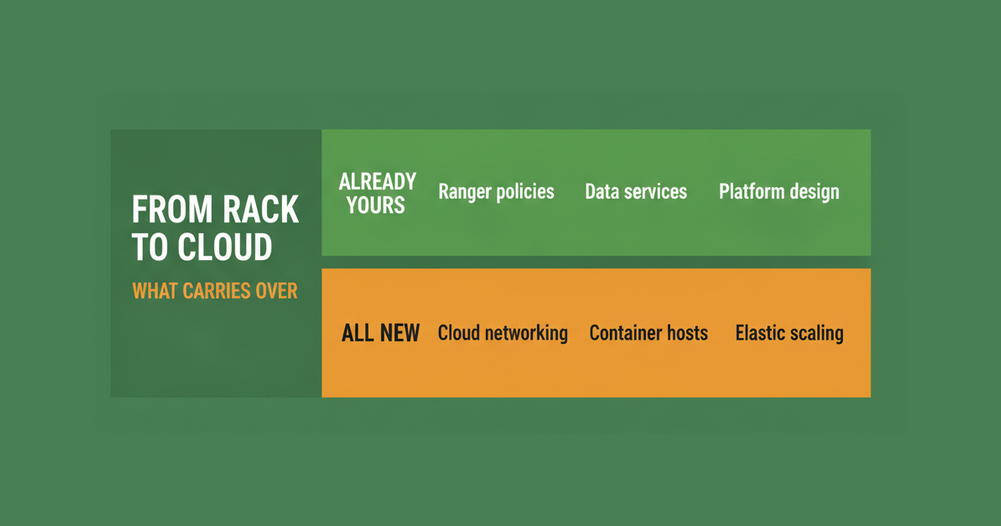
That shift is visible in the syllabus. The first domain is called Onboarding, Prerequisites and Info Sec, and ten of its named concepts are cloud provider primitives rather than Cloudera features. The exam is telling you plainly that you cannot administer this platform in the cloud without being competent in the cloud.
There is a second shift that matters just as much. In the cloud the platform is elastic, so capacity becomes a policy rather than a purchase. Auto scaling appears as its own objective, and the decisions around it have cost consequences that a fixed cluster simply does not have.
The quickest way to find out whether your experience covers both halves is to work exam-style items and see which ones you are guessing at. The sets on the money site’s CDP-5001 practice exam mix the two kinds of question in roughly the proportion the real paper does, which makes the gap obvious early.
How is the CDP-5001 exam delivered and scored?
CDP-5001 is 60 questions in 90 minutes with a 60 percent pass mark, priced at $330 USD and registered through Cloudera. It is the most expensive exam of the group covered here, and the price reflects Cloudera’s flat pricing across its certification line rather than anything specific to this paper.
| Field | Value |
|---|---|
| Credential name | Cloudera CDP Certified Administrator – Public Cloud |
| Vendor’s current naming | Cloudera Administrator Cloud |
| Exam code | CDP-5001 |
| Questions | 60 |
| Duration | 90 minutes |
| Passing score | 60 percent |
| Price | $330 USD |
| Domains | 4, all weighted |
| Registration | Cloudera |
| Prerequisite certification | None published |
A word about that pass mark, because it is contested online. Several third-party pages assert a much higher figure for Cloudera exams. Cloudera itself publishes no passing score at all for any of its nine credentials, and the money site’s syllabus page publishes 60 percent for this exam while reporting the sibling Generalist exam as simple pass or fail. Sixty percent is what a published source states, and the higher number is not traceable to one.
Sixty questions in 90 minutes is 90 seconds each, which is comfortable, and a 60 percent bar means 36 correct answers with a margin of 24. That is a workable allowance, but it is not enough to write off the 22 percent onboarding domain, which alone is worth about 13 questions.
Where do the marks sit across the four domains?
Environments and Data Lakes is the largest domain at 31 percent, Data Hubs and Data Services follows at 27 percent, Onboarding at 22 percent and Cloudera Identity Management at 20 percent. That is the most evenly spread distribution of any exam covered here, with only eleven points between the biggest and smallest domain.
| Domain | Weight | Approximate questions | What it is really about |
|---|---|---|---|
| Environments and Data Lakes | 31% | 19 | Cloudera architecture, environments, the cloud provider interface, data lake storage and IDBroker |
| Data Hubs and Data Services | 27% | 16 | Data services architecture, auto scaling, security and integration |
| Onboarding, Prerequisites and Info Sec | 22% | 13 | Cloud networking, compute, Kubernetes, IAM, storage, templates and key management |
| Cloudera Identity Management | 20% | 12 | Ranger architecture, policies and auditing, control plane auditing, identity provider integration |
An even spread changes the planning calculus. Where a lopsided exam lets you concentrate, this one does not: no single domain can carry you, and no single domain can be skipped, because even the smallest is worth half the pass margin.
The useful way to read this table is by grouping rather than ranking. Two domains, worth 58 percent between them, are about what you build and run. One, worth 22 percent, is about the ground you build it on. One, worth 20 percent, is about who is allowed to touch it. Those are three genuinely different bodies of knowledge and they need three genuinely different study approaches.
The onboarding domain is mostly not about Cloudera
Ten concepts are named under the onboarding domain and almost all of them belong to the cloud provider. Networking and compute architecture, virtual private clouds, subnets, security groups, elastic compute, managed Kubernetes, identity and access management, storage options, infrastructure templates, and key management and encryption.
This is the domain that catches experienced Cloudera administrators out. Knowing the platform inside out does not help you answer a question about which subnet layout a deployment requires, or about how a managed Kubernetes service schedules the workloads the platform places on it.
The Kubernetes objective deserves particular attention because it is easy to read past. Cloudera’s data services run on managed Kubernetes in the cloud, so understanding the managed Kubernetes service is not background knowledge here, it is a prerequisite for the domain that follows it. A candidate who has never looked at a node group will find the auto scaling objectives opaque.
Encryption and key management close the domain, and they connect forward to governance. Where keys live and who can use them determines what the platform can read, which is why this sits in the same domain as identity rather than in a separate security section.
Environments and data lakes carry the largest share
At 31 percent, roughly 19 questions, this is where Cloudera’s own abstractions live. Four objectives: Cloudera architecture, environments and the cloud service provider interface, data lake storage and components, and Data Lake IDBroker.
The environment as a unit
An environment is the container that binds a Cloudera deployment to a specific cloud provider region, network and credential. Creating one is the first real action an administrator takes, and almost everything downstream inherits from it, which is why the objective pairs it with the provider interface rather than treating it as a Cloudera-only concept.
The data lake that sits inside an environment provides the shared storage and the shared security and governance services that every workload then uses. Cloudera’s public cloud overview documentation is the clearest statement of how those pieces nest, and it is worth reading before the deeper service documentation.
IDBroker is its own objective for a reason
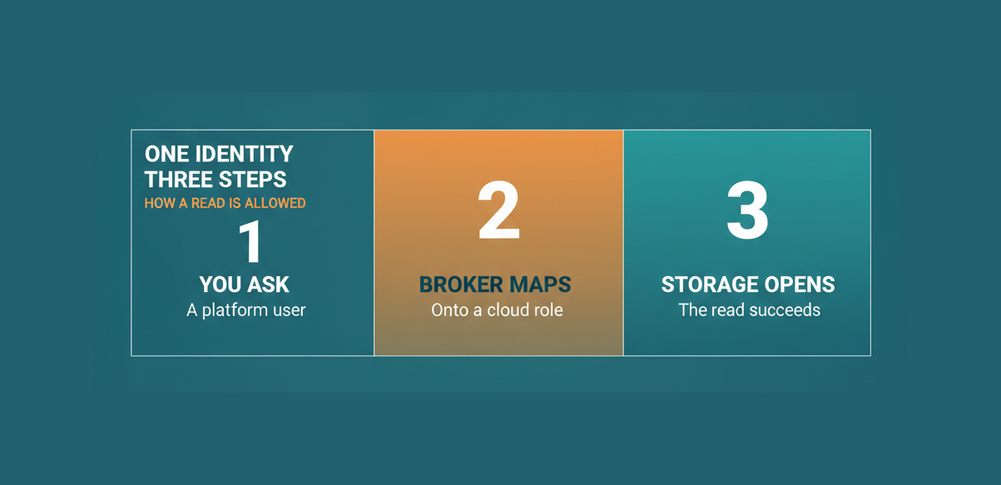
IDBroker is named separately from everything else in the domain, which is a strong signal. It is the component that maps a platform user to a cloud provider identity, so that when a workload reads from object storage it does so as someone the cloud provider recognises rather than as a shared service account.
That mapping is the join between Cloudera’s identity model and the cloud provider’s, and it is exactly the kind of thing that is invisible when it works and baffling when it does not. Expect questions that describe an access failure and ask where the mapping broke.
What does the identity management domain expect?
Cloudera Identity Management is 20 percent, about 12 questions, across four objectives: Ranger architecture and policies, Ranger auditing, control plane auditing, and identity provider integration. It is the smallest domain and the most consequential in production.
Ranger is the policy engine that decides who may read which table, column or file across the whole platform. It is an Apache project rather than a Cloudera-proprietary component, which means its documentation is public and its concepts transfer to other distributions that use it.
The syllabus separates Ranger policies from Ranger auditing, and then separates Ranger auditing from control plane auditing. Those are three distinct things. Policies decide what is allowed. Ranger auditing records what was accessed. Control plane auditing records what was administered, which is a different question entirely and the one a compliance reviewer usually asks first.
Identity provider integration is the fourth objective and it closes the loop opened in the onboarding domain. The platform does not maintain its own user directory in any meaningful sense; it federates to whatever the organisation already runs, and the administrator’s job is to make that federation work rather than to create accounts.
Does the on-premises exam prepare you for this one?
Partly, and the honest answer is less than most candidates expect. Cloudera runs a separate administrator credential for on-premises deployments, and the two exams share the platform vocabulary, the governance model and the data services, but they diverge completely on everything underneath.
What transfers is real. Ranger policies work the same way. Data services are the same services. The architecture of the platform is the architecture of the platform. Anyone who has worked through the Cloudera on-premises administrator exam starts this one with roughly half the ground already covered.
What does not transfer is the entire onboarding domain and a good part of the environments domain. Provider networking, managed Kubernetes, cloud identity and access management, object storage classes and infrastructure templates have no on-premises equivalent, and elastic scaling behaves nothing like capacity planning on owned hardware.
The practical recommendation follows from the weights. If your Cloudera experience is entirely on-premises, budget most of your study time for the 22 percent onboarding domain plus the cloud-facing half of the 31 percent environments domain, and treat the rest as revision. If your cloud experience is strong but your Cloudera experience is thin, invert that.
How should you prepare for CDP-5001?
Preparation for CDP-5001 should be split by origin rather than by domain order, because the exam draws on two separate bodies of knowledge. Cloudera’s own recommended route is the free Introduction to Cloudera Public Cloud course, or the CDP Public Cloud Administration course for OnDemand subscribers.
- Work out which half you are weak on first, since an on-premises Cloudera administrator and a cloud engineer new to Cloudera need almost opposite study plans for the same exam.
- Close the cloud provider gap before anything else, covering virtual networks, subnets, security groups, elastic compute, managed Kubernetes, identity and access management, storage classes and key management.
- Create a real environment end to end, binding it to a provider region, network and credential, because everything in the largest domain inherits from that single object.
- Build a data lake inside that environment and trace what it provides to the workloads above it, so that shared storage and shared governance stop being abstractions.
- Follow one identity all the way through IDBroker to an object storage read, since the mapping between platform user and cloud identity is its own named objective and its own failure mode.
- Deploy at least one data hub and one data service, then trigger auto scaling deliberately and watch what it does to both capacity and cost.
- Write Ranger policies, read the Ranger audit trail, and then read the control plane audit trail separately, because the syllabus treats those three as distinct and so will the questions.
- Finish with timed sets of 60 questions in 90 minutes, checking that you are not spending the extra time on cloud provider questions you should already know.
Five to eight weeks is realistic, and the range is wide on purpose. Someone strong in both halves can move quickly. Someone strong in only one should expect the unfamiliar half to take most of the calendar.
For anyone mapping the wider Cloudera track, the role-based exams differ sharply in shape rather than just in subject, and the CDP-3003 data operator exam is a useful illustration of how differently the vendor weights a pipeline credential against an administration one.
Frequently Asked Questions
How many questions are on the CDP-5001 exam?
Sixty questions in 90 minutes, which is 90 seconds each. That is a comfortable pace by the standards of vendor platform exams.
What is the passing score for the Cloudera public cloud certification?
Sixty percent, which is what the money site’s syllabus page publishes. Cloudera itself publishes no passing score for any of its exams, and higher figures circulating on third-party sites are not traceable to a published source.
How much does CDP-5001 cost?
$330 USD, registered through Cloudera. That is the same price Cloudera applies across its certification line rather than a figure specific to this exam.
Which domain carries the most marks?
Environments and Data Lakes at 31 percent, roughly 19 questions. Data Hubs and Data Services follows at 27 percent, Onboarding at 22 percent and Cloudera Identity Management at 20 percent.
Do I need cloud provider knowledge for this exam?
Yes, and more than most candidates expect. The onboarding domain is 22 percent on its own and names ten cloud provider concepts including virtual private clouds, subnets, security groups, elastic compute, managed Kubernetes and identity and access management.
Is this the same as the Cloudera Administrator on premises exam?
No. They share the platform vocabulary, the governance model and the data services, but the cloud exam adds an entire domain of provider infrastructure and changes how capacity and identity work. Roughly half the ground transfers.
What is IDBroker and why is it its own objective?
IDBroker maps a platform user to a cloud provider identity, so that a workload reading object storage does so as someone the provider recognises. It is the join between two identity models, which is why it is named separately rather than folded into the data lake objective.
Why does the syllabus separate Ranger auditing from control plane auditing?
Because they answer different questions. Ranger auditing records what data was accessed. Control plane auditing records what was administered. A compliance reviewer usually asks about the second first.
Is there a prerequisite certification?
None is published. Cloudera states no prerequisite for this exam and sets no formal experience minimum, although the syllabus assumes working familiarity with both the platform and a cloud provider.
Does Cloudera still call it CDP-5001?
The exam code is still CDP-5001, but Cloudera’s own catalogue now names the exam Cloudera Administrator Cloud, having dropped the CDP prefix from the credential names while keeping it in the codes. Both names are in circulation.
Conclusion
CDP-5001 is two exams sharing one paper: a Cloudera platform exam and a cloud infrastructure exam, weighted 31, 27, 22 and 20 across four domains with only eleven points between the largest and the smallest. Sixty questions, 90 minutes, $330, and a 60 percent bar with a margin of 24.
Start by identifying which of the two halves you are weaker on, because that single judgement decides the whole study plan. Build a real environment, follow one identity through IDBroker to a storage read, trigger auto scaling on purpose, and read the two audit trails separately. An evenly weighted exam rewards even coverage, and this one has nowhere safe to be thin.


