Four function names sit on the SOL-C01 syllabus under the heading Snowflake Cortex LLM functions, and Snowflake’s documentation now files all four of them as legacy. PARSE_DOCUMENT, TRANSLATE, CLASSIFY_TEXT and COMPLETE still work, but the pages that describe them point to AI_PARSE_DOCUMENT, AI_TRANSLATE, AI_CLASSIFY and AI_COMPLETE as the replacements, and two of those swaps change what comes back. That is the kind of detail the SnowPro Associate Platform certification from Snowflake rewards: not whether you can name a function, but whether you know what it does to a stage, a VARIANT column or a document when you call it. The exam itself is short and cheap by vendor standards. It costs 100 USD, runs 65 questions in 85 minutes, is delivered unproctored through Pearson VUE, and once you buy it you have 24 hours to launch and finish it before the fee is forfeited.
This article lays out what SOL-C01 tests, the four domains exactly as the money-site syllabus publishes them, how the Associate differs from the SnowPro Core exam that renews it, why the Cortex names look different in the docs, what the two heaviest domains actually ask about stages and warehouses, and a preparation order built on the nine modules of Snowflake’s own Platform Training.
Table of Contents
- What does the SnowPro Associate Platform certification actually test?
- Which four domains make up SOL-C01, and where do the marks sit?
- How is SnowPro Associate different from SnowPro Core?
- Why do the Cortex function names on the syllabus look different in the docs?
- What do stages, COPY INTO and warehouse sizing have to do with 40 percent of the exam?
- Notebooks, Time Travel and sharing: the smaller objectives that still cost marks
- How should you prepare for SOL-C01 with three months of Snowflake behind you?
- Frequently Asked Questions
- Conclusion
What does the SnowPro Associate Platform certification actually test?
The SnowPro Associate Platform certification, exam code SOL-C01, tests whether you can work inside Snowflake’s AI Data Cloud at an entry level: navigate Snowsight and Snowflake Notebooks, create databases, schemas and stages, load structured and semi-structured data, understand roles and access, size and scale a virtual warehouse, and call the Cortex LLM functions. It is Snowflake’s only associate-level credential and sits below SnowPro Core.
| Field | Value | Where it is published |
|---|---|---|
| Exam code | SOL-C01 | Money-site syllabus page and Snowflake’s launch FAQ |
| Credential | SnowPro Associate: Platform | Snowflake’s launch FAQ |
| Fee | 100 USD | Both sources agree |
| Questions | 65 | Both sources agree |
| Duration | 85 minutes, plus 5 minutes for the candidate agreement and survey | 85 on both; the extra 5 is from Snowflake |
| Passing score | 750 on a scaled range of 0 to 1000 | Money-site syllabus page; Snowflake’s FAQ does not state one |
| Delivery | Pearson VUE, unproctored, with a 24 hour window to launch after purchase | Pearson VUE on both; the unproctored detail and the window are from Snowflake |
| Question types | Multiple choice, multiple select and interactive items such as matching and drag and drop | Snowflake’s launch FAQ |
| Validity | 2 years; earning SnowPro Core extends it | Snowflake’s launch FAQ |
| Recommended experience | 3 or more months with Snowflake, or the instructor-led Snowflake Platform Training course | Snowflake’s launch FAQ |
The 24 hour rule is the detail that trips people
Because the exam is unproctored, Snowflake does not book you a time slot. You buy the exam and a 24 hour window opens in which you must launch and complete it. Miss the window and the registration fee is forfeited; you can buy the exam again only after a 7 day waiting period, and Snowflake says no exceptions are granted. The practical reading is simple: do not purchase SOL-C01 until the evening you intend to sit it, on a machine and a connection you trust.
Snowflake published every one of those delivery facts, along with the fee, the question count and the validity period, on the SnowPro Associate launch FAQ dated 3 February 2025, which is the day registration opened. What that page does not publish is a passing score or a domain list. Those come from the money-site syllabus page, which is why the table above names the source for every row.
What the architecture objective actually covers
The first domain opens with the key features of the AI Data Cloud and the Snowflake layers. Snowflake’s own description of its architecture is a hybrid: a central storage layer that every compute cluster can reach, plus independent virtual warehouses that process queries in parallel, plus a cloud services layer that handles sign-in, access control, metadata and query optimisation. The money-site sample questions test exactly that split, asking which layer optimises a SQL query and which two statements describe elasticity.
Storage is worth a second look because it is no longer one thing. Snowflake lists three table types in that layer: its own compressed columnar tables, hybrid tables for transactional work, and Apache Iceberg tables that keep their data and metadata in cloud storage you manage. SOL-C01 does not ask you to configure an Iceberg catalog, but a question that describes storage and compute as tightly coupled is wrong on every one of those three, and knowing why is the point of the objective.
Which four domains make up SOL-C01, and where do the marks sit?
SOL-C01 has four domains. Interacting with Snowflake and the Architecture carries 35 percent, Identity and Data Access Management 15 percent, Data Loading and Virtual Warehouses 40 percent, and Data Protection and Data Sharing 10 percent. Three quarters of the exam therefore sits in two domains, and the heaviest one is about moving data in and paying for the compute that does it.
| Domain | Weight | What the objectives name |
|---|---|---|
| Interacting with Snowflake and the Architecture | 35% | Elastic storage and compute, the Snowflake layers, Snowsight and Snowflake Notebooks, Worksheets in Python and SQL, data loading and query history in Snowsight, object browsers, creating databases, schemas and stages, notebook sessions and cell execution status, Streamlit visualisation, Python variable substitution, and the object hierarchy of databases, schemas, tables, views and data types |
| Identity and Data Access Management | 15% | Role-based access control, the role hierarchy, role types, privileges and object access by role, creating a database and transferring ownership, INFORMATION_SCHEMA and the PUBLIC schema, context, creating and dropping schemas, and basic SQL including EXCLUDE, SELECT * and LIMIT |
| Data Loading and Virtual Warehouses | 40% | Stages, loading and querying structured and semi-structured data, COPY INTO, INSERT and LIST, standard against multi-cluster warehouses, warehouse sizing and scaling in, out, up and down, creating tables and loading them through Snowsight, INSERT and COPY INTO with file format options, directory tables and pre-signed URLs for unstructured data, and the Cortex LLM functions PARSE_DOCUMENT, TRANSLATE, CLASSIFY_TEXT and COMPLETE |
| Data Protection and Data Sharing | 10% | Time Travel and cloning, Snowflake Marketplace listings, Data Exchange and private data shares |
Notice where the Cortex functions sit. Every third-party summary files them under an AI heading, but on the syllabus they are the last objective of the loading domain, next to directory tables. That placement is deliberate: PARSE_DOCUMENT reads a file from a stage, so the exam treats it as the final step of a loading workflow rather than as a separate subject. The full objective list, with the sub-bullets that the table above condenses, is on the SOL-C01 syllabus on VMExam, which is the source the domain names and weightings here were taken from.
Two things about the weighting shape your study time. The 15 percent access domain is small but entirely testable from memory, so it is cheap marks: the role hierarchy, what SHOW GRANTS returns, how ownership transfers. The 10 percent protection and sharing domain is even smaller, but its objectives are the ones most candidates have never touched in a trial account, because a trial rarely needs a clone or a private listing. Spend an hour on each rather than skipping them for the big two.
How is SnowPro Associate different from SnowPro Core?
SnowPro Associate: Platform is a 100 USD, 65 question, unproctored entry exam that asks you to use Snowflake. SnowPro Core, exam COF-C03, costs 175 USD, is proctored, and asks how Snowflake should be implemented. Earning Core extends an Associate credential, so the two form a ladder rather than a choice, and the Associate is the rung Snowflake added in 2025 for people with about three months of experience.
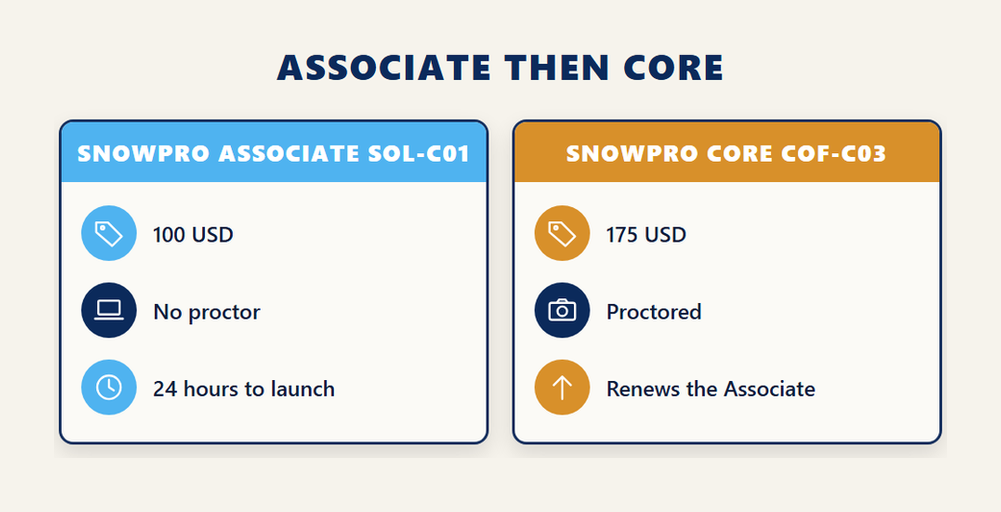
| Point of difference | SnowPro Associate: Platform (SOL-C01) | SnowPro Core (COF-C03) |
|---|---|---|
| Fee | 100 USD | 175 USD, with a 20 percent regional discount for exams delivered in India |
| Proctoring | Unproctored; 24 hour launch window after purchase | Proctored online or at a Pearson test centre |
| Position in the programme | Associate level, below Core | The foundation exam that Specialty and Advanced tracks build on |
| Renewal | Earning SnowPro Core extends it | Renewed by a same, equivalent or higher certification, or an eligible instructor-led course |
| Intended experience | 3 or more months with Snowflake | Hands-on implementation experience |
Which one to book first
Search demand shows the confusion plainly. People type the Associate’s name with “core” attached, and the money-site pages that rank for the Associate often get impressions for Core terms too. The honest answer is that the exams reward different depths of the same material. If you have loaded a file through Snowsight, resized a warehouse and granted a role, the Associate will feel like a check of what you already do. Core expects you to know why a multi-cluster warehouse is an Enterprise Edition feature and when resizing beats adding clusters.
If Core is your real target, the Associate is still worth the 100 USD as a rehearsal of the Pearson VUE delivery and of the interactive item types, which Core also uses. Our SnowPro Core COF-C03 breakdown covers the domain split on that exam, and reading the two side by side shows how much of the Associate blueprint reappears there at a higher level of detail. A pass on the Associate also buys two years of credential before Core becomes the renewal route.
What the Associate is not
It is not a shortcut into the Advanced series. Snowflake’s documentation of its continuing education programme lists renewal options for Core, the three Specialty exams and the seven Advanced exams, and the Associate is renewed by moving up to Core rather than by sitting it again. It is also not a cheaper Core: a question about Snowpipe Streaming, replication or clustering keys would be out of scope on SOL-C01, and nothing on the syllabus goes beyond what a single person can do in a single account from Snowsight.
Why do the Cortex function names on the syllabus look different in the docs?
The SOL-C01 syllabus names four Cortex LLM functions: PARSE_DOCUMENT, TRANSLATE, CLASSIFY_TEXT and COMPLETE. Snowflake’s documentation now lists those as legacy SNOWFLAKE.CORTEX functions and names an AI_ prefixed replacement for each, with the AI Functions described as the focus of future development. The legacy names still run, so the exam objective stands, but you should know both names and what changed between them.
| Name on the syllabus | Replacement in the docs | What changes |
|---|---|---|
| COMPLETE | AI_COMPLETE | Drop-in for the basic model and prompt form; calls that pass an options object are split into separate arguments |
| TRANSLATE | AI_TRANSLATE | Direct replacement, same arguments and output |
| CLASSIFY_TEXT | AI_CLASSIFY | The output format changes, and the new function also accepts images |
| PARSE_DOCUMENT | AI_PARSE_DOCUMENT | The file argument changes; the function still extracts text in OCR mode or text with layout in LAYOUT mode from a document on an internal or external stage |
The money-site sample set asks what PARSE_DOCUMENT is for, and the answer it wants is extraction of content from a document, not sentiment, summary or translation. That is unchanged under the new name. What a careful candidate adds is the mechanics: the document has to be on a stage first, which is why the function lives in the loading domain, and the role that calls any Cortex function needs the USE AI FUNCTIONS privilege plus one of the CORTEX_USER or AI_FUNCTIONS_USER database roles. The legacy function migration page sets out the full mapping and the behaviour changes, and it is a better study text for this objective than any summary.
Expect the exam to describe a task rather than quote a signature. A row of support tickets that needs sorting into three buckets is CLASSIFY_TEXT. A column of product descriptions that must appear in Japanese is TRANSLATE. A free-text instruction that asks a model to draft a reply is COMPLETE. A contract PDF sitting in a stage that you need as text before any of the others can run is PARSE_DOCUMENT. If you can map the task to the function and say what the function returns, the name on the paper will not matter.
What do stages, COPY INTO and warehouse sizing have to do with 40 percent of the exam?
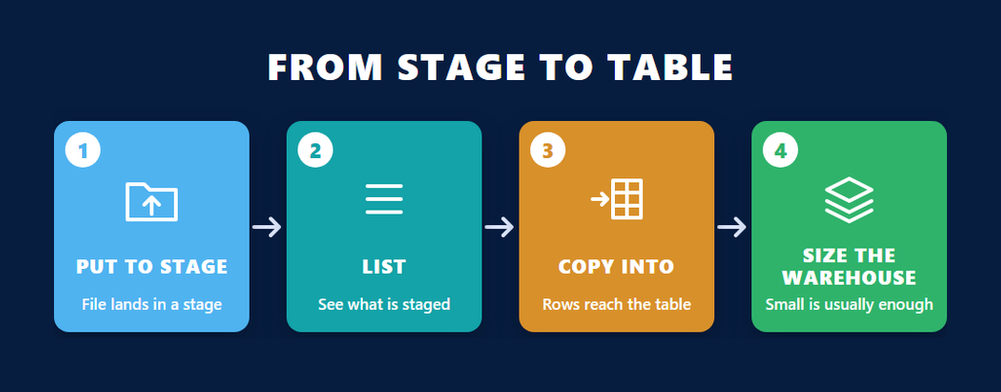
Data Loading and Virtual Warehouses is the heaviest SOL-C01 domain at 40 percent because it covers the whole path a file takes into Snowflake and the compute that runs it. You stage the file, list it, load it with COPY INTO or INSERT, query it, all on a virtual warehouse whose size and cluster count you chose. Every objective in the domain is a decision on that path.
Stages before tables
A stage is Snowflake’s name for the place files sit before they are loaded. Internal stages live inside your account and come in three kinds: a user stage allocated to each user, a table stage tied to each table, and a named stage that is a database object with its own privileges. External stages point at your own Amazon S3, Google Cloud Storage or Azure containers. The LIST command shows what is in a stage; PUT uploads a local file to an internal one; COPY INTO moves the staged data into a table, applying the file format options the syllabus names.
The sample set tests the difference between loading and inserting. INSERT writes rows you already have in SQL; COPY INTO reads files. Snowsight’s load wizard wraps the second path for small files, which is why the syllabus lists loading through Snowsight as its own objective next to COPY INTO. Semi-structured files land in a VARIANT column, and the exam expects you to know that a VARIANT can hold an OBJECT or an ARRAY and that nested data is queried by path rather than flattened first.
Sizing and scaling are two different verbs
The syllabus separates scaling up or down from scaling in or out, and the distinction is worth memorising. Scaling up means a bigger warehouse size, and Snowflake’s credit table doubles at each step: a Medium costs twice a Small per hour. Scaling out means adding clusters to a multi-cluster warehouse so more queries can run at once without queueing, and multi-cluster warehouses are an Enterprise Edition feature with two modes, maximized and auto-scale. The money-site sample asks what happens when a Small becomes a Medium, and the expected answer is that compute capacity doubles.
Two documentation facts separate a confident answer from a guess. First, Snowflake bills per second with a 60 second minimum each time a warehouse starts, so auto-suspend matters more than size for a trial account’s credit balance. Second, a larger warehouse does not always load data faster; loading performance depends more on the number and size of the files than on the compute behind COPY INTO, so a Small or Medium is usually enough unless you are bulk loading hundreds of files at once.
Directory tables and pre-signed URLs
Unstructured data gets its own objective. A directory table is not a separate object: it is metadata layered on a stage, switched on when you create the stage or later with ALTER STAGE, and it has no grantable privileges of its own. Querying it returns one row per file with the size, the last modified timestamp and a Snowflake file URL. A pre-signed URL is how you hand a specific file to a process outside Snowflake for a limited time, and the syllabus notes that it is produced by a function that takes the stage and the file path as arguments. The sample set’s question on how a directory table is enabled points at the CREATE STAGE path.
Notebooks, Time Travel and sharing: the smaller objectives that still cost marks
Three SOL-C01 objectives are easy to under-prepare because a trial account rarely forces you into them: Snowflake Notebooks, Time Travel with cloning, and data sharing through the Marketplace and Data Exchange. Between them they touch roughly a quarter of the first domain and all of the fourth, and each has a documented detail that a plausible wrong answer relies on you not knowing.
Notebooks have been renamed under you
The syllabus asks you to work with Snowflake Notebooks: start a session, run SQL and Python cells, read a cell’s execution status, visualise with Streamlit and substitute Python variables into SQL. Snowflake has since renamed the original product Legacy Notebooks and introduced Notebooks in Workspaces, a Jupyter-compatible successor, with the legacy notebooks documentation stating that accounts created after April 2026 cannot create the legacy kind at all. The objectives still hold in the new experience, but a fresh trial account will show you a different interface from the one older study material screenshots. Learn the concepts, not the menu positions.
The sample set’s notebook questions are about status and scope: a cell marked Completed means execution succeeded, and a single notebook session can both load data into tables and run several SQL queries, but it is not where you manage roles. Keep in mind that Streamlit is a Python library, so the visualisation objective is really a Python cell objective.
Time Travel is one day unless someone changed it
Continuous data protection on the syllabus means Time Travel and cloning. The documented defaults are what get tested: Time Travel is on for every account with a standard retention period of one day, Enterprise Edition and above can raise that to any value up to 90 days for permanent databases, schemas and tables, and once the period ends the historical data moves into Fail-safe for seven days where only Snowflake can recover it. A zero-copy clone created with CREATE CLONE shares the original’s storage until one side changes, and external tables and internal stages are not cloned.
Marketplace listings and a private share are not the same thing
The sharing objective has two halves. The Snowflake Marketplace is public: you search listings and get access to a provider’s data without copying it. A Data Exchange is the private version, where a provider shares with a named set of consumer accounts. Both rest on Secure Data Sharing, which shares selected objects from one account to another without moving the data. Snowflake’s own Platform Training treats the Marketplace and private sharing as one module alongside cloning, and a question that describes copying a dataset to a consumer is describing something other than a share.
How should you prepare for SOL-C01 with three months of Snowflake behind you?
Prepare for SOL-C01 by working through the nine modules of Snowflake’s Platform Training in order inside a trial account, because the course was built to cover every exam topic and its module list maps onto the four domains almost objective for objective. Three months of regular use is the experience Snowflake recommends; a focused four to six weeks on top of that is enough for most candidates.
The preparation sequence
- Work through Snowflake’s nine Platform Training modules in order, from Snowsight and Notebooks through identity, object hierarchy, tables and loading, warehouses, the load wizard and Marketplace, checking your code, stages and semi-structured data, and finally unstructured data with the Cortex functions.
- Rebuild the object hierarchy by hand in a trial account, creating a database, two schemas, a named stage and a table, then transfer ownership of the database to a second role and confirm with SHOW GRANTS what each role can now see.
- Load the same file three ways, through the Snowsight load wizard, through PUT and COPY INTO on a named internal stage, and through INSERT from a query, and note which path applied file format options and which did not.
- Resize a warehouse from X-Small to Small to Medium while a query runs and read the credit usage in Snowsight afterwards, then set auto-suspend to its minimum so the account stops spending while you study.
- Stage one PDF, enable a directory table, query it for the file URL, and run PARSE_DOCUMENT on the file, because that single exercise covers unstructured data, pre-signed URLs and the Cortex objective in one sitting.
- Drop a table, restore it with UNDROP inside the one day retention window, and clone a schema, so that the smallest domain is practised rather than read about.
Snowflake publishes the module list on its Platform Training programme page, and the nine headings are a usable self-study syllabus even if you never attend a delivered session. The credential was launched alongside that programme, and the company’s chief executive framed the training as a matter of baseline skills rather than specialist ones.
“To succeed in this digital age, every employee must be equipped with the skills that enable them to contribute in a data and AI-centric world. This requires that AI must not only be accessible for users at every skill level, but that users also have knowledge of how these applications work across the data lifecycle, as well as how to best engage with them.”
That statement came with the January 2025 programme announcement that named the SnowPro Platform Associate certification as the credential a trainee would sit after the course. Read the six skills it lists against the four domains above and they match: user interface and Notebooks, databases and stages and compute, structured and semi-structured and unstructured data, roles and access, account structure, and the Cortex LLM functions.
Exam day, and what comes after
Buy the exam on the day you intend to sit it, because the 24 hour launch window starts at purchase. Work through the 65 questions at a little over a minute each, leaving the interactive matching and drag-and-drop items for a second pass if they slow you down. A scaled 750 out of 1000 is the pass mark the money site publishes, and the score report follows through your certification account. After a pass you hold the credential for two years, and the next step is SnowPro Core, which renews the Associate when you earn it. The full Snowflake ladder from Core through Specialty to Advanced is laid out on our Snowflake certification overview, which is the right place to decide whether Core or a Specialty follows.
Frequently Asked Questions
How much does the SnowPro Associate Platform certification exam cost?
SOL-C01 costs 100 USD per attempt. Snowflake’s launch FAQ and the money-site syllabus page both publish that figure. SnowPro Core, the next exam up, costs 175 USD, so the Associate is the cheapest route to a SnowPro credential.
How many questions are on SOL-C01 and how long is the exam?
The exam has 65 questions in an 85 minute testing period, with an extra 5 minutes set aside for the candidate agreement and the end-of-exam survey. Question types are multiple choice, multiple select and interactive items such as matching and drag and drop.
What is the passing score for SOL-C01?
The money-site syllabus page publishes a passing score of 750 on a scaled range of 0 to 1000. Snowflake’s launch FAQ for the exam does not state a passing score, so the syllabus figure is the one to plan around.
Is the SnowPro Associate exam proctored?
No. Snowflake delivers SOL-C01 unproctored through Pearson VUE. Once you purchase the exam you have 24 hours to launch and complete it; if you miss that window the fee is forfeited and you can repurchase only after a 7 day wait, with no exceptions.
How long is the SnowPro Associate Platform credential valid?
Two years from the date you earn it. Snowflake renews it when you earn the SnowPro Core certification, which is the intended next step rather than a second sitting of the Associate exam.
What are the four SOL-C01 domains and their weights?
Interacting with Snowflake and the Architecture at 35 percent, Identity and Data Access Management at 15 percent, Data Loading and Virtual Warehouses at 40 percent, and Data Protection and Data Sharing at 10 percent, as published on the money-site syllabus page.
Do I need SnowPro Core before taking the Associate exam?
No. The Associate sits below Core and has no prerequisite. Snowflake recommends three or more months of Snowflake knowledge or attendance at its instructor-led Snowflake Platform Training course, which covers every exam topic.
Which Cortex LLM functions does SOL-C01 cover?
The syllabus names PARSE_DOCUMENT, TRANSLATE, CLASSIFY_TEXT and COMPLETE. Snowflake’s documentation now lists those as legacy functions with AI_PARSE_DOCUMENT, AI_TRANSLATE, AI_CLASSIFY and AI_COMPLETE as replacements, so learn what each does rather than only its name.
Is SnowPro Associate worth it if I plan to take SnowPro Core anyway?
It costs 100 USD, rehearses the Pearson VUE delivery and the interactive item types that Core also uses, and gives you a credential for two years that Core then extends. If you are three months into Snowflake it is a low-risk first exam; if you already implement Snowflake daily, go straight to Core.
Conclusion
SOL-C01 is a small exam with precise edges: 100 USD, 65 questions, 85 minutes, four domains weighted 35, 15, 40 and 10 percent, a scaled 750 to pass, and a 24 hour launch window that starts the moment you pay. The marks sit in loading and compute, so the hours that matter are the ones spent staging a file, running COPY INTO, resizing a warehouse and reading what it cost. Learn the four Cortex functions by what they do, because the documentation has already renamed them, and give the small protection and sharing domain its hour rather than assuming a trial account taught it. Then buy the exam on the evening you mean to sit it. If you want to see the objectives in their full sub-bullet form before you book, the syllabus page linked above is the place to start.


