Eight of the nine exams in Cloudera’s certification catalogue are written for one job. The administrator exams test administrators, the data analyst exam tests analysts, and the machine learning exam tests machine learning engineers. One exam declines to choose. The Cloudera Generalist certification, exam code CDP-0011, is the only Cloudera exam that Cloudera says applies to several roles at once, and it asks every candidate the same 60 questions about the whole platform: how it is deployed, what runs inside it, how it is governed, and which data service does which job.
That breadth makes it the natural first Cloudera exam for most people, and also the one that is easiest to underestimate. This article covers the exam details as Cloudera and the money-site syllabus publish them, the five domains and where the marks sit, what Shared Data Experience and the data services actually are, how the Generalist compares with the role exams, what online proctoring through Questionmark demands on the day, and a preparation order that follows the official topic list.
Table of Contents
- What is the Cloudera Generalist certification, and who is it for?
- How many questions, how long, and what does CDP-0011 cost?
- Which five domains does CDP-0011 cover, and how are they weighted?
- Why do SDX and the data services carry 44 percent of the exam?
- What do the Runtime and on cloud domains ask you to tell apart?
- Should your first Cloudera exam be the Generalist or a role exam?
- How does online proctoring through Questionmark work on exam day?
- How should you prepare for the CDP-0011 exam?
- Frequently Asked Questions
- Conclusion
What is the Cloudera Generalist certification, and who is it for?
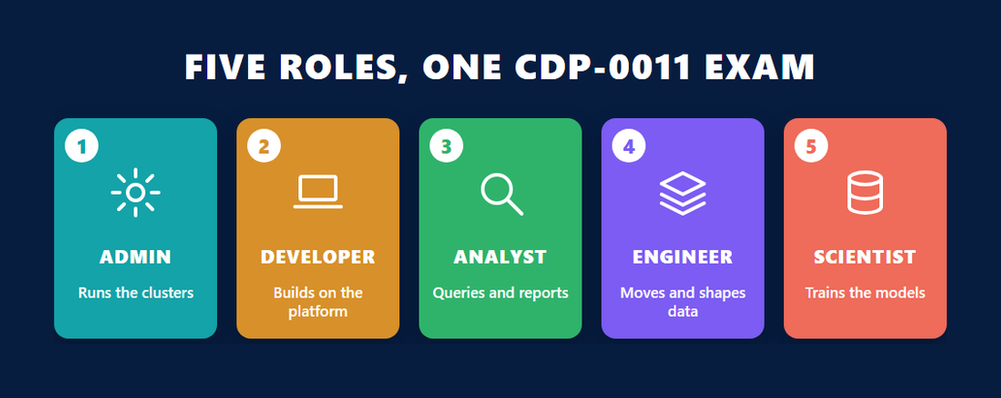
The Cloudera Generalist certification is Cloudera’s broad platform exam, code CDP-0011. It tests general knowledge of Cloudera rather than the depth of one job, and Cloudera lists five audiences for it: administrators, developers, data analysts, data engineers and data scientists. It suits an experienced professional proving platform breadth or a newcomer starting an enterprise data career.
Cloudera’s catalogue now calls the credential simply Cloudera Generalist. The money-site syllabus page and many older resources still use the earlier name, Cloudera CDP Generalist, from the period when the platform was branded Cloudera Data Platform. Both names refer to the same exam, and the code CDP-0011 has not changed.
What sets it apart is scope, not difficulty. A role exam asks how well you can do one job on Cloudera. The Generalist asks whether you understand how the pieces fit together: where a workload runs, which service owns which task, and how security and metadata follow data across environments. A data engineer who has only ever used one service will meet questions about four others.
Why one exam covers five roles
In practice, the five roles share one platform and one governance layer. An analyst querying a warehouse, an engineer scheduling Spark jobs and a data scientist training a model in Cloudera AI all inherit the same Ranger policies and the same Atlas lineage. The Generalist tests that shared ground, which is why Cloudera positions it as applicable across roles rather than as an entry rung below them.
How many questions, how long, and what does CDP-0011 cost?
CDP-0011 has 60 questions in 90 minutes, and the money-site syllabus page lists the price as 330 USD. Cloudera’s own exam guide states a pass score of 60 percent. The exam is delivered online and proctored through Questionmark, no reference material is allowed, and the certification stays valid for two years.
| Field | Value | Where it is published |
|---|---|---|
| Exam code | CDP-0011 | Money-site syllabus page and Cloudera’s exam guide |
| Credential | Cloudera Generalist (earlier: Cloudera CDP Generalist) | Cloudera’s catalogue; the older name on the money site |
| Questions | 60 | Both sources agree |
| Duration | 90 minutes | Both sources agree |
| Pass score | 60 percent | Cloudera’s exam guide (the money site says only pass or fail) |
| Price | 330 USD | Money-site syllabus page; Cloudera’s guide does not state it |
| Delivery | Online, proctored, through Questionmark; no test centers | Cloudera’s exam guide and certification FAQ |
| Allowed resources | None | Cloudera’s exam guide |
| Validity | 2 years | Cloudera’s certification FAQ |
| Retake wait | 7 calendar days after a failed attempt, each attempt paid in full | Cloudera’s certification FAQ |
What the 60 percent pass mark means in questions
On 60 questions, a 60 percent pass mark works out to 36 correct answers, so you can miss 24 and still pass. That margin is generous, but it is spread across five domains of near-equal weight, so a candidate who knows two domains deeply and three not at all will not reach it. Cloudera publishes the figure on the official Generalist exam guide, alongside the topic table this article follows.
Results appear on screen and by email as soon as you submit, with a breakdown by topic. Cloudera does not let you review specific questions afterwards, so the topic breakdown is the only feedback you get if a retake is needed.
Which five domains does CDP-0011 cover, and how are they weighted?
CDP-0011 covers five domains: Cloudera Deployments at 16 percent, Cloudera Runtime Concepts at 20 percent, Cloudera on Cloud Concepts at 20 percent, Cloudera Shared Data Experience (SDX) at 22 percent, and Data Services at 22 percent. The money-site syllabus page and Cloudera’s exam guide list the same domains, sub-topics and weights.
| Domain | Weight | Sub-topics |
|---|---|---|
| Cloudera Deployments | 16% | Cloudera on cloud; Cloudera Base on premises; Cloudera Data Services on premises |
| Cloudera Runtime Concepts | 20% | Yarn; Data Access; Operational Database; Streams Messaging & Stream Analytics; Open Data Lakehouse; Replication Manager; Virtual Private Cluster |
| Cloudera on Cloud Concepts | 20% | Data Catalog; Cloudera Observability; Management Console; Data Hub |
| Cloudera Shared Data Experience (SDX) | 22% | Apache Ranger; Apache Atlas; Apache Knox; Cloudera Data Catalog |
| Data Services | 22% | Cloudera Data Engineering; Cloudera Data Warehouse; Cloudera Operational Database; Cloudera AI; Cloudera Data Flow |
Three things stand out in that table. No domain is above 22 percent, so there is no single area to bank on. The smallest domain, deployments, is also the one every other domain depends on, because a question about Data Hub or Replication Manager often hides a question about where the cluster runs. And Data Catalog appears twice, once under on cloud concepts and once under SDX, which is a hint that the exam treats it as both a cloud service and a governance tool.
The fastest way to see how those topics turn into questions is to work through the Cloudera Generalist sample questions, which are written as short business scenarios: a team losing capacity to other jobs, a bank replacing cron scripts, a partner needing one hardened entry point. Each one names a situation and asks which component solves it, which is the shape of the real exam.
Cloud, Base and Data Services on premises
The deployments domain asks you to tell three form factors apart. Cloudera on cloud runs in a public cloud account that Cloudera’s control plane manages. Cloudera Base on premises is the classic cluster in your own data center. Cloudera Data Services on premises brings the containerised data services to your own hardware. Cloudera’s product leadership describes the goal behind running all three in plain terms:
“Our customers no longer accept trade-offs. They want the flexibility of the cloud, the control of the data center, and the ability to scale without disruption.”
For the exam, that sentence is the domain in miniature. Expect questions that describe a constraint, such as data that must stay in a specific country or a workload that spikes at month end, and ask which form factor fits.
Why do SDX and the data services carry 44 percent of the exam?
SDX and Data Services carry 44 percent of CDP-0011 because together they describe what makes Cloudera one platform rather than a bundle of tools. SDX is the shared security, governance and metadata layer that follows data everywhere, and the five data services are the workloads that run on top of it. A generalist must know both.
The four parts of SDX
- Apache Ranger defines and enforces access policies, including row-level filtering and column masking, and keeps an audit trail of who accessed what.
- Apache Atlas records metadata, classification and lineage, so you can trace a column back to the source that produced it.
- Apache Knox is the perimeter gateway, giving outside users a single hardened entry point instead of direct access to cluster nodes.
- Cloudera Data Catalog lets users search and understand datasets across environments, built on the metadata Atlas holds.
Ranger is worth reading about at the source, because the exam tests what it does rather than how to click through it. The Apache Ranger project describes itself as a framework to enable, monitor and manage comprehensive data security across the Hadoop platform, which is exactly the role SDX gives it. Atlas sits beside it, and the Apache Atlas project site explains the classification and lineage model that Data Catalog builds on.
The classic trap is confusing the four. A question about restricting which rows a role can see is Ranger. A question about where a dataset came from is Atlas. A question about exposing services to partners over the internet is Knox. A question about finding a dataset without knowing which environment holds it is Data Catalog.
The five data services, one job each
| Data service | The job it does | A scenario that points to it |
|---|---|---|
| Cloudera Data Engineering | Runs and schedules Spark jobs on isolated compute, with job history | Nightly ETL launched from a cron entry on an edge node |
| Cloudera Data Warehouse | Self-service SQL analytics on virtual warehouses | Analysts needing fast BI queries without sharing compute |
| Cloudera Operational Database | Low-latency reads and writes at scale | An application serving per-customer records in real time |
| Cloudera AI | Building, training and deploying machine learning models | A data science team that needs governed notebooks and model serving |
| Cloudera Data Flow | Moving and streaming data, including from edge devices | Sensor readings collected on a factory floor |
Questions in this domain rarely ask for a definition. They describe a problem and offer four services, two of which sound plausible. The way through is to ask what the workload actually is: batch transformation, interactive SQL, row-level serving, model work or data movement.
What do the Runtime and on cloud domains ask you to tell apart?
The Runtime and on cloud domains, 40 percent of CDP-0011 together, test whether you can pick the right component for a described situation. Runtime covers what runs inside a cluster, such as YARN scheduling, replication and Virtual Private Clusters. On cloud concepts covers the services that manage environments: Management Console, Data Hub, Observability and Data Catalog.
Runtime concepts that get confused
- YARN preemption versus speculative execution. Preemption reclaims containers from a lower-priority queue when a higher-priority queue falls below its guaranteed share. Speculative execution reruns slow tasks. Only one of them solves a starved queue.
- Virtual Private Cluster versus copying data. A Virtual Private Cluster gives a team dedicated compute against the same shared data, with no copy of the data lake.
- Replication Manager versus scripts. Replication Manager replaces hand-written copy jobs between clusters with centrally managed, policy-based replication, which is the usual disaster recovery answer.
- Streams Messaging versus Stream Analytics. One moves event streams, the other processes them as they arrive.
On cloud services that get confused
Management Console is the starting point: it registers cloud credentials, creates environments and shows the health of each one. Data Hub provides clusters built from templates for a specific workload inside an environment. Cloudera Observability reports on workload performance and cost. Data Catalog is the discovery layer. Cloudera’s Management Console documentation is the clearest single place to see how those four relate, and it is one of the documentation areas Cloudera’s exam guide recommends.
A reliable test: if the scenario mentions onboarding, credentials or creating an environment, the answer is Management Console. If it mentions a cluster for a particular workload, it is Data Hub. If it mentions cost or a slow job, it is Observability.
Should your first Cloudera exam be the Generalist or a role exam?
Take the Generalist first if you are new to Cloudera, if your work touches several services, or if you are not yet sure which role you will grow into. Take a role exam first if your job is already clearly one of administration, data engineering, analysis or machine learning, because a role exam proves the depth an employer hiring for that role checks for.
| Your situation | Better first exam | Why |
|---|---|---|
| New to Cloudera, or moving into enterprise data work | Cloudera Generalist | Cloudera positions it for someone just starting an enterprise data career |
| Architect, consultant or pre-sales role spanning several services | Cloudera Generalist | Breadth across deployments, SDX and all five data services is the job |
| Running clusters in your own data center | Cloudera Administrator on premises | Depth on installation and maintenance |
| Administering Cloudera in a public cloud | Cloudera Administrator Cloud | Environment and cloud provider depth |
| Building pipelines and Spark jobs | Cloudera Data Engineer | Engineering depth the Generalist only touches |
| Ingesting and moving data across systems | Cloudera Data Operator | Flow and ingestion depth |
| Writing SQL and building dashboards | Cloudera Data Analyst | Analyst tooling depth |
| Training and deploying models | Cloudera Machine Learning Engineer or Generative AI Engineer | Model and AI system depth |
Is a Cloudera certification worth it? That depends on whether Cloudera runs where you work or where you want to work. Cloudera builds its business around financial services, telecommunications, the public sector and other industries that keep data in their own data centers as well as the cloud, so the credential carries most weight with employers in those sectors. If your target employers run a different stack, the Generalist proves broad data platform literacy but carries less direct weight.
Many candidates take the Generalist and then a role exam within the same two-year validity window. If administration is the next step, the public cloud administrator exam is the natural follow-on, and the breakdown of the CDP-5001 cloud administrator exam shows how much of the Generalist’s on cloud domain carries straight over.
How does online proctoring through Questionmark work on exam day?
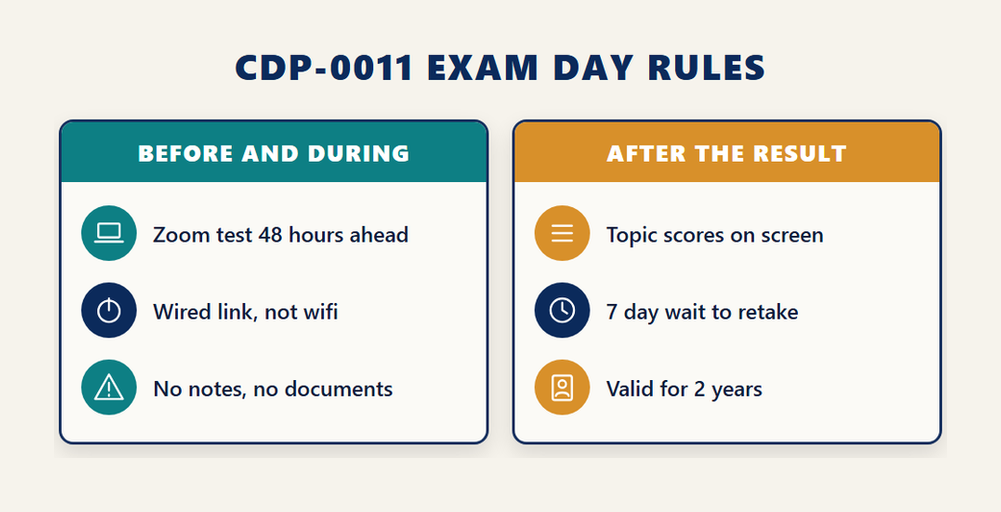
CDP-0011 is taken online only, through Questionmark, with a live proctor watching over webcam, microphone and desktop sharing. There is no test center option. Cloudera asks you to install Zoom and run a system test 48 hours ahead, use a wired connection rather than wifi, and keep a completely clear desk with no notes or reference material.
Before the exam
After purchase, Cloudera University emails instructions for scheduling in Questionmark. Time slots are limited each day, so book early. You can cancel or reschedule up to 24 hours before the start; a no-show forfeits the fee. The start icon becomes active 10 minutes before the appointment.
During the exam
The rules are strict and the proctor enforces them. You must be alone in a silent room, with your face clearly visible and not backlit. No headphones, phones or other devices, no food or drink, no other applications, no screenshots and no breaks. If your connection drops and you reconnect quickly you may continue, but the timer keeps running while you are offline, which is the practical reason for the wired connection.
After the exam
Results appear immediately with a topic breakdown. A failed attempt means waiting seven calendar days, counted from the day after, before you can retake, and every attempt is paid at the full price with no retake discount. A pass cannot be retaken to improve the score. The Cloudera certification FAQ sets out each of these rules, and they apply to every exam in the program, not only the Generalist.
How should you prepare for the CDP-0011 exam?
Prepare for CDP-0011 by working through the five domains in the order the platform is built: deployments first, then Runtime, then on cloud services, then SDX, then the data services. Use Cloudera’s Essentials training and documentation areas for each, then test yourself on scenario questions until you can name the right component without hesitation.
- Learn the three form factors first, Cloudera on cloud, Cloudera Base on premises and Cloudera Data Services on premises, and be able to say which constraint points to each.
- Work through the seven Runtime sub-topics, writing one sentence for each on the problem it solves, starting with YARN queues and preemption.
- Map the on cloud services in order: Management Console to create an environment, Data Hub to run a workload in it, Observability to watch it, and Data Catalog to find data across it.
- Study SDX by contrasting Ranger, Atlas, Knox and Data Catalog side by side until each scenario has exactly one answer.
- Match each of the five data services to a workload type, using batch, SQL, serving, models and data movement as the five labels.
- Finish with timed scenario practice at 90 seconds a question, and review every miss against the domain it came from.
Cloudera’s exam guide names Cloudera Essentials as the suggested course and lists the documentation areas worth reading: Management Console, Cloudera on Cloud, Open Data Lakehouse, Data Services, Streams Messaging, Streaming Analytics, Observability, Data Hub and governance concepts. That list maps closely to the domain table, so it doubles as a checklist.
For a compact view of the topics and question style in one place, the existing CDP-0011 topics and questions page on this site works well as a final review sheet once the documentation reading is done.
Hands-on time helps, but it is not required in the way it is for the administrator exams. Because the Generalist asks which component fits a situation rather than how to configure it, clear mental models of each service matter more than hours at a terminal.
Frequently Asked Questions
How many questions are on the Cloudera Generalist exam?
The CDP-0011 exam has 60 questions, and you have 90 minutes to answer them. Both Cloudera’s exam guide and the money-site syllabus page give the same figures.
What is the passing score for CDP-0011?
Cloudera’s exam guide states a pass score of 60 percent, which is 36 correct answers out of 60. Some third-party pages describe the exam only as pass or fail, but Cloudera publishes the 60 percent figure.
How much does the Cloudera Generalist certification cost?
The money-site syllabus page lists the exam at 330 USD. Every retake is charged at the full price, because Cloudera offers no retake discount.
Is CDP-0011 the same as the Cloudera CDP Generalist exam?
Yes. Cloudera now calls the credential Cloudera Generalist, while older resources and the money site still use Cloudera CDP Generalist. The exam code CDP-0011 is the same.
Can I take the Cloudera Generalist exam at a test center?
No. Cloudera certification exams are delivered online only, through Questionmark, with a live proctor watching by webcam and desktop sharing.
Can I use documentation during the exam?
No. Cloudera allows no resources at all during the exam, including reference material, white papers and user guides, and you may not open any other application or website.
How long is the Cloudera Generalist certification valid?
Cloudera certifications are valid for two years. When yours expires, you can retake the exam to keep your certification status.
How soon can I retake CDP-0011 if I fail?
You must wait seven calendar days, counted from the day after the failed attempt. There is no limit on attempts, but each one is paid.
Is the Cloudera Generalist certification worth it for beginners?
For someone starting an enterprise data career on Cloudera, yes. Cloudera positions the exam for both experienced professionals and newcomers, and it covers the whole platform rather than one job.
Conclusion
The Cloudera Generalist certification is the one Cloudera exam that tests the whole platform for every role. CDP-0011 is 60 questions in 90 minutes with a 60 percent pass mark, spread over five domains between 16 and 22 percent, so breadth beats depth in any single area. The marks go to candidates who can match a described problem to the right component: Ranger or Atlas, Management Console or Data Hub, Data Engineering or Data Warehouse. Learn the platform in the order it is built, rehearse scenario questions until each has one obvious answer, and set up a wired, quiet room before booking. Take it first if your work spans services or your path is still open, then add a role exam within the two-year validity window.


