Prepare for A00-480 the way you would prepare for any other SAS exam and you will study the wrong thing. Not one of its 5 objectives names a SAS procedure, a Viya interface or a line of code. The SAS statistics for machine learning certification, formally SAS Certified Associate: Applied Statistics for Machine Learning, tests whether you understand sampling, hypothesis tests, linear and logistic regression, honest assessment, regularization and cross-validation well enough to build models that survive new data. It is the one SAS credential that is about the statistics rather than the tool.
There is a second thing the credential page does not say loudly. Passing A00-480 earns an Associate badge; SAS awards the Specialist title, SAS Certified Specialist: Statistics for Machine Learning, only once you also hold the Modeling Using SAS Visual Statistics associate credential (exam A00-485). AnalyticsExam lists A00-480 as 60 questions in 105 minutes with a 68 percent pass mark for $120 USD. This article walks the 5 weighted objectives, explains why logistic regression carries the most marks, separates explanatory from predictive modeling the way the exam does, and sets out a six week order of study.
What Does the SAS Statistics for Machine Learning Certification Actually Prove?
The SAS statistics for machine learning certification proves that a candidate can reason statistically about a predictive model: describe and sample data correctly, test a hypothesis, fit and diagnose a linear regression, build and score a logistic regression, and explain the bias-variance tradeoff, regularization and cross-validation that machine learning borrows from statistics. A00-480 is the associate-level exam behind that claim.
SAS lists five skill areas on the credential page, and they match the AnalyticsExam syllabus objective for objective: statistics and machine learning, fundamental statistical concepts, explanatory modeling using linear regression, predictive modeling using logistic regression, and the statistical foundations of machine learning. Read that list again and notice what is absent. There is no data step, no CAS action, no Model Studio pipeline. The exam is deliberately platform-light, which is why the recommended course is titled Statistics You Need to Know for Machine Learning rather than anything with Viya in the name.
That makes the credential useful in a way most vendor badges are not. A hiring manager reading it learns that you can explain why a p-value matters in feature selection, why a model that scores well on training data may still be useless, and why an odds ratio of 1.0 means a predictor is doing nothing. Those are the questions that separate a data scientist from someone who can press the train button.
Who the exam is written for
The syllabus assumes a reader who already works with data and wants the statistical reasoning formalized: analysts moving from reporting into modeling, programmers who build pipelines without owning the model choices, and graduates who know the mathematics but have never had to defend a classification cutoff to a business owner. It is not an exam for statisticians who already publish, and it is not a coding exam for SAS programmers.
How Is A00-480 Delivered: Format, Pass Mark, Fee and Validity?
A00-480 is a 60 question exam with 105 minutes to complete it and a passing score of 68 percent, priced at $120 USD and delivered through Pearson VUE. SAS describes the items as multiple choice and short answer, states that the certification expires after 5 years, and bases the current paper on SAS Viya 2022.09 LTS.
| Detail | A00-480 |
|---|---|
| Credential | SAS Certified Associate: Applied Statistics for Machine Learning |
| Questions | 60 (multiple choice and short answer) |
| Time | 105 minutes |
| Passing score | 68 percent |
| Fee | $120, charged in USD worldwide |
| Delivery | SAS and Pearson VUE |
| Software basis | SAS Viya 2022.09 LTS |
| Validity | Expires after 5 years |
| Recommended course | Statistics You Need to Know for Machine Learning |
Sixty questions in 105 minutes is 105 seconds each, which is generous for recall items and tight for the short-answer calculations. Expect to read an output table, a residual plot or a classification table and be asked what it shows: which predictor to drop, whether an assumption holds, what the c-statistic implies. Working through the A00-480 sample questions before you book is the quickest way to see that house style, because the item wording is closer to a statistics tutorial than to a software manual.
Two practical points come from the SAS credential page rather than from the syllabus. The fee is the same $120 in every country, and students and educators qualify for academic discounts on exams. The five year expiry also matters for planning: the Specialist credential that this exam feeds into inherits the renewal clock of its component exams, so sitting A00-480 and A00-485 close together keeps the two expiry dates aligned.
Which Five Objectives Make Up the A00-480 Syllabus?
The A00-480 syllabus has 5 objectives: Statistics and Machine Learning at 9 to 12 percent, Fundamental Statistical Concepts at 17 to 21 percent, Explanatory Modeling Using Linear Regression at 18 to 24 percent, Predictive Modeling Using Logistic Regression at 25 to 31 percent, and Statistical Foundations of Machine Learning at 18 to 24 percent. Together the two regression objectives account for roughly half the paper.
| Objective | Weight | Topic areas |
|---|---|---|
| Statistics and Machine Learning | 9-12% | Relevance of Statistics in Big Data and Machine Learning; Terminology and Vocabulary |
| Fundamental Statistical Concepts | 17-21% | Basics of Statistical Analysis; Descriptive Statistics; Inferential Statistics |
| Explanatory Modeling Using Linear Regression | 18-24% | Correlation and Simple Linear Regression; Multiple Regression and Model Selection; Model Diagnostics |
| Predictive Modeling Using Logistic Regression | 25-31% | Introduction to Predictive Modeling; Categorical Associations; Logistic Regression Model; Model Deployment |
| Statistical Foundations of Machine Learning | 18-24% | Overview of Machine Learning; Data Pre-processing for Machine Learning Models; Model Evaluation, Estimation, and Post-training Tasks |
Objective 1: Statistics and Machine Learning
The smallest objective sets the vocabulary. You describe the ways of obtaining data and the different data types and how each is analyzed, define big data and the smart applications it produces, compare machine learning with classical statistics, and explain why statistics matters in machine learning at all. The terminology sub-area asks you to relate statistical words to their machine learning equivalents, compare variable types and levels of measurement, and use common modeling vocabulary. Expect questions where a target is called a dependent variable in one sentence and a label in the next.
Objective 2: Fundamental Statistical Concepts
This is the classical core. Basics of statistical analysis covers populations against samples, the process of statistical analysis, descriptive against inferential statistics, and sampling methods including event-based sampling. Descriptive statistics covers measures of central tendency, position and dispersion, how to visualize a distribution, why the normal distribution is useful in machine learning, and measures of distribution shape. Inferential statistics covers sampling distributions, confidence intervals, hypothesis tests, the one-sample t test, and why p-values are useful in machine learning.
Objective 3: Explanatory Modeling Using Linear Regression
Three sub-areas build a regression from scatterplot to diagnosis. Correlation and simple linear regression defines explanatory modeling, explores bivariate relationships with scatterplots, contrasts correlation with covariance, uses correlation to find irrelevant and redundant predictors, and explains simple linear regression with OLS estimation, hypothesis tests and model fit. Multiple regression and model selection adds categorical predictors, ANOVA and its relation to regression, interaction effects, model comparison with R-square, adjusted R-square and information criteria, and sequential selection methods. Model diagnostics covers the assumptions of linear regression, residual plots, collinearity and its remedies, and the problems caused by outliers, leverage points and influential observations.
Objective 4: Predictive Modeling Using Logistic Regression
The heaviest objective is covered in its own section below. Its four sub-areas are an introduction to predictive modeling, categorical associations, the logistic regression model, and model deployment.
Objective 5: Statistical Foundations of Machine Learning
The overview defines machine learning, distinguishes supervised, unsupervised, semi-supervised and reinforcement learning, explains neural networks, names common algorithms, and separates data preparation from data preprocessing. The pre-processing sub-area covers common modeling difficulties, the challenge of visualizing big data, diagnosing and correcting errors, missing values and outliers, why and how to transform inputs, high dimensional data and feature engineering, and feature scaling. The final sub-area, model evaluation, estimation and post-training tasks, is where signal and noise, cross-validation, bootstrap aggregation, coefficient shrinkage, L1, L2 and L12 regularizations, estimation criteria, parameters against hyperparameters, and model interpretability all live.
Why Does Logistic Regression Carry the Most Marks?
Logistic regression carries 25 to 31 percent of A00-480 because it is the bridge between the statistics in the first half of the syllabus and the machine learning in the second. It is the first model on the paper that is built to predict rather than to explain, so it introduces honest assessment, data partitioning, the bias-variance tradeoff and scoring in one place.
The objective opens with the predictive modeling ideas that every later algorithm reuses. You compare explanatory and predictive modeling, define honest assessment through data partitioning, explain how different time frames enter a predictive model, describe how to optimize model complexity for prediction, and explain the bias-variance tradeoff. None of that is specific to logistic regression, which is the point: SAS teaches the discipline on the simplest predictive model so that it carries over to trees and gradient boosting later in the track.
Categorical associations before the model
Before fitting anything you are expected to measure association between categorical predictors, define and use Cramer’s V statistic, and interpret odds ratios. The odds ratio is the single most examinable idea in the objective because it appears twice: once as a descriptive association and again as the exponentiated coefficient of the fitted model.
The model itself
The logistic regression sub-area asks you to define the model, define odds and log odds, describe maximum likelihood estimation, interpret coefficients, assess fit, use categorical predictors, explain interaction effects, compare models using concordant and discordant pairs, the c-statistic and information criteria, and describe sequential model selection. Notice the deliberate echo of the linear regression objective: categorical predictors, interactions, information criteria and sequential selection appear in both, and a well-set question will ask what changes when the target becomes binary.
Deployment is on the paper
The objective ends with model deployment: how a logistic regression model is deployed, how it is scored, and what the classification cutoff does to a scored probability. That last topic is the one candidates from a pure statistics background most often get wrong, because the cutoff is a business decision about the cost of false positives and false negatives, not a property of the model. A model with a strong c-statistic can still be deployed badly at the wrong cutoff.
Explanatory Versus Predictive Modeling: The Distinction the Exam Keeps Returning To
A00-480 draws one line through the whole syllabus: explanatory modeling asks whether a relationship is real and what its size is, predictive modeling asks whether a scored output will hold up on data the model has never seen. Linear regression is taught as the explanatory case and logistic regression as the predictive case, and the diagnostics differ accordingly.
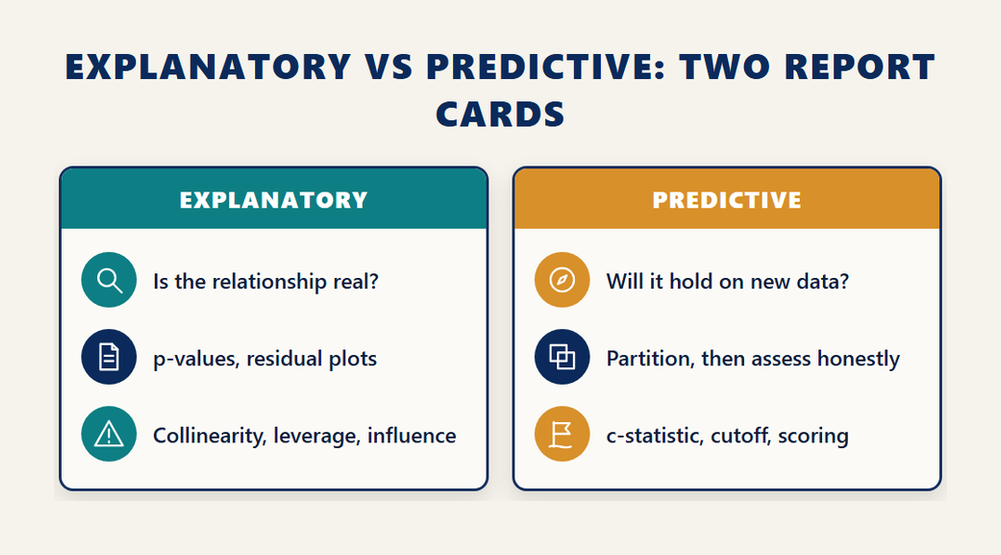
On the explanatory side the tools are inferential. You test the regression hypothesis, read p-values for individual predictors, check residual plots against the assumptions, and look for collinearity, leverage and influence because any of them can make a coefficient estimate meaningless even when the overall fit looks fine. The NIST handbook’s treatment of model validation beyond R-square is a good independent read on exactly the point the syllabus makes: a high R-square is not evidence that the model’s assumptions hold.
On the predictive side the tools are about honesty. You partition data so that the assessment is made on observations the model did not train on, you choose complexity to minimise error on that held-out data rather than on the training set, and you compare models by concordance and the c-statistic rather than by how well they explain the sample. The same regression family therefore gets two different report cards depending on the question being asked, and A00-480 expects you to know which report card applies.
Why the exam insists on the difference
Because most real failures come from mixing the two. A predictor that is statistically significant in a sample may add nothing to out-of-sample accuracy; a model that predicts well may contain coefficients no one can interpret. The syllabus topic “compare and contrast explanatory and predictive modeling” sits at the head of the heaviest objective for that reason, and the time-frame topic beside it, which asks how different time frames enter a predictive model, is the practical form of the same idea: you train on the past and score the future.
Where Does Classical Statistics End and Machine Learning Begin on This Exam?
On A00-480 the boundary falls inside objective 5. Classical statistics supplies estimation, inference and the regression models; machine learning adds the learning process, the split between parameters and hyperparameters, resampling through cross-validation and bootstrap aggregation, and the regularization penalties that trade a little bias for a lot less variance. The exam treats these as extensions of statistics, not replacements for it.
The overview sub-area is definitional. You define machine learning, separate supervised, unsupervised, semi-supervised and reinforcement learning, explain what a neural network is, and name the common algorithms. This is the only place the syllabus goes beyond regression models, and it does so by name rather than by mechanics; you will not be asked to derive backpropagation.
Pre-processing is where the marks hide
The pre-processing sub-area is longer than it looks. It covers the common difficulties of modeling data for machine learning, why big data is hard to visualize, diagnosing and correcting errors, missing values and outliers, why input variables get transformed and the simple transformations used, the problems of high dimensional data and feature engineering as the remedy, and feature scaling. Candidates who have only ever handed clean tables to an algorithm should budget real time here, because the questions are about judgement: which transformation, which imputation, and why scaling matters to some algorithms and not to others.
Evaluation and the words that get mixed up
The final sub-area carries the vocabulary that trips up self-taught practitioners. Signal and noise. Cross-validation and bootstrap aggregation, which are resampling methods with different jobs: one estimates generalisation error, the other builds an ensemble. Coefficient shrinkage and why it helps. L1, L2 and L12 regularizations, which you should be able to tell apart by what they do to a coefficient. The learning process and estimation criteria. Parameters against hyperparameters. Model interpretability. If you want a platform-neutral reference for the resampling half, the scikit-learn cross-validation guide explains k-fold, stratified and time-series splits in the same terms the syllabus uses, and the ideas transfer to SAS Viya unchanged.
How Does A00-480 Combine With A00-485 to Make the Specialist Credential?
SAS awards SAS Certified Specialist: Statistics for Machine Learning to candidates who hold both SAS Certified Associate: Applied Statistics for Machine Learning (A00-480) and SAS Certified Associate: Modeling Using SAS Visual Statistics (A00-485). There is no separate Specialist exam. A00-480 supplies the statistical reasoning; A00-485 supplies the hands-on modeling in SAS Visual Statistics.
That stacking explains why A00-480 feels incomplete on its own. It is the theory half of a two-part credential. The Specialist credential page states the combination rule and adds one exemption: candidates who already hold SAS Certified Specialist: Visual Modeling using SAS Visual Statistics 8.4 on SAS Viya do not need to take the A00-485 exam. For everyone else the second paper is a 55 to 60 question, 110 minute exam at the same 68 percent pass mark and the same five year expiry, based on SAS Viya 2025.03 LTS, and it gives 41 percent of its marks to building and assessing regression-type models. The A00-485 exam topics are worth reading before you decide the order, because the regression you learn statistically in A00-480 is the regression you then build in Visual Statistics.
The order to sit them
Sit A00-480 first. Its syllabus is the explanation of everything A00-485 asks you to click through, and the odds ratios, c-statistics and residual diagnostics you interpret in Visual Statistics are precisely the items you are tested on here. Candidates who do it the other way round tend to pass A00-485 by pattern recognition and then struggle with the short-answer statistics on A00-480.
A00-240 is a different credential
Search traffic for the statistical business analyst credential lands on pages about this exam often enough to be worth a paragraph. A00-240 is SAS Statistical Business Analysis Using SAS 9 (Regression and Modeling), a separate credential on the SAS 9 platform. It shares the regression and modeling subject matter but it is not part of the Statistics for Machine Learning path, it is not based on SAS Viya, and passing it does not count toward the Specialist title. If your goal is the machine learning track, A00-480 and A00-485 are the two codes that matter.
Who Should Sit A00-480, and How Should You Prepare in Six Weeks?
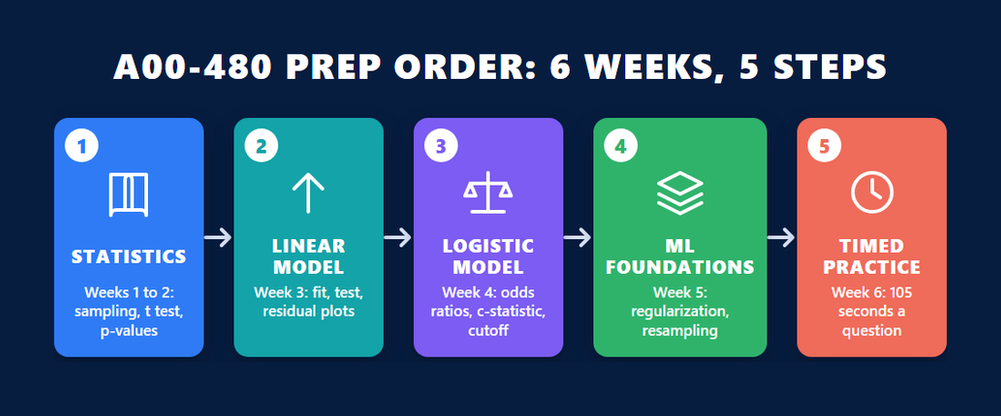
A00-480 suits analysts and programmers who already use SAS Viya and want the statistical foundations behind its models made explicit, and it suits anyone building toward the Specialist credential or the supervised machine learning exam that follows it. Six weeks is realistic for a working candidate: two on classical statistics, two on the regression objectives, one on the machine learning foundations and one on practice.
If you already run gradient boosting pipelines and your interest is production modeling rather than statistical reasoning, read the supervised machine learning pipelines path first, because A00-406 is the credential that tests what you do all day. Most readers of this article are not in that position: they can build a model and cannot yet defend its statistics, and A00-480 is the exam that closes that gap.
A six week preparation order
- Weeks 1 and 2: work through objective 2 in full, from populations and sampling to the one-sample t test, and write out in your own words why p-values are useful in machine learning.
- Week 3: fit, test and diagnose a multiple linear regression with at least one categorical predictor and one interaction, then read its residual plots for collinearity, leverage and influence.
- Week 4: build a logistic regression on partitioned data, interpret every odds ratio, compare two models by c-statistic and information criteria, and choose a classification cutoff for a stated cost of error.
- Week 5: cover objective 5 by contrast, writing a one-line distinction for each pair the syllabus names: parameter and hyperparameter, cross-validation and bootstrap aggregation, L1 and L2 regularization, data preparation and data preprocessing.
- Week 6: sit timed practice at 105 seconds a question, review every miss against the syllabus topic line it belongs to, and reread objective 1 vocabulary the day before the exam.
The retake rules to know before you book
The SAS certification FAQ allows up to five attempts at an exam in any 12 month period with at least 14 days between attempts, and every attempt is charged. Once you pass, no further attempts on that exam are allowed unless the credential expires, in which case the associated exams can be retaken after one year. A first attempt that misses 68 percent therefore costs you two weeks and another $120, not the credential.
Frequently Asked Questions
Is A00-480 a SAS programming exam?
No. The syllabus names no SAS procedure, interface or code. It tests statistical reasoning: sampling, inference, linear and logistic regression, honest assessment, pre-processing, regularization and cross-validation.
How many questions does A00-480 have and how long is it?
60 questions in 105 minutes, with a passing score of 68 percent. SAS describes the items as multiple choice and short answer.
How much does the A00-480 exam cost?
$120, charged in USD in every country. Students and educators qualify for academic discounts on SAS certification exams.
Does passing A00-480 make me a SAS Certified Specialist?
No. A00-480 earns SAS Certified Associate: Applied Statistics for Machine Learning. The Specialist title, Statistics for Machine Learning, is awarded once you also hold the Modeling Using SAS Visual Statistics associate credential from exam A00-485.
Which objective is worth the most on A00-480?
Predictive Modeling Using Logistic Regression, at 25 to 31 percent. The two regression objectives together are roughly half the paper.
How long is the certification valid?
SAS states that the certification expires after 5 years.
Is A00-480 the same as the SAS Statistical Business Analyst exam?
No. The statistical business analyst credential is A00-240, SAS Statistical Business Analysis Using SAS 9 (Regression and Modeling), a separate SAS 9 credential that does not count toward the Statistics for Machine Learning Specialist title.
Do I need linear algebra or calculus for A00-480?
The syllabus does not list them. It asks you to describe maximum likelihood and OLS estimation and to interpret their outputs, not to derive them.
What happens if I fail A00-480?
SAS allows up to five attempts in a 12 month period with at least 14 days between attempts, and each attempt is charged the exam fee.
Conclusion
The SAS statistics for machine learning certification is the only SAS exam that asks you to think like a statistician rather than operate a product, and that is its value. A00-480 puts half its marks on the two regression objectives, a quarter on classical statistics and a fifth on the ideas machine learning adds: honest assessment, regularization, resampling and the parameter-hyperparameter split. It costs $120, runs 60 questions in 105 minutes at a 68 percent pass mark, and stays valid for 5 years. Treat it as the first half of the Specialist credential, sit it before A00-485, and prepare in the syllabus order: statistics, linear regression, logistic regression, then the machine learning foundations. Start with the sample questions to learn the item style, then give the logistic regression objective the weeks it deserves.


