Search Cloudera’s certification catalogue for a data scientist credential and you will not find one. Nine exams are listed, and the only one written for people who train and ship models is the Cloudera Machine Learning Engineer certification, exam code CDP-6001, which AnalyticsExam still titles Cloudera CDP Machine Learning Engineer. It is 45 questions in 90 minutes, 60 percent to pass, $330 through Cloudera’s own store, delivered online under a live proctor and nowhere else.
There is a second thing to know before you open a study plan. The heaviest domain, worth 31 percent, is named after a product called Cloudera Machine Learning. Open Cloudera’s documentation today and the same product is called Cloudera AI, and its workbench is the Cloudera AI Workbench. The exam guide was written under the old name, the documentation now uses the new one, and the questions sit in between. This article covers what the exam costs and tests, how its five domains are weighted, which name maps to which screen, what the Spark and deployment questions expect, who the credential is written for, what the role pays, and how to prepare in an order that follows the weightings.
Is There a Cloudera Data Scientist Certification?
No. Cloudera’s certification catalogue has no data scientist exam. The Cloudera Machine Learning Engineer certification, CDP-6001, is the credential Cloudera offers to anyone who builds, tunes and deploys models on its platform, and it is the exam a data scientist on Cloudera would sit. The catalogue lists it as Cloudera Machine Learning Engineer; the exam guide calls it CDP Machine Learning Engineer; AnalyticsExam calls it Cloudera CDP Machine Learning Engineer.
The three names describe one exam with one code. Cloudera dropped the CDP prefix from its catalogue titles while keeping it in the codes, so CDP-6001 appears beside Cloudera Generalist, Cloudera Data Engineer and the two administrator exams. The guide’s audience statement is the clearest description of who the exam is for: a machine learning engineer who designs and develops models using MLOps and Cloudera Machine Learning, with a strong grasp of data modeling and data science concepts, deploying and tuning models, Spark, Spark MLlib, algorithms and general machine learning.
Read that list again and notice the order. Platform and MLOps come first, Spark second, algorithms last. The weightings in the next sections follow the same order, which is why a candidate with a strong statistics background and no Cloudera time is the one most likely to be surprised.
What Does the Cloudera Machine Learning Engineer Certification Cost and Cover?
CDP-6001 costs $330, runs 90 minutes and has 45 questions with a 60 percent pass mark. It is delivered online only, proctored live through Questionmark, with no reference material of any kind allowed. The two Cloudera courses that cover the content are optional. A pass is valid for two years, and the certification is for Cloudera Machine Learning Engineer, under whichever of its three titles you meet.
| Item | CDP-6001 |
|---|---|
| Exam name | Cloudera CDP Machine Learning Engineer (catalogue: Cloudera Machine Learning Engineer) |
| Exam code | CDP-6001 |
| Questions | 45 |
| Duration | 90 minutes |
| Passing score | 60 percent |
| Price | $330 USD |
| Delivery | Online, live proctored through Questionmark; no test centres |
| Allowed resources | None |
| Suggested training | Predicting with Cloudera Machine Learning (ILT and OnDemand); CDP Data Visualization Training (OnDemand only), both optional |
| Validity | Two years |
Two of those rows deserve a second look. The 60 percent pass mark is published by Cloudera on the CDP-6001 exam guide itself, which is not true of every Cloudera exam, so there is no guessing involved: 27 correct answers out of 45 is the line. And the price is the only figure that does not appear on the guide; it is on the Cloudera Education store page where the exam is bought, and a retake costs the full amount again.
What the question style looks like
The questions are scenario items set inside a named company, with four or five options and the occasional choose-two. The scenarios are short and the distractors are specific: one option names the right Cloudera feature for the wrong purpose, another names the right purpose for the wrong feature. That shape rewards candidates who have clicked through a workbench, not candidates who have memorised a feature list.
How Are the Five CDP-6001 Domains Weighted?
CDP-6001 has five domains. Cloudera Machine Learning carries 31 percent, Spark MLlib 22, Spark 18, Deploying a Machine Learning Model 18, and Deep Learning and General Machine Learning 11. The platform domain alone is nearly a third of the exam, Spark and MLlib together are 40 percent, and the general machine learning theory that most candidates already know is the smallest share.
| Domain | Topics listed | Weight |
|---|---|---|
| Cloudera Machine Learning | Workspaces; Projects; Experiments; Accelerators for ML Projects; Data Visualizations; Runtimes; GPUs | 31% |
| Spark | DataFrames; File Types; Window Functions | 18% |
| Spark MLLib | Model Selection and Tuning; Fitting and Evaluating Models; Pipelines | 22% |
| Deploying a Machine Learning Model | Applications/API; Autoscaling and Performance; Model Metrics and Monitoring; ML Flow | 18% |
| Deep Learning and General Machine Learning | General Machine Learning; Supervised and unsupervised learning; Algorithms | 11% |
Rounded to 45 questions, the weights translate to roughly 14 platform items, 10 on MLlib, 8 on Spark, 8 on deployment and 5 on general theory. A candidate who knows the platform and Spark cold can miss every theory question and still clear 60 percent; a candidate who knows only theory cannot pass. The published CDP-6001 sample questions show the mix in practice: items on runtimes, workspace quotas and data visualizations outnumber the ones on validation sets and algorithms.
Reading the platform domain
Seven topics sit under Cloudera Machine Learning, and they are the seven things a user does in the workbench in order. A workspace is provisioned by an administrator and holds projects and a shared compute quota. A project holds code, sessions, jobs and collaborators. An experiment records training runs and their metrics. Accelerators for ML Projects, called AMPs in the product, are complete reference projects built by Cloudera’s research arm, Fast Forward Labs, that install from a catalogue. Data Visualizations build shareable dashboards without leaving the project. Runtimes bundle an editor, a kernel and a library edition into one selectable image. GPUs are requested per session or job through a resource profile. Expect a question or two on each.
Why Does the Syllabus Say Cloudera Machine Learning When the Docs Say Cloudera AI?
Because the product was renamed after the exam guide was written. CDP-6001’s largest domain is titled Cloudera Machine Learning, and the sample questions abbreviate it to CML. Cloudera’s current documentation and product pages call the same service Cloudera AI, its workbench Cloudera AI Workbench, and the documentation URL path still reads machine-learning. Nothing in the domain changed; only the labels did.
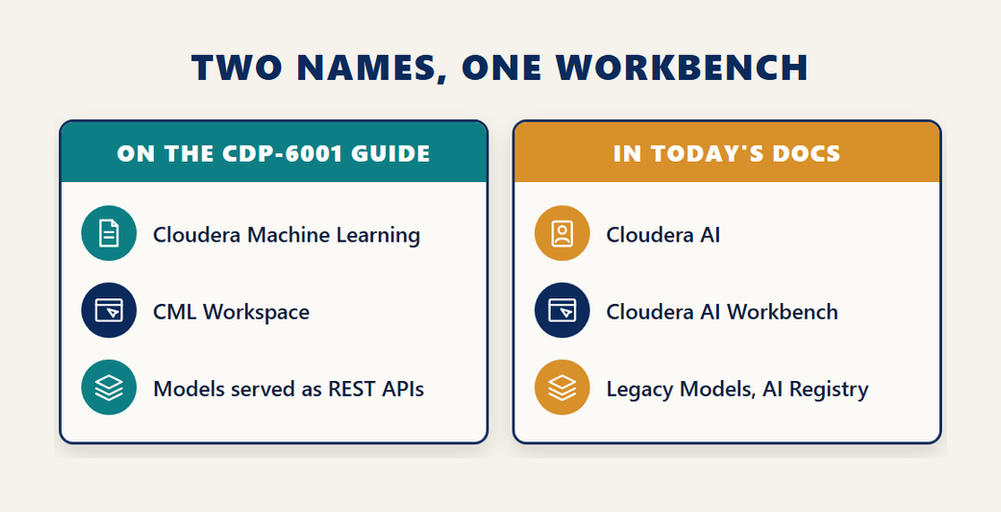
This matters for one practical reason: the search terms in your head will not match the page titles in front of you. The Cloudera AI documentation is the right reference for every topic in the 31 percent domain, and it opens with the line that Cloudera AI is Cloudera’s cloud-native machine learning platform. Within it, the names map as follows.
| On the exam guide and syllabus | In the current documentation |
|---|---|
| Cloudera Machine Learning (CML) | Cloudera AI |
| CML Workspace | Cloudera AI Workbench |
| Runtimes | ML Runtimes (unchanged) |
| Accelerators for ML Projects | Cloudera Accelerators for Machine Learning Projects (AMPs) |
| Data Visualizations | Cloudera Data Visualization inside Cloudera AI |
| Models (Applications/API) | Models in the workbench, now described as Legacy Models, with Cloudera AI Registry and Cloudera AI Inference recommended for new production deployments |
The last row is the one to be careful with. The exam guide’s deployment domain describes models served from inside the workbench as REST APIs with autoscaling and metrics, and the documentation still describes exactly that feature, but it now labels it the previous generation and points new production work to the AI Registry and the AI Inference service. The exam has not been rewritten around those newer services. Study the workbench model feature the guide names, know that the documentation calls it legacy, and do not assume a question about the registry unless the guide is updated.
What Does the Spark Half of CDP-6001 Expect?
Spark and Spark MLlib together make up 40 percent of the Cloudera Machine Learning Engineer certification. The Spark domain covers DataFrames, file types and window functions; the MLlib domain covers pipelines, fitting and evaluating models, and model selection and tuning. These are PySpark coding questions in scenario form: which operation, which storage level, which file format, which evaluator, which parameter grid.
Spark: 18 percent
The three listed topics are narrower than they look. DataFrames questions test transformations that candidates get wrong under pressure: a groupBy with a pivot to turn months into columns, the difference between cache and persist with an explicit storage level, when a join should be broadcast. File types means knowing what Parquet, ORC, Avro, CSV and JSON are each good for, down to which columnar format carries lightweight indexes that let a reader skip row groups. Window functions means ranking, lag and lead, and running totals partitioned by a key, the operations that turn an event log into model features.
Spark MLlib: 22 percent
This is the second largest domain and the one most purely about code. The Apache Spark MLlib guide organises the DataFrame-based API around exactly the three listed topics: pipelines made of transformers and estimators, fitting and evaluating with the classification, regression and clustering evaluators, and model selection with cross-validation or train-validation split over a parameter grid. Expect questions on which stage goes where in a pipeline, what an evaluator’s metric name is, how a ParamGridBuilder expands, and why a validation set is held out separately from the test set.
The general machine learning domain, at 11 percent, is where the theory lives: supervised against unsupervised learning, the algorithm families, what overfitting looks like in a learning curve. If you have built models anywhere, this domain is already covered. Spend the time on the other 89 percent.
How Is Model Deployment Tested on the Cloudera ML Engineer Exam?
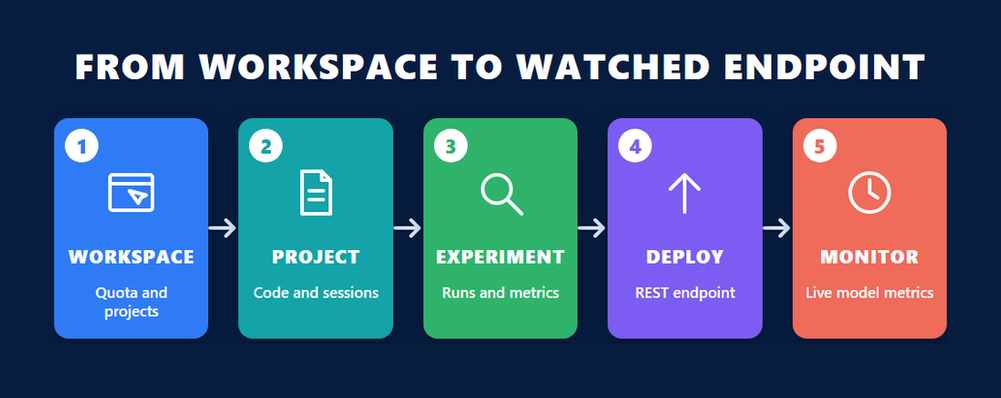
Deploying a Machine Learning Model is 18 percent of CDP-6001 and lists four topics: Applications/API, Autoscaling and Performance, Model Metrics and Monitoring, and ML Flow. In the product, deploying a model means selecting a Python or R function in a project file and having the workbench snapshot the code, package an immutable artifact, expose a REST endpoint and run a chosen number of load-balanced replicas.
That workflow is what the questions are built on. Applications and API items ask what a model endpoint accepts and returns, and how an Application differs from a model: an Application hosts a long-running web app such as a Flask or Streamlit front end inside the project, while a model serves predictions. Autoscaling and performance items ask about replica counts and resource profiles. Metrics and monitoring items draw the line the sample questions draw explicitly: comparing many training runs before deployment is experimentation, tracking one live model version is monitoring. ML Flow refers to the experiment tracking that records parameters and metrics for each run.
“Working with complex data environments every day, we know that moving from AI experimentation to production requires both the freedom to innovate and confidence that data remains governed and under our control”
That move from experimentation to production is the arc of the whole exam: workspace, project, experiment, deployed model, monitored endpoint. A candidate who can describe each hand-off, including which screen it happens on, has covered the platform domain and the deployment domain at once, which is 49 percent of the paper.
Who Should Take CDP-6001, and What Does the Role Pay?
CDP-6001 is written for machine learning engineers and data scientists who already work, or are about to work, on Cloudera. It is not an entry-level credential: the guide expects proficiency in designing and developing models with MLOps, plus Spark and MLlib expertise. Someone fluent in scikit-learn on a laptop but new to Spark and to the Cloudera workbench should budget most of their preparation for the platform and Spark domains.
On pay, PayScale puts the average base salary of a machine learning engineer in the United States at $126,315, with a range from $88,000 to $171,000 across 944 salary profiles updated in October 2026. No source attributes a premium to this credential specifically, and this article will not invent one. What the certification does is document, to an employer running Cloudera, that you can work inside its workbench rather than only around it.
Is the Cloudera certification worth it?
Worth it depends on one question: does your employer, or your next one, run Cloudera? If yes, CDP-6001 is the only machine learning credential on the vendor’s own list, and its platform domain is specific enough that a generic ML certification does not cover it. If no, a cloud vendor’s ML engineer credential will match more job listings. The three CDP-6001 pages BigDataRise already keeps, a syllabus-and-questions page, a Cloudera certification hub and this article, exist because the first answer is more common among its readers than it looks; the CDP-6001 exam topics page is the place to check the domain list again once you have read the guide.
How Should You Prepare for the Cloudera Machine Learning Engineer Exam?
Prepare for CDP-6001 in the order of its weightings: the workbench first, Spark and MLlib second, deployment third, theory last. Six to eight weeks is realistic for someone who already writes PySpark and has a Cloudera environment to practise in; longer without the environment, because 49 percent of the exam is about screens and features you need to have used.
- Read the Cloudera exam guide once and note the two names for every platform feature, old and new, so the documentation search terms match.
- Work through the Cloudera AI documentation for the seven platform topics in the order the syllabus lists them: workspaces, projects, experiments, AMPs, data visualizations, runtimes and GPUs.
- Build one project end to end in a workbench: launch a session on a chosen runtime, log an experiment, deploy the model as a REST endpoint and read its metrics.
- Rebuild your feature code in PySpark DataFrames, covering pivots, window functions, persist levels and the Parquet, ORC and Avro trade-offs.
- Train one MLlib pipeline with a CrossValidator over a parameter grid and an evaluator, and explain each stage without notes.
- Sit the sample questions under a 90 minute clock and keep a list of every feature name you had to guess at.
If you have not yet sat any Cloudera exam, there is a case for taking the Generalist first. It covers the whole platform at a shallower depth, and the Cloudera Generalist certification uses the same Questionmark delivery, the same 60 percent pass mark and the same two-year validity, so it doubles as a rehearsal of the exam process. It is not a prerequisite; nothing is.
How Does Exam Day Work Through Questionmark?
CDP-6001 is taken online through Questionmark with a live proctor on webcam, and there is no test-centre option. Cloudera asks candidates to install Zoom and run a system and bandwidth test 48 hours ahead, use a wired connection rather than wifi, clear the desk, stay alone and on camera for the whole 90 minutes, and open nothing but the exam window.
Results appear on screen and by email as soon as the exam is submitted, with a breakdown by topic but no view of individual questions. The Cloudera certification FAQ sets the retake terms: a failed candidate waits seven calendar days, pays the full fee for each further attempt, and a passed exam cannot be retaken to improve the score. If the connection drops, the clock keeps running while you reconnect. A no-show forfeits the fee. The pass is valid for two years, after which the exam is sat again to keep the status.
Frequently Asked Questions
Does Cloudera offer a data scientist certification?
No. Cloudera’s catalogue has no data scientist exam. The Cloudera Machine Learning Engineer certification, CDP-6001, is the credential for people who build, tune and deploy models on Cloudera, and it is the one a data scientist on the platform would take.
How much does the Cloudera Machine Learning Engineer certification cost?
CDP-6001 costs $330 USD, bought through the Cloudera Education store. A retake costs the full fee again; Cloudera offers no retake discount.
How many questions are on CDP-6001 and how long is it?
45 questions in 90 minutes, with a passing score of 60 percent, which works out to 27 correct answers.
Is CDP-6001 the same as the Cloudera CDP Machine Learning Engineer exam?
Yes. Cloudera’s catalogue now titles it Cloudera Machine Learning Engineer, the exam guide says CDP Machine Learning Engineer, and AnalyticsExam says Cloudera CDP Machine Learning Engineer. All three refer to exam code CDP-6001.
What is the biggest domain on the Cloudera ML Engineer exam?
Cloudera Machine Learning, at 31 percent, covering workspaces, projects, experiments, accelerators for ML projects, data visualizations, runtimes and GPUs. Spark MLlib is next at 22 percent.
Is Cloudera Machine Learning the same as Cloudera AI?
Yes. The exam guide uses the older name Cloudera Machine Learning; Cloudera’s documentation and product pages now call the service Cloudera AI and its workbench the Cloudera AI Workbench. The features tested are the same.
Do I need to take Cloudera training before the exam?
No. The exam guide lists Predicting with Cloudera Machine Learning and CDP Data Visualization Training as suggested courses and states they are optional. There are no certification prerequisites.
Can I take CDP-6001 at a test centre?
No. Cloudera certification exams are delivered online only, through Questionmark with a live webcam proctor.
How long is the Cloudera Machine Learning Engineer certification valid?
Two years. After it expires you may retake the exam to maintain the certification. A passed exam cannot be retaken earlier to improve the score.
Is the Cloudera certification worth it for a machine learning engineer?
It is worth it when your employer or target employer runs Cloudera, because CDP-6001 is the only machine learning credential on Cloudera’s list and its platform domain is not covered by generic ML certifications. If you do not work on Cloudera, a cloud vendor’s ML engineer credential matches more job listings.
Conclusion
The Cloudera Machine Learning Engineer certification is the answer to a search Cloudera’s catalogue cannot otherwise satisfy, and it is a narrower exam than its name suggests. CDP-6001 spends 31 percent on the workbench itself, 40 percent on Spark and MLlib, 18 percent on getting a model served and watched, and only 11 percent on the theory most candidates bring with them. Study the workbench under both of its names, write the PySpark and pipeline code yourself, deploy one model end to end, and sit the sample questions on a clock. Forty-five questions, 90 minutes, 27 right answers and two years of validity are the whole deal; the preparation that earns them is hands on, and it starts with opening a workspace rather than a textbook.


