The Qlik Compose certification is not a dashboard exam. Nothing in its four topics asks you to build a chart, write a load script or design a sheet in Qlik Sense. It is an exam about the plumbing underneath analytics: landing source data, modeling a warehouse, generating the ETL that fills it and keeping the whole pipeline running on a schedule.
That surprises people who know Qlik only for its visual products, and it changes how you should prepare. Qlik weights the exam so that modeling and data integration together carry 64 percent of the score, while administration carries just 12. This guide explains the format, what each topic actually expects, how Compose projects work in practice, and a preparation order that puts your study time where the marks are.
Table of Contents
- What Does the Qlik Compose Certification Prove?
- Who Is the Qlik Compose Exam Written For?
- How Are the Four QCOM Topics Weighted?
- What Does the Architecture Topic Expect You to Know?
- How Does QCOM Test Modeling and Data Marts?
- Why Is Data Integration and Mapping the Largest Topic?
- What Do Administration and Operations Questions Cover?
- How Should You Prepare for the Qlik Compose Certification?
- Retakes, Validity and the Next Credential
- Frequently Asked Questions
- Conclusion
What Does the Qlik Compose Certification Prove?
The Qlik Compose certification, exam code QCOM, shows that you can design, implement and support automated data warehouse and data lake solutions on the Qlik Data Integration Compose platform. The exam has 55 questions in 120 minutes, the pass mark is 70 percent, and the exam fee is $250 USD.
| Exam detail | Value |
|---|---|
| Credential | Qlik Compose Certification |
| Exam code | QCOM |
| Questions | 55 |
| Duration | 120 minutes |
| Passing score | 70% |
| Price | $250 USD |
| Registration | Qlik Learning |
| Topics | Four, with published weightings |
| Validity | 2 years from the date you pass |
| Award | Qlik Compose Certification Exam badge on Credly |
The clock is generous by Qlik standards. One hundred and twenty minutes for 55 questions gives you a little over two minutes each, which is enough time to picture a Compose project and reason through it, but not enough to guess your way through a mapping question you have never met. On paper a 70 percent pass mark means 39 correct answers, with 16 allowed to be wrong.
Qlik adds a caveat on the official Qlik Compose exam page: exam content is updated periodically, the number and difficulty of questions may change, and the passing score is adjusted to keep the standard consistent. Treat the figures above as current rather than permanent, and check the page again before you book.
Who Is the Qlik Compose Exam Written For?
The Qlik Compose exam is written for experienced data warehouse and data lake practitioners. Qlik recommends at least two to three years implementing data warehouse or data lake solutions, a working knowledge of warehouse architectures and every phase of the warehouse development life cycle, and the ability to turn business requirements into a workable design.
That is a senior profile. Three kinds of candidate usually fit it. Data warehouse developers and ETL engineers who already build dimensional models by hand and want to show they can automate the work. Data architects who decide how sources land, how history is kept and how marts are shaped for reporting. And integration consultants who deliver Qlik Data Integration projects for customers and need a credential that matches the platform.
If you have only used Qlik Sense or Qlik Cloud Analytics, expect most of this exam to be new ground. The product sits in a different part of the Qlik portfolio. Qlik bought Attunity, whose technology included change data capture and data warehouse automation, in a deal completed on 6 May 2019. At the time, one analyst described what that combination would mean for customers.
“In the longer term, Qlik customers stand to benefit from an integrated environment incorporating Attunity’s data replication and data warehouse automation functionality.”
That integrated environment is exactly what the exam probes. Replication feeds the landing area, and Compose automates everything after it. The original TechTarget acquisition report gives useful background on why Qlik moved into data management at all.
How Are the Four QCOM Topics Weighted?
The four QCOM topics are Architecture at 24 percent, Modeling at 30 percent, Data Integration and Mapping at 34 percent, and Administration and Operations at 12 percent. Modeling and mapping together carry 64 percent of the exam, so most of your marks depend on how you design a warehouse and how Compose fills it.
| Topic | Weight | Objectives | Approximate questions out of 55 |
|---|---|---|---|
| Architecture | 24% | 4 | About 13 |
| Modeling | 30% | 4 | About 16 or 17 |
| Data Integration and Mapping | 34% | 5 | About 19 |
| Administration and Operations | 12% | 3 | About 6 or 7 |
The question counts are simple arithmetic on the published weights, not figures Qlik releases, so treat them as a planning guide. What matters is the shape. Administration is the smallest topic by a wide margin, yet it is the area many working engineers know best, because it covers scheduling and monitoring they handle every day. The marks are elsewhere.
A useful way to test yourself against that shape is to work through a set of Qlik Compose sample questions early, before you plan your study weeks. If you miss modeling and mapping items, those two topics deserve most of your time.
What Does the Architecture Topic Expect You to Know?
The Architecture topic, 24 percent of QCOM, expects you to identify the components of a Compose data architecture, distinguish the data lake view options, know which storage and processing combinations Compose supports, and explain how Compose and Qlik Replicate work together. It is the conceptual map every later topic builds on.
Two project types, one pipeline idea
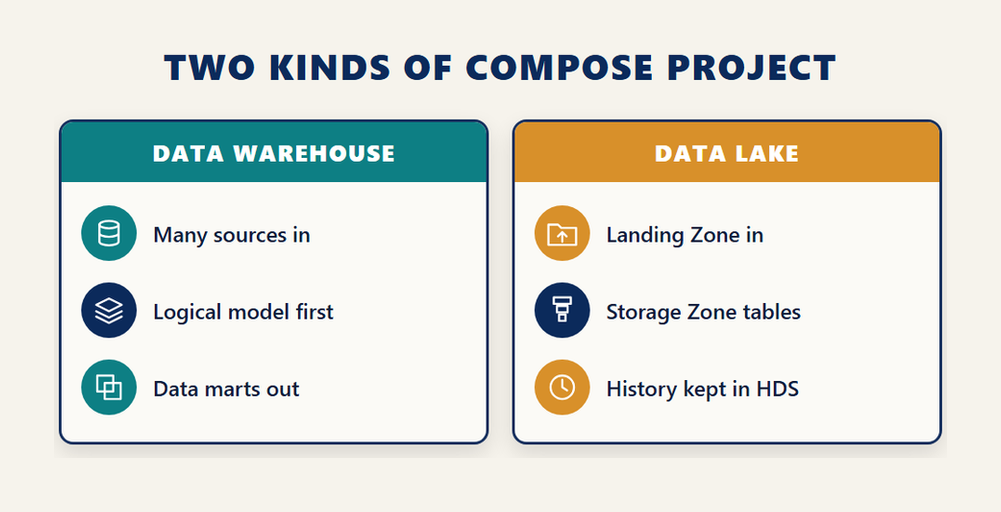
Compose offers two kinds of project, and the exam assumes you know when each applies. A data warehouse project ingests data from multiple sources and produces analytics-ready data marts. A data lake project ingests data from multiple sources and moves it into a storage system for analytics. Qlik’s Compose introduction guide describes both and is the best single page to read before this topic.
The data lake flow has two named stages. In the Land stage, source tables are loaded into the Landing Zone, usually with Qlik Replicate running either a Full Load task or a Full Load and Store Changes task. In the Store stage, Compose generates metadata from the sources, and once the mappings between landing and storage tables are final, it creates and populates the Storage Zone tables in a read-optimized format. Qlik warns that each data lake project must have its own dedicated Storage Zone.
Where Replicate fits
One architecture objective asks how Compose and Qlik Replicate are integrated, and the answer is the division of labour above. Replicate moves and captures changes; Compose designs, generates and runs what happens to that data afterwards. Expect questions that describe a pipeline and ask which product is responsible for a given step.
The data lake side also introduces two storage concepts worth knowing cold. An operational data store holds the current state of each source table. A historical data store appends new, time-stamped rows as updates arrive, which supports Type 2 slowly changing dimensions and time-based analysis.
How Does QCOM Test Modeling and Data Marts?
Modeling is 30 percent of QCOM. It covers building a logical warehouse model in Compose, defining data lake entities, designing data marts, and understanding how the logical model shapes the physical structures Compose creates. Questions reward people who think in models first and let the tool generate tables, rather than people who hand-build tables first.
Logical model first, physical tables second
Compose is built around the idea that you describe the warehouse logically and the product generates the physical structures, the task statements and the documentation. Qlik describes it as working with either a model-driven or a data-driven approach. The exam objective on the logical model’s impact on physical structures tests whether you can predict what a change in the model will do downstream, which is where most real project mistakes happen.
Data marts and star schemas
A data mart in Compose is a subset of the warehouse, and you can create as many as your reporting needs require, for example one per business unit. Each mart can hold several star schemas that reuse the same dimension tables, which saves space and keeps query results consistent. A star schema is a central fact table joined to its dimension tables by a single join path, so each query reads facts through one route.
Compose builds star schemas around three fact types, and the differences are prime exam material:
- Transactional facts let you retrieve the right data even when a dimension holds several versions of the same record.
- Aggregated facts support calculations across fact attributes, such as total freight cost per shipping region and product category.
- State oriented facts carry Type 2 columns in the fact table, for things that move through states over time, such as insurance claims or flight reservations.
Two operational details from the Compose data mart guide are easy to overlook. Editing a dimension expression or column lookup does not change existing data until you reload it, and data warehouse tasks cannot run in parallel with data mart tasks.
Why Is Data Integration and Mapping the Largest Topic?
Data Integration and Mapping is the largest QCOM topic at 34 percent because it is where Compose does its real work. It covers what Compose automates in the ETL for warehouse and lake projects, how to evaluate warehouse mappings and ETL sets, data lake mappings and storage tasks, data transformations, and data cleansing and validation rules.
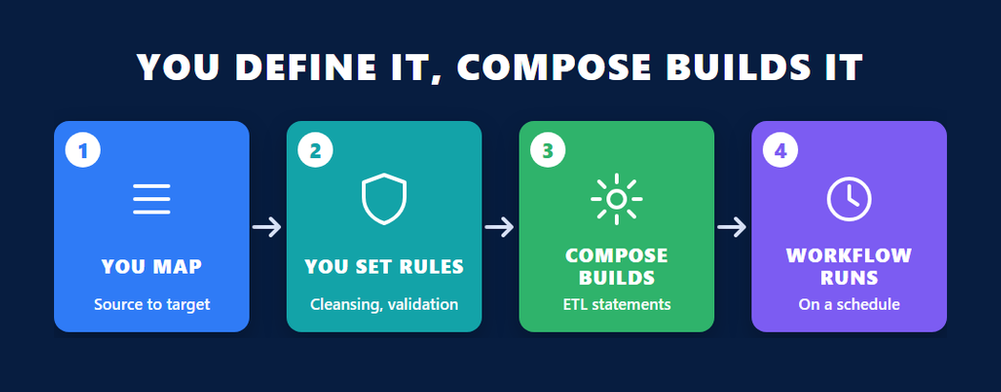
The first objective sets the frame: you need to know what Compose generates for you and what it leaves to you. Compose automates ETL generation and generates the task statements and structures from the model and the mappings. Your job is to define mappings correctly, decide where transformations belong, and set the rules that keep bad data out.
Mappings and ETL sets
Evaluating mappings is a judgement skill rather than a recall one. A question might describe a source table, a target entity and a mapping, then ask whether the result will load correctly or what needs to change. Practise reading mappings the way a reviewer would: check keys, check data types, and check what happens to history.
Transformations, cleansing and validation
Two of the five objectives deal with data quality. Compose lists data profiling and quality enforcement among its features, and the exam expects you to know where a cleansing rule or a validation rule is applied and what happens to a record that fails it. If you have built quality checks in another ETL tool, map that experience onto Compose’s terms rather than assuming the behaviour is identical.
Because this topic alone is worth about a third of the score, give it the most hands-on practice of any. Reading about mappings is not enough. You need to have defined them, run them and fixed them.
What Do Administration and Operations Questions Cover?
Administration and Operations is the smallest QCOM topic at 12 percent. Its three objectives cover defining workflows and scheduling, managing source control and deployment packages, and monitoring operations. Expect roughly six or seven questions, mostly about how a finished Compose project is run, moved between environments and watched in production.
Workflows chain Compose tasks into an order that can be scheduled, so a project that took manual steps to set up can then run on its own. Qlik lists a workflow designer and scheduler, monitoring, notifications and migration between environments among the product’s operational features, and those map almost one to one onto this topic.
Source control and deployment packages are the part most candidates underestimate. Moving a project from development to test to production is a different skill from building it, and the objective asks how you manage that movement. Data marts, for example, can be exported and imported between environments.
How Should You Prepare for the Qlik Compose Certification?
Prepare for the Qlik Compose certification by learning the architecture first, then spending most of your hands-on time on modeling and mapping, which carry 64 percent of the exam, and finishing with operations. Qlik’s preparation route is instructor-led training plus the self-paced Qlik Compose Essentials and Qlik Compose Advanced courses.
- Read the official exam page and copy the 16 objectives into a checklist, so every study session maps to a named objective.
- Complete Qlik Compose Essentials to learn the two project types, the landing and storage zones and how Replicate feeds Compose.
- Build one data warehouse project end to end, from source database to a data mart with at least two star schemas sharing dimensions.
- Build one data lake project with both an operational and a historical data store, and watch how history rows arrive.
- Complete Qlik Compose Advanced and spend extra time on mappings, transformations and validation rules.
- Create a workflow, schedule it, and move a data mart between two environments.
- Take timed practice questions, review every miss against its objective, and repeat the weakest topic before booking.
Steps three and four do more for your score than any amount of reading. The exam assumes you have watched Compose generate structures and have seen what changes when the model changes. If you can only build one project, make it a data warehouse project, because modeling and data marts are tested more heavily than lake storage.
Our earlier QCOM exam topics overview lists the same objectives in a compact form that works well as a revision sheet in the final week.
Retakes, Validity and the Next Credential
A Qlik Compose certification is valid for two years from the day you pass. If you fail, you may retake the exam, with up to three attempts in total and a fee or voucher for each. Qlik enforces waiting periods: 48 hours before a second attempt and 14 calendar days before a third.
After a third failed attempt you are blocked from that exam until a new version is released, so treat the second attempt as your real last chance to fix a weak topic. The rules sit on Qlik’s certification badges FAQ, which also explains that Qlik no longer issues certificates: your badge arrives by Credly invitation within 24 to 48 hours of passing, and Credly emails a reminder six months before it expires.
Renewal means passing the current version of the exam before your certification lapses. Qlik says its exams are usually updated about every three years, so a renewal may land on a revised blueprint rather than the one described here.
The natural companion credential is Qlik Replicate, because Replicate is the product that lands data for Compose and the architecture topic already asks how the two integrate. Our guide to the Qlik Replicate certification covers what that exam adds.
Frequently Asked Questions
How many questions are on the Qlik Compose certification exam?
The Qlik Compose exam has 55 questions and a 120 minute time limit. You need 70 percent to pass, which works out to 39 correct answers on paper.
How much does the Qlik Compose exam cost?
The exam fee is $250 USD. Each attempt needs a full payment or a new voucher, so a retake costs the same as the first sitting.
Which QCOM topic carries the most weight?
Data Integration and Mapping carries 34 percent, followed by Modeling at 30 percent, Architecture at 24 percent and Administration and Operations at 12 percent.
How much experience do I need before taking the Qlik Compose exam?
Qlik recommends at least two to three years implementing data warehouse or data lake solutions, plus knowledge of warehouse architectures and the full development life cycle.
Is QCOM related to the Qualcomm stock ticker?
No. QCOM is also Qualcomm’s stock ticker, which is why searches for the code alone return share prices. For the exam, search for Qlik Compose certification instead.
Do I need to know Qlik Replicate for the Compose exam?
You need to understand how the two integrate, because one architecture objective asks exactly that. Replicate loads source data into the landing zone, and Compose takes over from there.
How long is the Qlik Compose certification valid?
It is valid for two years from the date you pass. To keep it, pass the current version of the exam before the expiry date.
How many times can I retake the Qlik Compose exam?
You get three attempts. You must wait 48 hours after a first failure and 14 calendar days after a second, and a third failure blocks you until a new exam version is released.
Does the Qlik Compose exam test Qlik Sense skills?
No. The four topics cover architecture, modeling, data integration and mapping, and administration and operations. Dashboards and Qlik Sense apps are not part of the exam.
Conclusion
The Qlik Compose certification rewards engineers who can design a warehouse model and trust the tool to generate it. Its 55 questions in 120 minutes lean hard on modeling and on data integration and mapping, which together carry 64 percent of the score, while administration adds only 12. Learn the two project types and how Replicate feeds them, then build real projects: one warehouse with shared dimensions, one lake with history, and enough mappings to spot a bad one on sight. Finish with workflows and environment moves, practise against the clock, and book once your weakest topic is no longer weak. Two years of validity gives you time to use the credential on real projects before renewal comes round.


