The Salesforce Analytics-DA-201 exam, leading to the Salesforce Certified Tableau Data Analyst credential, validates a candidate’s proficiency in connecting to, transforming, exploring, analyzing, and publishing data within the Tableau ecosystem. This certification is ideal for data professionals aiming to demonstrate their expertise in leveraging Tableau for insightful data analysis, enhancing their career prospects in a data-driven world. This comprehensive article delves into crucial aspects of the Salesforce Analytics-DA-201 exam that often go unmentioned in standard study materials, providing practical insights and confidence-building strategies for aspiring Tableau Data Analysts.
Unlocking the Analytics-DA-201 Exam Structure
Understanding the fundamental details of the Salesforce Analytics-DA-201 exam is the first step toward effective preparation. While many guides focus on content, the practicalities of the exam experience itself are equally vital. Knowing the format and administrative specifics helps you manage your time and expectations on exam day.
- Exam Name: Salesforce Tableau Data Analyst
- Exam Code: Analytics-DA-201
- Exam Price: $200 (USD) – note that costs can vary by region and may be subject to taxes.
- Duration: 105 minutes – effective time management is key to answering all questions.
- Number of Questions: 65 – this means you have approximately 1.6 minutes per question.
- Passing Score: 65% – aim for mastery, not just the minimum, to ensure a comfortable pass.
For the most current information on exam policies and registration, always consult the official Salesforce documentation and resources. A comprehensive understanding of the exam details can be found on the Salesforce Certification page.
Mapping Your Knowledge: Unpacking the Analytics-DA-201 Syllabus
While a syllabus outlines topics, truly effective preparation involves understanding the weight and interconnectedness of each domain. The Salesforce Analytics-DA-201 syllabus is structured to assess your full journey through data analysis with Tableau, from initial connection to final publication. Each section builds upon the last, emphasizing a holistic approach to data analytics.
Core Competency Areas and Weighting:
- Connect to and Transform Data – 24%: This domain focuses on the crucial initial steps of data analysis. It covers various data connectors, data cleaning techniques, data blending, and preparing data for optimal use in Tableau. Expect questions on data sources, joins, unions, pivots, and data interpreter functionalities.
- Explore and Analyze Data – 41%: As the largest section, this domain is the heart of the exam. It tests your ability to create different chart types, use calculations (table calculations, LOD expressions), apply filters and parameters, create sets and groups, and interpret data visually. Mastery of analytical features like trend lines, forecasts, and reference lines is essential here.
- Create Content – 26%: This section evaluates your skills in designing effective dashboards and stories. It includes layout and formatting best practices, incorporating interactive elements, using dashboard actions, and ensuring the content is clear, compelling, and user-friendly.
- Publish and Manage Content on Tableau Server and Tableau Cloud – 9%: Although the smallest domain, it’s critical for understanding the operational aspect of sharing insights. Topics include publishing workbooks, managing data sources, understanding permissions, and collaborating within Tableau Server or Tableau Cloud environments.
A deep dive into each of these areas, prioritizing the higher-weighted sections, will significantly boost your chances of success. Referencing the detailed official exam guide helps clarify specific sub-topics within these domains.
Cultivating Key Skills: Practical Data Analysis for Tableau
Beyond theoretical knowledge, the Salesforce Analytics-DA-201 certification truly measures your practical abilities to solve real-world data challenges using Tableau. Guides might list skills, but they rarely emphasize the intuition developed through hands-on practice. This exam requires more than just memorization; it demands a deep understanding of how to apply Tableau features effectively to extract meaningful insights.
Developing Foundational Tableau Expertise:
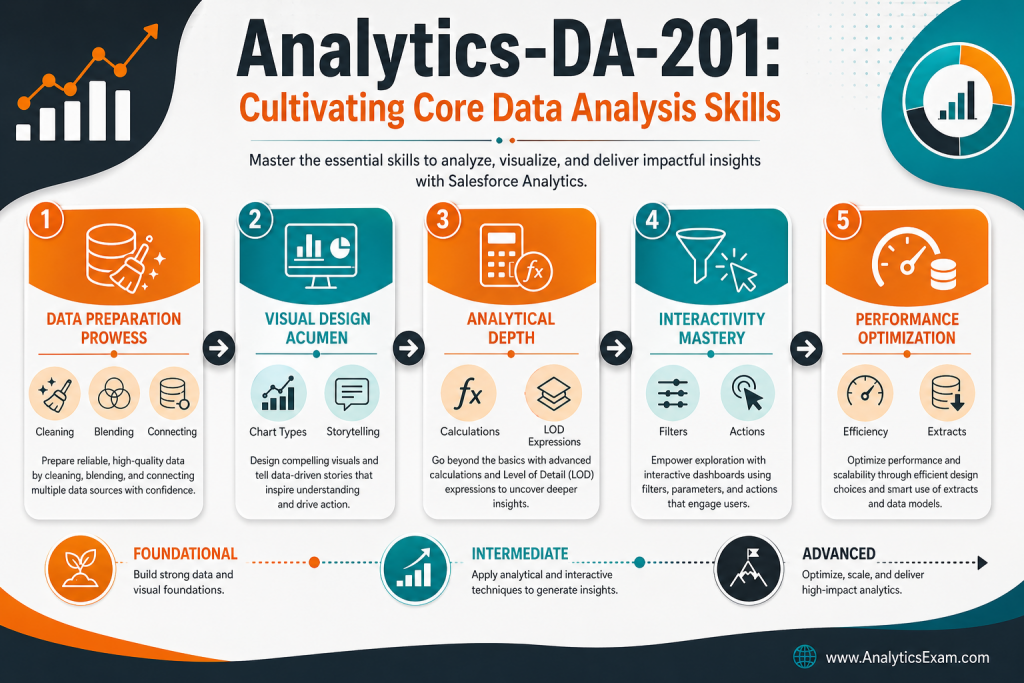
- Data Preparation Prowess: Strong command of data cleansing, shaping, and combining data from various sources is non-negotiable. This includes understanding the nuances of different join types, unions, and the use of Tableau Prep Builder if you encounter it in practice.
- Visual Design Acumen: The ability to choose the right chart for the right data, understanding visual best practices, and creating dashboards that tell a clear story without overwhelming the audience. This skill is refined through iterative design and feedback.
- Analytical Depth: Proficiently using calculations, especially Level of Detail (LOD) expressions, parameters, and sets, to perform complex analyses and create interactive views. This is where you move beyond basic visualization to deep insight generation.
- Interactivity Mastery: Designing engaging dashboards through filters, actions, and drill-downs that empower users to explore data independently and answer their own questions.
- Performance Optimization: Understanding how to build efficient workbooks and dashboards that perform well, even with large datasets. This includes knowledge of data extract creation, filter optimization, and calculation efficiency.
Engaging with the broader Tableau community through platforms like Tableau User Groups can provide invaluable real-world scenarios and tips that complement structured study, offering perspectives often absent from traditional guides.
Advancing Your Stature: Benefits of Certified Tableau Expertise
Obtaining your Salesforce Certified Tableau Data Analyst credential goes far beyond simply adding a line to your resume. It signals a profound commitment to data excellence and opens doors to new professional avenues. While many guides touch upon “career benefits,” they rarely articulate the tangible impact on your professional trajectory and market value.
Tangible Career Advantages:
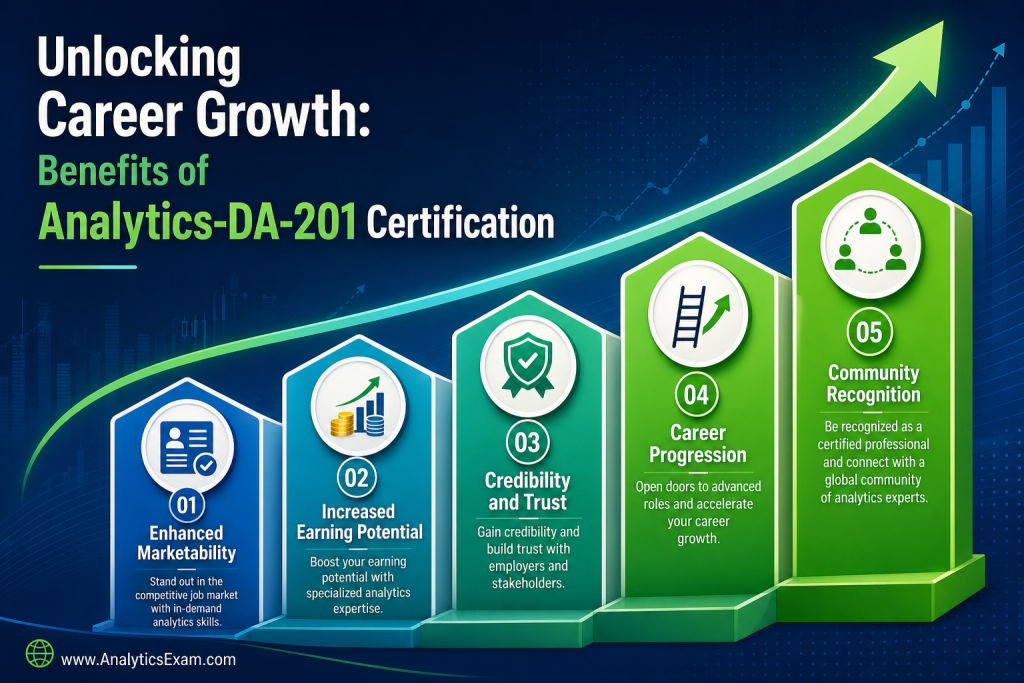
- Enhanced Marketability: The certification acts as a recognized benchmark of your skills, making you a more attractive candidate for roles requiring advanced data analysis capabilities. Employers value verified expertise.
- Increased Earning Potential: Certified professionals often command higher salaries due to their specialized and validated skill set. The average salary for a Salesforce Tableau Data Analyst typically reflects the high demand for these skills.
- Credibility and Trust: Earning the Analytics-DA-201 certification builds immediate trust with employers and clients, demonstrating your dedication and proven ability to work with Tableau effectively. It provides confidence in your analytical judgment.
- Career Progression: This certification can be a stepping stone to more advanced data roles, such as Lead Data Analyst, Business Intelligence Consultant, or Data Scientist, providing a clear path for professional growth within the Salesforce ecosystem.
- Community Recognition: Becoming certified connects you to a global community of Salesforce and Tableau experts, opening opportunities for networking, mentorship, and continuous learning.
These benefits contribute to not just a better job, but a more fulfilling and impactful career in data analytics, positioning you as a crucial asset in any data-driven organization.
Crafting Your Edge: Strategic Approaches to Analytics-DA-201 Success
Standard study guides often provide a list of topics, but rarely equip you with the strategic mindset needed to tackle the exam effectively. The key to passing the Salesforce Analytics-DA-201 isn’t just about knowing the answers, but understanding how to approach the questions and manage your study time efficiently. This involves smart resource utilization and a focused preparation plan.
Optimizing Your Preparation Journey:
- Deep Dive into Official Documentation: Beyond basic guides, immerse yourself in Tableau’s official documentation, help articles, and release notes. These resources often contain subtle details and best practices that are prime for exam questions.
- Hands-on Practice with Real Data: Theoretical knowledge without practical application is insufficient. Work with diverse datasets, build complex dashboards, and experiment with advanced calculations. This practical experience solidifies understanding and builds problem-solving intuition.
- Mastering Time Management: With 65 questions in 105 minutes, practice timed mock exams. This helps you get comfortable with the pace, identify areas where you spend too much time, and improve your speed and accuracy under pressure.
- Focused Review of Weak Areas: Utilize practice test results to pinpoint specific syllabus domains where you struggle. Allocate extra study time to these areas, rather than reviewing everything equally.
- Understanding Question Nuances: Salesforce exams often include scenario-based questions. Learn to deconstruct these scenarios, identify keywords, and choose the most appropriate Tableau solution, even if multiple options seem plausible.
To further refine your readiness, consider leveraging dedicated practice resources like those found on AnalyticsExam which can offer structured practice questions tailored to the exam objectives.
Navigating Certification: Common Hurdles and How to Overcome Them
Many individuals underestimate the Salesforce Analytics-DA-201 exam, thinking their daily Tableau use is enough. However, the exam tests a breadth of knowledge and specific application scenarios that might not be part of routine tasks. Recognizing common challenges upfront allows for targeted preparation and a smoother certification journey.
Addressing Typical Obstacles:
- Over-reliance on Superficial Knowledge: Some candidates know *how* to use a feature but not *why* it’s the best choice in a specific context, or its underlying mechanics. The exam often probes deeper into conceptual understanding. Combat this by always asking ‘why’ when learning a new feature.
- Lack of Exposure to All Data Connection Types: Many professionals primarily work with a few specific data sources. The exam can cover a wider array, including various database connectors, web data connectors, and file types. Diversify your practice data sources.
- Underestimating Dashboard Design Principles: While you might create functional dashboards daily, the exam evaluates adherence to best practices for performance, user experience, and visual clarity, often in specific hypothetical scenarios. Study dashboard layout and action principles rigorously.
- LOD Expression Complexity: Level of Detail expressions are powerful but often a source of confusion. They are heavily tested. Dedicate significant time to understanding the differences between FIXED, INCLUDE, and EXCLUDE, and when to apply each.
- Forgetting Tableau Cloud/Server Nuances: The publishing and management section, though small, requires specific knowledge of permissions, data source management, and collaboration features in Tableau’s online environments. Don’t neglect this administrative aspect.
Overcoming these hurdles involves deliberate study, consistent practice, and a willingness to explore areas of Tableau that might be outside your everyday workflow, building a comprehensive skill set.
Solidifying Mastery: Practice and Review for Peak Performance
Simply going through a study guide isn’t enough; true mastery of the Salesforce Analytics-DA-201 requires active reinforcement and systematic review. This means engaging with the material in ways that challenge your understanding and help you identify gaps before the exam. Effective practice isn’t just about quantity, but quality and strategic focus.
Techniques for Advanced Retention:
- Spaced Repetition: Instead of cramming, review topics at increasing intervals over time. This scientific method significantly improves long-term retention and recall, crucial for a comprehensive exam like Analytics-DA-201.
- Teaching Others: Explaining complex Tableau concepts to someone else (even if they’re not studying for the exam) forces you to articulate your understanding, highlighting any areas where your knowledge is fuzzy.
- Creating a “Cheat Sheet” (for study, not exam!): Condensing key formulas, concepts, and best practices into your own summary document helps you internalize the information and serves as a quick reference during practice.
- Reviewing Incorrect Answers: Don’t just look at the correct answer on practice tests. Understand *why* your answer was wrong and *why* the correct answer is superior. This deeper analysis prevents repeating mistakes.
- Simulated Exam Environment: Take at least one full-length practice exam under conditions as close to the real thing as possible: quiet room, no distractions, strict time limit. This builds stamina and reduces anxiety.
By implementing these mastery techniques, you can transform passive learning into active retention, ensuring that you’re not just familiar with the topics, but truly capable of applying your knowledge under exam conditions.
Realizing Potential: Career Trajectories with Salesforce Tableau Data Analyst
The Salesforce Certified Tableau Data Analyst credential not only validates your current abilities but also serves as a catalyst for future career growth. It positions you uniquely within the broader data analytics landscape, integrating Salesforce’s powerful CRM capabilities with Tableau’s leading visualization platform. This dual expertise creates a highly sought-after profile in various industries.
Expanding Your Professional Horizons:
- Specialized Data Analyst: You’ll be equipped to take on more complex data challenges, translating raw data into actionable business intelligence for departments ranging from sales and marketing to finance and operations.
- BI Developer/Consultant: With proven Tableau skills, you can design and implement business intelligence solutions, building robust dashboards and reports that empower organizational decision-making. Consultants with this certification are highly valued.
- Data Storyteller: Beyond technical skills, the certification implicitly enhances your ability to communicate insights effectively. This storytelling aspect is crucial for influencing stakeholders and driving data-driven change within an organization.
- Team Lead/Manager: As you gain experience, your certified expertise can qualify you for leadership roles, guiding junior analysts and setting best practices for data visualization and analysis projects.
- Path to Advanced Certifications: This credential often serves as a foundational step towards more advanced Salesforce or Tableau certifications, allowing you to continually expand your specialized knowledge and career potential.
Embracing the Salesforce Tableau Data Analyst certification opens doors to a dynamic and evolving career, offering both stability and significant opportunities for innovation and impact in the data sphere.
Conclusion
The Salesforce Analytics-DA-201 exam is more than a test of technical skills; it’s a validation of your strategic thinking, problem-solving abilities, and commitment to data excellence. By understanding not just the syllabus but also the nuances of preparation, common pitfalls, and the profound career benefits, you can approach the certification with confidence and clarity. Your journey to becoming a Salesforce Certified Tableau Data Analyst is an investment in your professional future, equipping you to transform data into powerful insights.
Ready to master Tableau and unlock your full potential? Explore our detailed readiness guide for the Salesforce Tableau Data Analyst exam to gain comprehensive insights and ensure you’re fully prepared. Additionally, discover a wealth of Salesforce certification resources that can further propel your career. You can also download our Salesforce Analytics-DA-201 Study Guide for a focused approach to your exam preparation.
Frequently Asked Questions
1. What is the passing score for the Salesforce Analytics-DA-201 exam?
The passing score for the Salesforce Analytics-DA-201 exam is 65%. Candidates must achieve this score to earn the Salesforce Certified Tableau Data Analyst credential.
2. How long is the Salesforce Analytics-DA-201 exam?
The exam duration for Salesforce Analytics-DA-201 is 105 minutes. This time includes an allotted period for reading questions and selecting answers.
3. What topics are covered in the Analytics-DA-201 exam?
The Analytics-DA-201 exam covers four main domains: Connect to and Transform Data (24%), Explore and Analyze Data (41%), Create Content (26%), and Publish and Manage Content on Tableau Server and Tableau Cloud (9%).
4. Is the Salesforce Tableau Data Analyst certification worth pursuing?
Yes, the Salesforce Tableau Data Analyst certification is highly valued. It enhances marketability, increases earning potential, builds credibility, and supports career progression in data analysis and business intelligence roles.
5. Are there any prerequisites for taking the Salesforce Analytics-DA-201 exam?
While Salesforce generally recommends prior experience with Tableau, there are no strict formal prerequisites for taking the Analytics-DA-201 exam. However, a strong foundation in data analysis and hands-on Tableau experience is highly advisable for success


