Why Is CDP-3003 Almost Entirely NiFi and Kafka?
Because those two projects are what a Cloudera data operator spends the day in. NiFi carries 48% of CDP-3003 and Kafka carries 30%, leaving 22% split between Cloudera DataFlow and MiNiFi. The exam is testing the practical craft of ingestion and movement rather than a general survey of the Cloudera Data Platform.
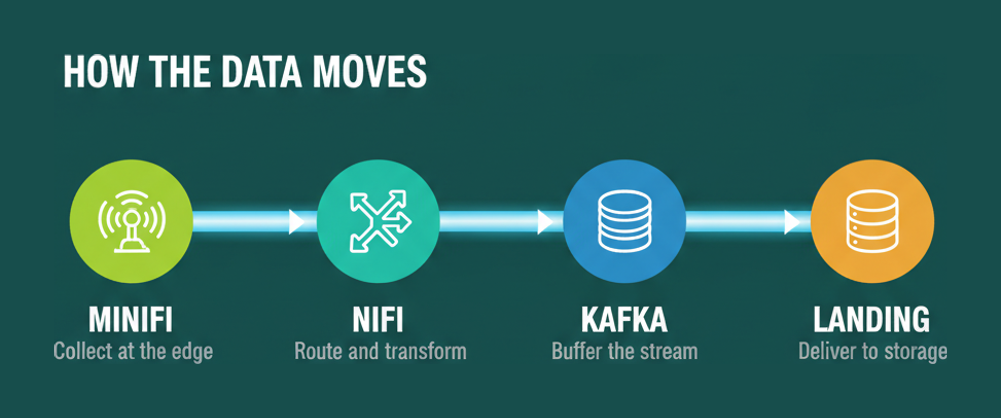
The two tools answer different halves of the same problem. NiFi is the flow engine, the place where data is routed, transformed, enriched, and delivered under an operator’s direct control. Kafka is the durable backbone that decouples producers from consumers, so a slow downstream system does not stall an upstream one.
Knowing one well and the other vaguely is the classic failure pattern here. A candidate strong on NiFi who has never configured a Kafka cluster is leaving nearly a third of the paper to chance, and the 55% pass mark does not leave much room for that.
What Does the CDP-3003 Exam Look Like?
CDP-3003 is a 50 question exam with 90 minutes on the clock and a 55% pass mark, which means roughly 28 correct answers. It costs $330 USD and Cloudera delivers it online with a proctor. The exam is closed book: no reference materials, white papers, or user guides are permitted while you sit it. Administrators following the platform track instead should look at the CDP-5001 administrator exam, which starts from AWS rather than a cluster.
One point worth planning around is that Cloudera’s official exam guide currently lists CDP-3003 as a beta exam, which means the content may still receive small edits. Passing a beta exam still earns the certification, so this is a scheduling consideration rather than a reason to wait.
Format, cost, and scoring
| Attribute | Detail |
|---|---|
| Exam code | CDP-3003 |
| Certification | Cloudera CDP Data Operator |
| Questions | 50 |
| Duration | 90 minutes |
| Passing score | 55% |
| Cost | $330 USD |
| Delivery | Online, proctored |
| Reference materials | Not permitted during the exam |
How the four domains are weighted
| Domain | Weight |
|---|---|
| NiFi | 48% |
| Kafka | 30% |
| Data Flow | 16% |
| MiNiFi | 6% |
At 50 questions in 90 minutes you have a little under two minutes each, which is comfortable. The pressure in this exam comes from breadth of tooling, not from the clock.
What Does the NiFi Domain Cover?
The NiFi domain is worth 48% of CDP-3003 and spans six areas: NiFi concepts and fundamentals, data flows and processors, ETL and record data, optimisation and troubleshooting, integration, and security and scalability. Nearly half the exam sits here, so this is where preparation should begin and where it should be deepest.
Concepts before components
NiFi has a very large component library, and trying to memorise processors is a losing strategy. The Apache NiFi documentation catalogues hundreds of processors alongside controller services and reporting tasks. What the exam rewards is understanding the model underneath: how a piece of data and its attributes travel through a flow, how connections queue and apply back pressure, and how a processor decides what to do next.
Record-oriented processing
The syllabus calls out ETL and record data specifically. Record-based processing, where a reader and a writer interpret structured data rather than treating it as opaque bytes, is both a major NiFi capability and a common exam theme. Being able to explain why a record-aware approach outperforms splitting a file into individual pieces is worth real marks.
Troubleshooting and scale
Optimisation and troubleshooting questions tend to be symptom-led: a queue is growing, throughput has dropped, a flow is consuming too much memory. Work backwards from the symptom to the mechanism, because that is how the questions are constructed.
How Much Kafka Do You Need to Know?
Enough to run it, not just to use it. The Kafka domain carries 30% of CDP-3003 and covers concepts and fundamentals, the Kafka APIs, cluster setup and configuration, security and scalability, monitoring and operations, the wider Kafka ecosystem, and troubleshooting. That is an operator’s syllabus, not a developer’s.
Apache’s own introduction to Kafka frames the platform around three capabilities: publishing and subscribing to streams of events, storing those streams durably for as long as needed, and processing them as they arrive or retrospectively. Most exam questions trace back to one of those three.
Areas that reliably carry marks:
- Topics, partitions, and how partitioning decides both ordering and parallelism
- Consumer groups and what happens to assignment when membership changes
- Replication and acknowledgement settings, and the durability they buy
- Retention, since it governs what a late consumer can still read
- Monitoring signals that show a cluster is unhealthy before users notice
Candidates coming from a NiFi background often underestimate this domain because NiFi can talk to Kafka without them understanding much about it. The exam closes that gap deliberately.
Where Do Cloudera DataFlow and MiNiFi Fit?
They cover the two ends of the pipeline that plain NiFi does not. Data Flow is worth 16% and covers flow deployments, DataFlow Functions, and the ReadyFlows catalogue. MiNiFi is the smallest domain at 6% and covers its concepts, installation and configuration, and ongoing management.
Cloudera DataFlow: running flows as a service
Cloudera DataFlow takes a NiFi flow from a central catalogue and runs it as a managed deployment. The Cloudera DataFlow documentation describes two runtimes: auto-scaling deployments on Kubernetes with centralised monitoring, and a serverless Functions option for flows that do not need to run continuously.
“Cloudera DataFlow automates and manages cloud-native data flows on Kubernetes – and it is something only we offer.”
For the exam, the useful distinction is when each runtime is appropriate. A continuous ingestion flow belongs in a deployment. An event-triggered, intermittent flow is a candidate for Functions.
MiNiFi: collection at the edge
MiNiFi is a lightweight agent that runs where the data originates rather than in the cluster. At 6% it is roughly three questions, so it does not warrant deep study, but the concepts are cheap to learn and those marks are easy to bank.
How Should You Split Your Study Time?
Proportionally to the weightings, with a bias towards whichever tool you use least at work. NiFi and Kafka decide the outcome at 78% between them, so roughly three quarters of your preparation belongs there. A practical schedule runs six to eight weeks part time for someone already operating pipelines.
- Audit yourself against the four domains and be honest about which of NiFi and Kafka you actually operate rather than merely consume
- Build a small end to end flow so data physically moves, then break it deliberately and fix it
- Stand up or borrow a Kafka cluster and work through partitions, consumer groups, and retention until the behaviour is predictable
- Read the Data Flow material with one question in mind: deployment or function
- Spend a single short session on MiNiFi, since 6% does not justify more
- Move to timed questions and let every miss point you back at a specific topic
Because the exam is closed book, the goal is recall rather than knowing where to look. Reviewing the full CDP-3003 syllabus against your own experience is the quickest way to find the topics your environment never made you learn.
Which Roles Does the Data Operator Credential Fit?
CDP-3003 suits the people who keep ingestion running: data engineers with an operations bias, streaming and integration engineers, platform engineers who own pipelines, and operations staff supporting a Cloudera estate. Cloudera describes the audience as professionals who ingest and flow data across complex ecosystems using its tools.
The credential is narrower than a general data engineering certification, and that is its strength. It says something specific: this person can build a flow, back it with a durable stream, deploy it, and diagnose it when the queue starts growing.
It pairs naturally with streaming knowledge from elsewhere in the ecosystem. Engineers who already hold Kafka-focused credentials will find the Kafka domain familiar and can concentrate on NiFi and DataFlow instead.
How Does CDP-3003 Compare With Cloudera’s Other Exams?
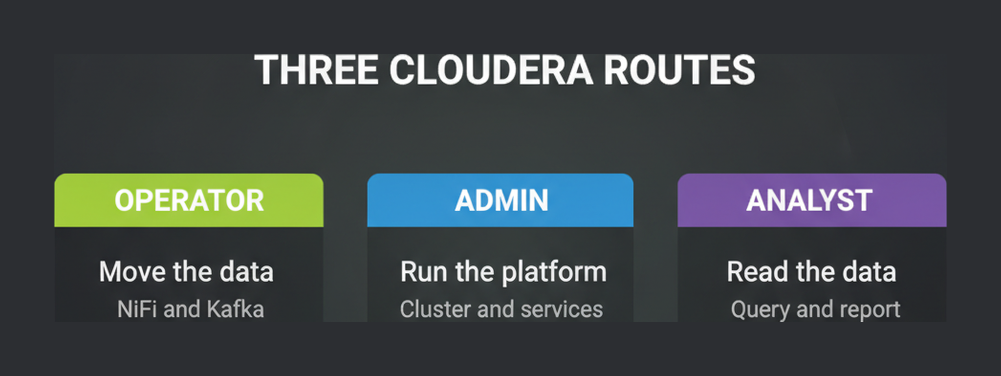
Cloudera separates its certifications by what you do with the platform rather than by seniority. The Data Operator exam is about moving data. The administrator exams are about running the platform itself. The analyst exam is about querying and interpreting what has landed. They overlap far less than the shared CDP prefix suggests.
| Focus | Data Operator | Administrator | Data Analyst |
|---|---|---|---|
| Core question | Does the data arrive reliably | Is the platform healthy | What does the data say |
| Main technologies | NiFi, Kafka, DataFlow, MiNiFi | Cluster services and configuration | Query and analysis tooling |
| Typical owner | Streaming and integration engineers | Platform administrators | Analysts and reporting teams |
If your interest is the platform rather than the pipelines, the on-premises administrator route is the better match. If it is querying and reporting on data once it has landed, the Cloudera data analyst path covers that ground instead.
Frequently Asked Questions
How many questions are on the CDP-3003 exam?
The exam has 50 questions with a 90 minute limit. That gives you a little under two minutes per question, which most candidates find comfortable, so the difficulty comes from the range of tooling rather than time pressure.
What is the passing score for CDP-3003?
You need 55%, which is roughly 28 correct answers out of 50. Because NiFi and Kafka together carry 78% of the paper, a weak domain there is very difficult to compensate for elsewhere. Because Kafka carries so much of this paper, the Confluent Cloud certification makes a natural follow-on for anyone running streaming infrastructure.
How much does the Cloudera Data Operator exam cost?
The exam costs $330 USD. Cloudera delivers it online with a proctor, so there is no test centre to travel to, though you will need a suitable room and a working webcam setup.
Can you use reference material during the exam?
No. Cloudera states that reference materials, white papers, user guides, and other resources are not permitted during the exam. Preparation therefore has to build recall rather than familiarity with where to look things up.
Which domain carries the most weight?
NiFi, at 48%. It covers concepts and fundamentals, data flows and processors, ETL and record data, optimisation and troubleshooting, integration, and security and scalability, making it nearly half the exam on its own.
Is CDP-3003 still a beta exam?
Cloudera currently lists it as being in beta, which means the content may receive small edits. Passing a beta exam still earns the certification, so it is a planning note rather than a reason to postpone booking.
Do you need to know Kafka administration or just usage?
Administration. The syllabus covers cluster setup and configuration, security and scalability, and monitoring and operations, so consuming a Kafka topic from a NiFi processor is well short of what the questions expect.
How much MiNiFi study is worthwhile?
Very little. MiNiFi is 6% of the exam, roughly three questions, covering concepts, installation and configuration, and management. A single focused session is enough to secure those marks efficiently.
Are there prerequisites for the Data Operator certification?
No formal prerequisites are published. Cloudera aims the exam at professionals who already move data across complex ecosystems with its tools, so genuine hands-on experience matters far more than any stated requirement.
How long does preparation usually take?
Six to eight weeks part time suits someone already operating pipelines. Candidates who use only one of NiFi or Kafka in their daily work should plan longer, since the unfamiliar tool will account for a large share of the questions.
Conclusion
CDP-3003 rewards operators rather than generalists. With NiFi at 48% and Kafka at 30%, the exam asks whether you can build a flow, back it with a durable stream, run it as a managed deployment, and work out what went wrong when the queue starts growing.
Plan your preparation in the same proportions the blueprint uses. Give NiFi the largest share, close whatever Kafka operations gap your day job has left you with, learn the DataFlow deployment decision, and spend one short session on MiNiFi. Because the exam is closed book, finish with timed practice against the published domains so recall is there when you need it.


