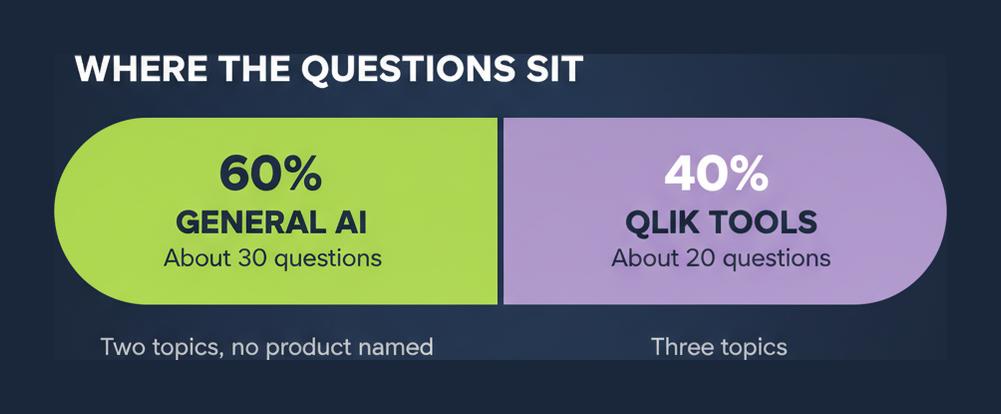
Sixty percent of the Qlik AI Specialist certification has nothing to do with Qlik. The first two domains of QAIS, worth 30 percent each, cover artificial intelligence in general terms: the subsets of AI, how people communicate with large language models, the machine learning workflow, the LLM application project lifecycle, and the governance and ethical questions that come with putting any of it into production. Only the remaining 40 percent touches a Qlik product.
That split is the most useful thing to know before booking. It means a candidate who lives inside Qlik Cloud every day is still facing 30 of the 50 questions on material their day job may never have covered, and it means someone arriving from a general AI background already holds most of the paper. QAIS asks for 73 percent across 50 questions in 90 minutes, which is a high bar by any standard. This guide walks all five domains, converts the weights into question counts, and shows which half of the syllabus usually needs the work.
Why Is Most of the Qlik AI Specialist Certification Not About Qlik?
Because Qlik built QAIS as a credential in applied artificial intelligence that happens to be assessed through its own platform. Introduction to Artificial Intelligence and Business applications for Artificial Intelligence are worth 30 percent each, and neither mentions a Qlik product. Together they account for 60 percent of a 50-question paper.
The reasoning is visible in the objectives themselves. The exam wants you to identify appropriate use cases for generative AI and machine learning, to recognise the LLM application project lifecycle, and to assess data governance, security practice and ethics for AI projects. Those are judgement skills that survive a change of tooling, which is exactly what a specialist credential should be validating.
It also reframes who should sit it. A Qlik developer who can build an app blindfolded is not automatically two thirds of the way through this exam. Conversely, a data professional who has spent a year on generative AI projects elsewhere can walk into 30 of the 50 questions with very little Qlik-specific study, and then only needs the three product domains.
What Are the Five QAIS Domains and Their Weights?
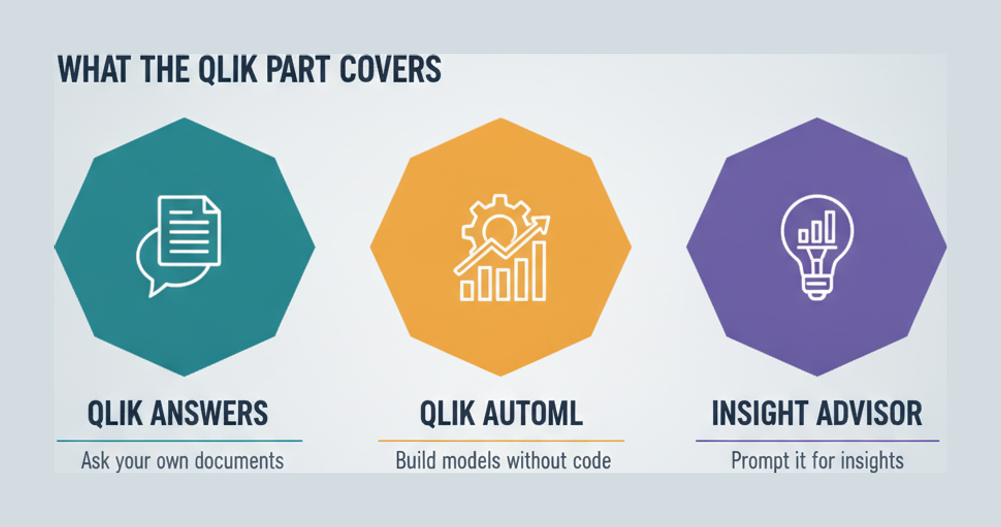
QAIS publishes five weighted topics. Introduction to Artificial Intelligence and Business applications for Artificial Intelligence take 30 percent each. Fundamentals of Qlik Answers and Fundamentals of Qlik Machine Learning take 15 percent each. Fundamentals of Insight Advisor closes the syllabus at 10 percent.
| Topic | Weight | What it asks you to do |
|---|---|---|
| Introduction to Artificial Intelligence | 30% | Understand the subsets of AI including generative AI and machine learning, contrast the ways humans communicate with AI through natural language processing and large language models, and define common AI terms and concepts |
| Business applications for Artificial Intelligence | 30% | Identify appropriate use cases, recognise the LLM application project lifecycle, evaluate LLM apps in production including data pipelines and latency, explain the machine learning workflow, assess governance, security and ethics, and identify the limits of AI |
| Fundamentals of Qlik Answers | 15% | Outline a typical Qlik Answers workflow, recognise its key concepts and terms including retrieval augmented generation, and evaluate use cases for it |
| Fundamentals of Qlik Machine Learning | 15% | Understand the foundations of Qlik AutoML, apply the AutoML workflow appropriately, and evaluate use cases for it |
| Fundamentals of Insight Advisor | 10% | Generate insights using Insight Advisor and demonstrate best practice in interacting with it, including prompt generation |
Notice how the verbs escalate. The first domain asks you to understand, contrast and define. The second asks you to identify, recognise, evaluate, explain and assess. The three product domains settle back into outline, apply and evaluate. The hardest cognitive work on this paper sits in the domain that never names a product.
How Many Questions Does Each Domain Get?
Applied to 50 questions, the weights give 15 questions each to the two artificial intelligence domains, seven or eight each to Qlik Answers and Qlik Machine Learning, and five to Insight Advisor. A 73 percent pass mark means 37 correct answers, so the margin for error across the whole paper is 13 questions.
| Topic | Weight | Approximate questions of 50 |
|---|---|---|
| Introduction to Artificial Intelligence | 30% | 15 |
| Business applications for Artificial Intelligence | 30% | 15 |
| Fundamentals of Qlik Answers | 15% | 7 to 8 |
| Fundamentals of Qlik Machine Learning | 15% | 7 to 8 |
| Fundamentals of Insight Advisor | 10% | 5 |
Thirteen wrong answers sounds generous until you set it against the shape of the paper. Losing the whole of Insight Advisor and half of Qlik Answers already costs nine, leaving four across 45 remaining questions. That is why the two big AI domains have to be genuinely solid rather than merely familiar, and why reading the QAIS syllabus breakdown objective by objective is worth an evening before any studying starts.
What Is the QAIS Exam Format?
QAIS is a 50-question exam with a 90-minute limit and a 73 percent passing score, priced at $250 US dollars. Registration runs through Qlik rather than a third-party test-delivery partner. Ninety minutes across 50 questions is about 108 seconds each, which is comfortable for definitional items and adequate for the use-case judgement questions.
| Detail | Value |
|---|---|
| Exam name | Qlik AI Specialist Certification |
| Exam code | QAIS |
| Questions | 50 |
| Duration | 90 minutes |
| Passing score | 73% |
| Price | $250 USD |
| Registration | Qlik |
| Recommended training | Qlik AI Specialist Certification Exam Preparation |
Two details from the Qlik exam details page are worth carrying into planning. Qlik states that exam content is updated periodically and that the number and difficulty of questions may change, so the 50-question figure describes the current form rather than a permanent structure. It also states that the passing score is adjusted to maintain a consistent standard, meaning 73 percent is a calibrated threshold rather than an arbitrary one.
Passing earns a digital badge, which matters more than it sounds for a credential this new. A verifiable badge is currently the clearest way to show an employer that AI capability was assessed rather than asserted.
What the Two AI Domains Actually Ask
Between them the two artificial intelligence domains carry 30 questions, and their objectives are specific enough to study against directly rather than treating as general reading. They divide cleanly into vocabulary, project shape, and the limits of the technology.
Vocabulary and the subsets of AI
The first domain wants the map: what sits inside artificial intelligence, where machine learning fits, where generative AI fits, and how natural language processing and large language models differ as ways of communicating with a system. Definitional questions are the cheapest marks on this paper, and there are roughly 15 of them.
The LLM application project lifecycle
The second domain names this explicitly, alongside evaluating LLM applications in production: adapting data pipelines, reducing latency, and extending what a model can usefully do. This is the objective most candidates underestimate, because it is about running a system rather than describing one.
Governance, ethics and limits
The same domain asks you to assess data governance, security practices and ethical considerations for AI projects, and separately to identify the limits of AI and the data challenges of implementing generative AI. Anyone who has worked through a structured approach such as the NIST AI risk framework will recognise the shape of these questions immediately.
How Deep Does the Qlik Answers Section Go?
Not as deep as its 15 percent weighting suggests, but deeper on one specific concept. The domain asks you to outline a typical Qlik Answers workflow, recognise its key concepts and terms including retrieval augmented generation, and evaluate use cases for it. Retrieval augmented generation is the term the objective names outright, which makes it the one to know cold.
Understanding why matters more than memorising a definition. Qlik Answers is positioned as an assistant that answers questions from an organisation’s own unstructured content, and retrieval augmented generation is the mechanism that lets a general model respond using specific documents it was never trained on. The Qlik Answers product page is the right place to see how the vendor frames that workflow.
Use-case evaluation is the other half. Expect scenarios asking whether Qlik Answers or a different tool suits a described problem, which is a judgement question wearing product clothing. If you can say what the tool is good for and what it is not, seven or eight questions come easily.
What Does the Qlik AutoML Section Expect?
Foundations, workflow and fit. The Qlik Machine Learning domain asks you to understand the foundations of Qlik AutoML, demonstrate appropriate application of the AutoML workflow, and evaluate use cases for it. At 15 percent that is seven or eight questions, and none of them requires you to write code.
The word “appropriate” is doing the work in that middle objective. Automated machine learning tools make model building easy enough that the harder question becomes whether a model should be built at all, and whether the data supports the prediction being asked for. Questions here tend to describe a business situation and ask what the correct AutoML step would be.
This domain also connects back to the machine learning workflow objective in the second AI domain, which is a useful efficiency. Study the general workflow once and it covers marks in both places, which is worth remembering when planning the order of preparation.
Is Insight Advisor Worth Ten Percent of Your Study Time?
Yes, and probably slightly less than that. Insight Advisor is the smallest domain at 10 percent, roughly five questions, and it asks only two things: generate insights using Insight Advisor, and demonstrate best practice in interacting with it, including prompt generation. It is the narrowest objective set on the paper.
Prompt generation is the interesting inclusion. Qlik is asking whether you can phrase a question well enough for a natural-language analytics tool to answer it usefully, which is a genuinely current skill and one the wider industry has started to treat as a hiring signal. The Stack Overflow AI survey shows how quickly this kind of interaction has become ordinary for technical professionals.
For candidates already inside the Qlik ecosystem, this is the domain closest to daily work, so it usually needs the least deliberate study. If you are new to the platform, an hour of hands-on time with Insight Advisor covers most of what is asked. The QAIS exam topics page is a useful cross-check on whether your coverage of the smaller domains is complete.
How Should You Plan for a 73 Percent Pass Mark?
By treating the two AI domains as the exam and the three product domains as the finishing work. Thirty-seven correct answers out of 50 leaves only 13 to give away, and 30 of the 50 questions sit in material that is not Qlik-specific, so the preparation order should follow the marks rather than the product familiarity.
- Start with the vocabulary objective, building a clear map of what sits inside artificial intelligence, where machine learning and generative AI fit, and how natural language processing differs from a large language model.
- Move to the LLM application project lifecycle and the production concerns named alongside it, since adapting data pipelines and reducing latency are the objectives candidates most often meet for the first time in the exam.
- Work the governance, security, ethics and limits objectives together as one block, because questions here usually describe a situation and ask what should worry you about it.
- Take Qlik Answers next, learning retrieval augmented generation properly rather than as a phrase, and being able to say which problems the tool suits.
- Cover Qlik AutoML by walking its workflow end to end, reusing the general machine learning workflow you already studied in the second domain.
- Finish with an hour of hands-on Insight Advisor practice, concentrating on how a question needs to be phrased to get a useful answer back.
Four to six weeks is realistic for a Qlik practitioner who is new to generative AI concepts, and two to three for someone arriving from AI work who only needs the product layer. If your longer plan is a full Qlik credential path rather than this one exam, the Qlik Sense Data Architect route covers the platform side that QAIS deliberately leaves out.
Frequently Asked Questions
How many questions are on the QAIS exam?
Fifty questions with a 90-minute limit, which is about 108 seconds each. Qlik notes that the number and difficulty of questions may change as exam content is updated.
What is the passing score for the Qlik AI Specialist certification?
Seventy-three percent, so 37 correct answers out of 50. Qlik states the passing score is adjusted to maintain a consistent standard, so it is calibrated rather than fixed arbitrarily.
How much does the QAIS exam cost?
Two hundred and fifty US dollars. Registration runs through Qlik directly rather than through a third-party test-delivery partner such as Pearson VUE.
How much of QAIS is about Qlik products?
Forty percent. Qlik Answers and Qlik AutoML carry 15 percent each and Insight Advisor carries 10 percent. The remaining 60 percent covers artificial intelligence in general terms.
Do you need to write code to pass QAIS?
No. The machine learning domain is built around Qlik AutoML, which is an automated tool, and the objectives ask you to understand foundations, apply a workflow and evaluate use cases.
What does retrieval augmented generation mean for this exam?
It is named directly in the Qlik Answers objectives, so it is examinable vocabulary. It describes letting a general language model answer using an organisation’s own documents rather than only its training data.
Is QAIS suitable for someone new to Qlik?
Reasonably, yes. Sixty percent of the paper is vendor-neutral AI material, and the three product domains ask for workflows and use cases rather than deep configuration skill.
Does passing QAIS earn a badge?
Yes. Qlik awards a Qlik AI Specialist Certification Exam badge on passing, which can be verified through its badging platform and shared on a professional profile.
Which domain is hardest?
Business applications for Artificial Intelligence. It carries 30 percent, and its objectives use the most demanding verbs on the syllabus: identify, recognise, evaluate, explain and assess.
How long does preparation usually take?
Four to six weeks for a Qlik practitioner new to generative AI concepts, and two to three weeks for someone already working in AI who only needs the three product domains.
Conclusion
QAIS is best understood as an applied AI exam with a Qlik layer on top, not a Qlik exam with some AI in it. Thirty of its 50 questions sit in vendor-neutral territory covering AI vocabulary, the LLM application lifecycle, production concerns, governance and the limits of the technology. The three product domains together account for the other 20, and none of them asks for code.
Plan accordingly: give the two large AI domains the bulk of the study time, learn retrieval augmented generation properly, walk the AutoML workflow once, and spend an hour with Insight Advisor. With 37 of 50 needed to pass, the exam rewards even coverage far more than deep product expertise, and working through the published objectives one at a time is the most reliable way to get there.


