Open almost any guide to the AWS Certified AI Practitioner and you will find the same list: what machine learning is, what a model is, what SageMaker does. None of them mention that the published objectives for AIF-C01 now ask candidates to define multi-agent system patterns, explain the Model Context Protocol and its role in connecting agents to external systems, and describe prompt injection as a security risk. That vocabulary is in the blueprint, in plain sight, and most study material has not caught up with it.
The gap matters because it changes who the exam suits. A 65-question paper priced at $100 with a 90-minute clock sounds like a definitions quiz, and the first domain genuinely is one. The other 80 percent is not. This guide works through the five weighted domains as the syllabus publishes them, converts each weighting into a share of the 65 questions, and is honest about which parts have moved far enough that older preparation material is now actively misleading.
What Is the AWS Certified AI Practitioner?
The AWS Certified AI Practitioner is a foundational credential earned by passing exam AIF-C01. It runs 65 questions in 90 minutes, costs $100 US dollars, and is passed at 700 on a scale of 100 to 1000. AWS aims it at people validating knowledge of AI, machine learning and generative AI on its platform rather than at engineers building models.
The audience framing is worth reading carefully. AWS describes the credential as suiting people already familiar with cloud or technical roles, and points anyone genuinely new to IT toward Cloud Practitioner Essentials or AWS Technical Essentials first. In other words, foundational here means foundational within AI, not foundational within technology.
The credential is valid for three years and is offered in twelve languages, including Arabic, Japanese, Korean, both Spanish variants, both Portuguese-relevant and Chinese variants, French, German and Italian alongside English. That breadth is unusual for a foundational paper and signals the audience AWS expects: business and delivery roles across many markets, not a narrow engineering cohort.
Why Does the Blueprint Now Name Agentic AI?
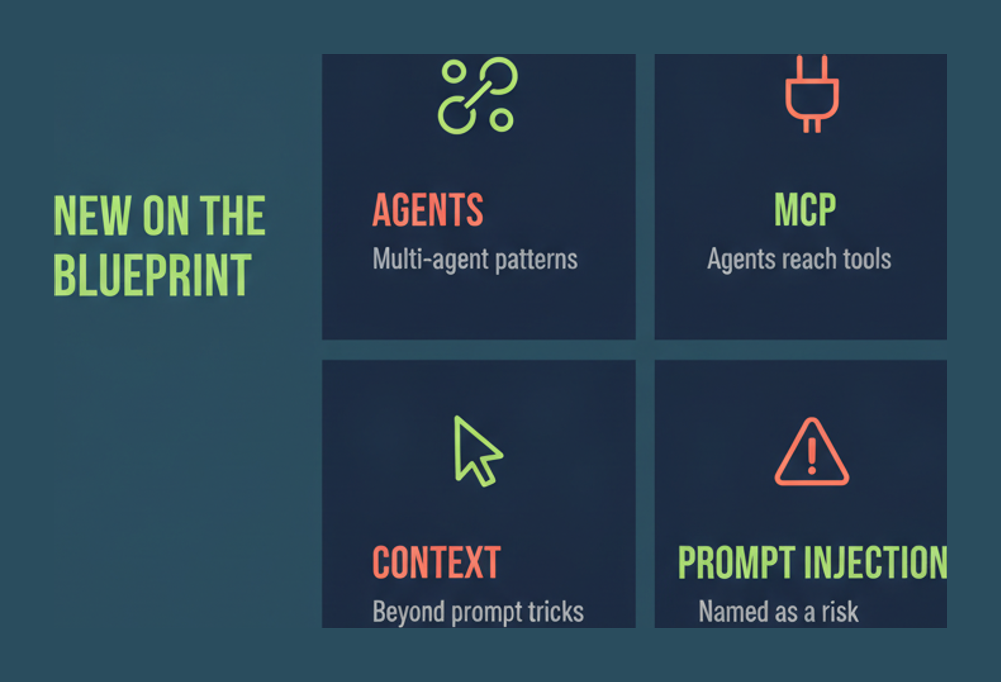
Because the objectives were rewritten around what people actually build. The GenAI domain explicitly asks candidates to define foundational agentic AI concepts, including multi-agent system patterns for complex applications, the Model Context Protocol and its role in connecting agents to external systems, multi-agent communication patterns, memory management, tool usage and workflow orchestration.
That is a substantial list for a foundational exam, and it sits alongside several other markers of a refreshed blueprint.
- Context engineering appears as its own objective, separate from prompt engineering.
- Token-based pricing and its effect on inference cost and performance is examinable.
- Named services include Amazon Bedrock AgentCore, Strands Agents, Amazon Q, Amazon Quick and Kiro, none of which belonged to an entry-level AI syllabus in the credential’s first year.
- Prompt injection, output filtering and validation, and audit trail requirements for AI interactions all appear in the security domain.
The protocol named in the objectives has its own Model Context Protocol specification, maintained independently of AWS, and reading its overview is a faster route to the concept than any exam-prep summary. The practical consequence is simple: material that predates agentic tooling will leave a visible hole in the second-largest domain.
How Are the Five Domains Weighted?
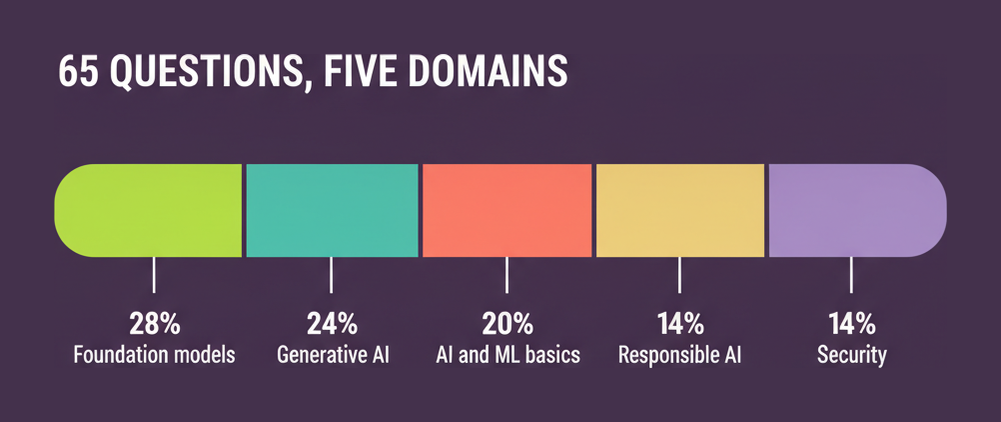
Applications of Foundation Models is the largest at 28 percent, followed by Fundamentals of GenAI at 24 percent and Fundamentals of AI and ML at 20 percent. Guidelines for Responsible AI and Security, Compliance, and Governance close the syllabus at 14 percent each. The weightings sum cleanly to 100.
| Domain | Weight | Approximate questions of 65 |
|---|---|---|
| Applications of Foundation Models | 28% | 18 |
| Fundamentals of GenAI | 24% | 16 |
| Fundamentals of AI and ML | 20% | 13 |
| Guidelines for Responsible AI | 14% | 9 |
| Security, Compliance, and Governance for AI Solutions | 14% | 9 |
Read the top two rows together and the shape of the paper becomes obvious. Foundation models and generative AI account for 52 percent between them, roughly 34 of the 65 questions. Classic machine learning concepts, the part most people assume dominates a credential like this, is worth 13 questions. Checking that split against your own confidence is what AIF-C01 exam material is most useful for early in preparation.
What Does the Largest Domain Actually Cover?
Applications of Foundation Models covers four things: how to choose and configure a model, how to prompt it, how to fine-tune it, and how to evaluate whether it worked. At 28 percent it carries roughly 18 of the 65 questions, which makes it the single most valuable block of study time on the exam.
Selection and configuration
The objectives ask for selection criteria including cost, modality, latency, multilingual support, model size, complexity, customisation, input and output length, and prompt caching. They also cover inference parameters such as temperature and length, retrieval augmented generation and its business applications, the AWS services that store embeddings in vector databases, and the cost tradeoffs between pre-training, fine-tuning, in-context learning, RAG and model distillation.
Prompting, tuning and evaluation
Prompt engineering is examined as a discipline rather than a trick: context, instruction and negative prompts, chain-of-thought, zero-shot, single-shot and few-shot techniques, templates, and the specific risks of exposure, poisoning, hijacking and jailbreaking. Fine-tuning covers instruction tuning, domain adaptation, transfer learning, continuous pre-training and data preparation including reinforcement learning from human feedback. Evaluation names ROUGE, BLEU, BERTScore and using a model as a judge, alongside business metrics such as task completion rate and cost per interaction.
That last group is where non-engineers often score best and engineers often score worst, because it is about deciding whether a system met a business objective rather than about how it was built.
How Much of the Exam Is Responsible AI and Governance?
Twenty-eight percent, split evenly between two domains worth 14 percent each, or roughly 18 of the 65 questions combined. That is the same share as the largest single domain, and it is the part candidates most often treat as padding and then lose marks on.
Responsible AI asks for the features of responsible systems including bias, fairness, inclusivity, robustness, safety and veracity, the legal risks of generative AI from intellectual property claims to hallucinations, the effects of bias and variance on demographic groups, and the difference between models that are transparent and explainable and models that are not. Tooling is named specifically, from Bedrock Guardrails to SageMaker Clarify, Model Cards and Model Monitor.
The governance domain moves from principles to controls: identity and access policies, encryption, data lineage and cataloguing, hallucination detection and grounding, and then the compliance services AWS provides for audit and evidence. Because the objectives name governance frameworks directly, candidates benefit from reading a real one rather than a summary, and the NIST AI Risk Management Framework is the reference most organisations actually align to.
What Are the AIF-C01 Exam Details?
AIF-C01 is 65 questions in 90 minutes for $100 US dollars, passed at a scaled 700 out of a possible 1000 with a floor of 100. Scheduling runs through AWS Certification, the credential stays valid for three years, and it is available in twelve languages.
| Detail | Value |
|---|---|
| Exam name | AWS Certified AI Practitioner |
| Exam code | AIF-C01 |
| Questions | 65 |
| Duration | 90 minutes |
| Passing score | 700 on a scale of 100 to 1000 |
| Price | $100 USD |
| Validity | 3 years |
| Languages | 12, including Arabic, Japanese, Korean and Simplified Chinese |
| Scheduling | AWS Certification |
Ninety minutes across 65 questions gives roughly 83 seconds each, which is tight for a foundational paper. The reason is the question style: a scenario naming three AWS services and asking which fits a cost or latency constraint takes longer to read than a definition does. AWS publishes the current figures on the official AI Practitioner certification page, which is also where language availability is confirmed.
Is This Credential Worth It for a Non-Engineer?
For analysts, product owners, consultants and delivery leads, yes, and more so than the word foundational suggests. Fifty-two percent of the paper is about foundation models and generative AI, and much of that is about choosing, evaluating and governing systems rather than building them, which is the work those roles already do.
The honest caveat is the AWS specificity. Objectives name particular services throughout, so a candidate whose organisation runs on a different cloud will learn a vocabulary they cannot immediately apply. The concepts transfer; the service names do not. Anyone weighing this against the rest of the programme will find our AWS certification path overview a useful comparison before committing.
For engineers the calculation is different. The machine learning fundamentals will be familiar, but the responsible AI and governance domains, worth 28 percent between them, cover ground that engineering work rarely forces you to articulate. Plenty of strong engineers lose marks there rather than on the technical domains.
Independent evidence supports the underlying demand rather than the credential itself. The annual developer survey on AI adoption shows how widely AI tooling has entered professional practice, which is the market context in which a shared vocabulary across technical and non-technical colleagues becomes valuable.
How Should You Prepare for the Ninety Minutes?
Work in weighting order and start where the questions are, not where you are comfortable. Applications of Foundation Models and Fundamentals of GenAI hold 34 of the 65 questions between them, so a preparation plan that opens with machine learning definitions has spent its best hours on 13 questions.
- Read the current objectives directly rather than a summary, because the agentic AI and Model Context Protocol material is recent enough that most third-party study notes still omit it entirely.
- Start with Applications of Foundation Models, since 18 of the 65 questions come from it and its four sub-areas of selection, prompting, tuning and evaluation each carry real weight.
- Move to Fundamentals of GenAI next, treating agents, the Model Context Protocol and token-based pricing as first-class topics rather than as background reading.
- Learn the named AWS services as a mapping exercise, pairing each service with the single job it does, because scenario questions usually turn on picking the right service rather than on explaining it.
- Give responsible AI and governance a full study block of their own, since together they match the largest domain in weight and are the easiest marks to lose through vagueness.
- Finish with the machine learning fundamentals as a confidence pass, confirming terminology rather than relearning it, then rehearse once against the clock at 83 seconds per question.
The pacing rehearsal matters more here than the content revision for most candidates. Scenario questions reward a quick decision and punish rereading, and 83 seconds disappears fast when three plausible service names are on screen.
Where the Credential Leads
AIF-C01 is the entry point to the AI branch of the AWS programme rather than a destination. The natural progression is toward the professional generative AI credential for people building systems, or toward the machine learning associate and specialty credentials for people working with models directly.
Readers already thinking about that step will find our guide to the AIP-C01 professional credential covers what changes when the exam stops asking you to describe agents and starts asking you to build them. The gap between the two is larger than the shared subject matter suggests.
Whichever branch you take, the credential’s real value is durable in a way its three-year validity does not capture. The vocabulary it teaches, from inference parameters and retrieval augmented generation through to grounding and audit logging, is the language the next several years of AI project conversations will be conducted in, whether or not you renew.
Frequently Asked Questions
What is the AWS Certified AI Practitioner?
A foundational AWS credential earned by passing exam AIF-C01. It validates knowledge of artificial intelligence, machine learning and generative AI on AWS, and is aimed at people in cloud or technical roles rather than at model builders.
How many questions are on the AIF-C01 exam?
Sixty-five, with a 90-minute limit. That works out at roughly 83 seconds per question, which is tight because many items are scenarios naming several AWS services rather than straightforward definitions.
What is the passing score for AIF-C01?
Seven hundred on a scale that runs from 100 to 1000. Because the score is scaled rather than a raw count, there is no published way to work out how many questions you may answer incorrectly.
How much does the AWS Certified AI Practitioner cost?
One hundred US dollars, scheduled through AWS Certification. That is the foundational tier price, and it is the only unavoidable cost since AWS publishes preparation material for the credential itself.
Which AIF-C01 domain is the largest?
Applications of Foundation Models at 28 percent, roughly 18 of the 65 questions. It covers model selection, inference parameters, retrieval augmented generation, prompt engineering, fine-tuning and evaluation methods.
Does the exam cover agentic AI?
Yes. The generative AI domain names foundational agentic concepts directly, including multi-agent system patterns, the Model Context Protocol, memory management, tool usage and workflow orchestration.
How long is the AWS Certified AI Practitioner valid?
Three years from the date it is earned. AWS applies the same recertification cycle across its programme, so the credential expires on the same schedule as its associate and professional counterparts.
Is the AWS AI Practitioner exam hard?
It is not conceptually difficult, but it is broader than most people expect. Fifty-two percent covers foundation models and generative AI, and a further 28 percent covers responsible AI and governance, which candidates routinely underestimate.
What languages is AIF-C01 available in?
Twelve, including English, Arabic, French, German, Italian, Japanese, Korean, Portuguese, both Spanish variants, and Simplified and Traditional Chinese. That is unusually wide coverage for a foundational credential.
Do you need AWS Cloud Practitioner before AIF-C01?
Not formally. AWS recommends that anyone new to IT completes Cloud Practitioner Essentials or AWS Technical Essentials first, but there is no prerequisite blocking you from booking the AI Practitioner exam directly.
Conclusion
The AWS Certified AI Practitioner has quietly become a more current exam than its foundational label implies. Agentic patterns, the Model Context Protocol, context engineering, prompt injection and token-based pricing all sit in the published objectives, and 52 percent of the paper covers foundation models and generative AI rather than classical machine learning.
Prepare in weighting order, treat responsible AI and governance as a real 28 percent rather than as a formality, and check any study material against the current objectives before trusting it. Ninety minutes and $100 is a small commitment for a credential whose vocabulary is now the one your colleagues are actually using.


