
One question in five on the A00-282 exam asks whether a program is right, not how to write it. SAS gives Validate Clinical Trial Data Reporting 20 percent of the SAS Certified Professional: Clinical Trials Programming Using SAS 9.4 blueprint, which makes checking output the single largest domain on the paper, ahead of statistics, macros and reporting.
That weighting matches the job. In a pharmaceutical company or a contract research organisation, a table that reaches a regulator has usually been produced twice, by two programmers working independently, and the second program exists only to prove the first one. The exam rewards candidates who already think that way. It also expects a working knowledge of CDISC data standards, a prerequisite SAS credential before you can book, and enough PROC REPORT and ODS to build a listing from memory. This guide walks through all nine domains, where the weight really sits, and how to split your preparation to match.
Table of Contents
- What does the A00-282 exam look like on the day?
- Which SAS credential do you need before A00-282?
- How are the nine A00-282 domains weighted?
- Why is validation the largest domain?
- How much CDISC does the exam expect?
- The programming middle: transform, statistics and macros
- How much PROC REPORT and ODS does A00-282 test?
- How should you prepare for A00-282?
- Frequently Asked Questions
- Conclusion
What does the A00-282 exam look like on the day?
A00-282 is 60 to 70 questions in 110 minutes, and you need 68 percent to pass. The fee is 180 USD, charged in US dollars in every country, and the exam is administered by SAS and Pearson VUE. Questions mix multiple choice with short-answer items across nine weighted domains.
| Field | Value |
|---|---|
| Exam name | Clinical Trials Programming Using SAS 9.4 |
| Exam code | A00-282 |
| Credential earned | SAS Certified Professional: Clinical Trials Programming Using SAS 9.4 |
| Questions | 60 to 70, multiple choice and short-answer |
| Duration | 110 minutes |
| Passing score | 68 percent |
| Price | 180 USD |
| Delivery | SAS and Pearson VUE |
| Domains | 9, weighted from 5 to 20 percent |
The short-answer items deserve a moment of thought before exam day. A multiple choice question lets you eliminate wrong options; a short-answer item does not, so a half-remembered PROC option or a hazy macro trace is harder to rescue. Candidates who practise by reading code and predicting its output, rather than by recognising answers, are better placed for both formats.
A 68 percent bar across nine domains also leaves limited room for a domain you decided to skip, because every one of them is weighted and none is marked optional.
SAS keeps every current figure on its official credential page, including the registration link that uses the A00-282 exam ID.
Which SAS credential do you need before A00-282?
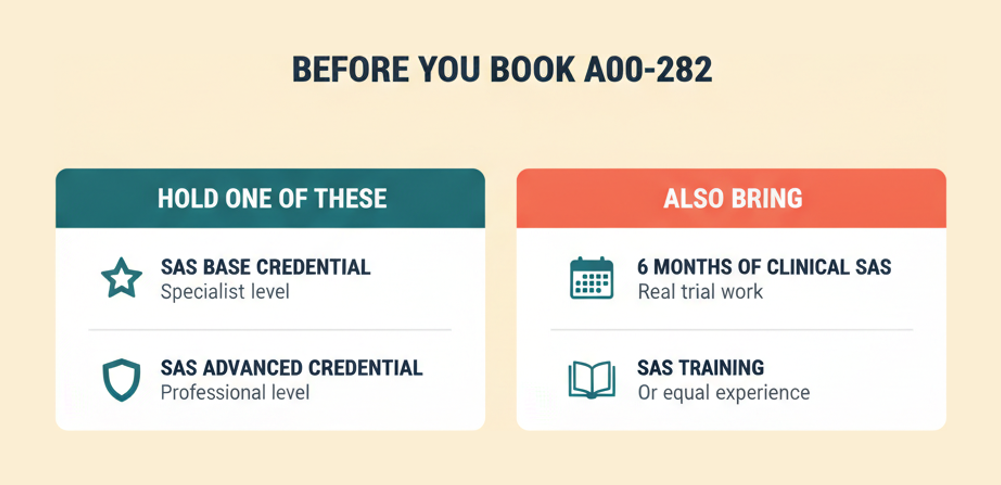
You cannot sit A00-282 cold. SAS requires you to hold either the Base Programming Specialist credential or the Advanced Programming Professional credential first. It also asks for the recommended training or equivalent experience, and at least six months working as a clinical trials programmer using SAS software.
That prerequisite shapes what the exam leaves out. Because every candidate has already proved core DATA step and procedure skills, A00-282 does not spend questions on reading raw files or basic syntax. It assumes them, and builds clinical problems on top.
The six months of experience matters for a different reason. Many objectives describe tasks you only meet on a real study: deriving programming requirements from a statistical analysis plan and an annotated case report form, programming for both safety and efficacy data, or working out why two validation programs disagree. Reading about those tasks is possible. Recognising them in a scenario question is much easier if you have done them.
- Hold one of the two prerequisite SAS credentials before registering
- Have at least six months as a clinical trials programmer using SAS
- Complete the recommended SAS training, or bring equivalent experience
How are the nine A00-282 domains weighted?
A00-282 spreads nine domains between 5 and 20 percent. Validate Clinical Trial Data Reporting leads at 20 percent. Three programming domains, transform or summarise, statistical procedures and macros, carry 15 percent each. Data structures and reporting take 10 percent each, and four smaller domains take 5 percent apiece.
| Domain | Weight | What it covers |
|---|---|---|
| Clinical Trials Process | 5% | Trial phases, key roles and organisations, requirements from an SAP and annotated CRF |
| Clinical Trials Data Structures | 10% | Clinical domains, CDISC terms, SDTM and ADaM, tracing raw data to mapped domains |
| Regulatory Submissions | 5% | SAS V5 requirements for exported data sets, define.xml |
| Manage Clinical Trials Data | 5% | DICTIONARY tables through PROC SQL, outliers, missing versus zero |
| Transform or Summarize Clinical Trials Data | 15% | Windowing, ISO 8601 dates, reshaping, change from baseline, event counts |
| Apply Statistical Procedures for Clinical Trials | 15% | FREQ, UNIVARIATE, MEANS, SUMMARY, error spotting in TTEST, GLM and REG |
| Macro Programming for Clinical Trials | 15% | Macro variables and parameters, automation, MPRINT, SYMBOLGEN, MLOGIC |
| Report Clinical Trials Results | 10% | PROC REPORT, ODS destinations, SGPLOT and SGPANEL graphs |
| Validate Clinical Trial Data Reporting | 20% | Validation principles, the log, PROC COMPARE, independent programs, error types |
Read the table in two groups. The four 5 percent domains total 20 percent, the same as validation alone, and they are mostly knowledge you can learn in a few focused sessions. The three 15 percent domains total 45 percent and are skills, which take practice at a keyboard rather than reading.
That makes the split of study time fairly clear. Give validation and the programming middle the bulk of it, and treat the small domains as quick wins rather than optional extras. Once you know the shape, a set of A00-282 sample questions shows how each domain is actually phrased.
Why is validation the largest domain?
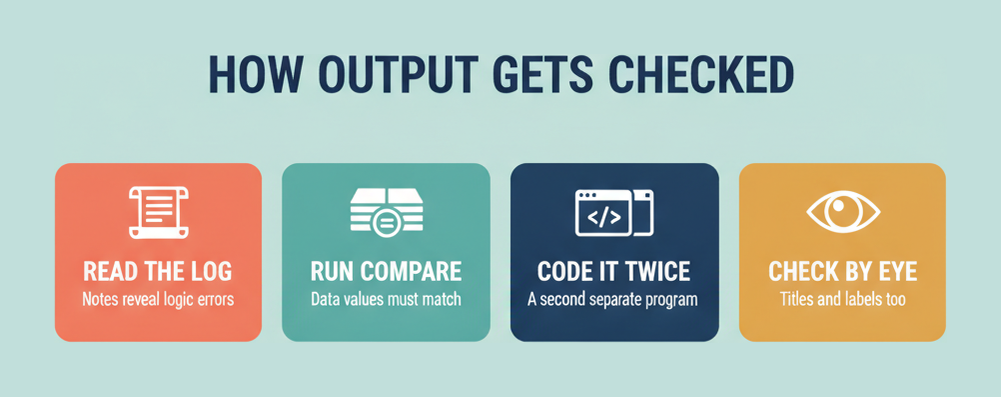
Validation is 20 percent of A00-282 because clinical output is checked before anyone trusts it. The domain tests validation principles in the clinical trial industry, using the SAS log, PROC COMPARE and the MSGLEVEL option, explaining why two independent programs disagree, and identifying and resolving data, syntax and logic errors.
Two programs, one answer
The industry habit behind this domain is independent programming. One programmer produces a data set or table, a second writes their own program from the same specification, and the two results are compared. The exam asks you to determine why two independent validation programs led to a different result, which is a diagnostic question: a different derivation rule, a sort order, a missed record, or a specification read two ways.
What PROC COMPARE does not see
PROC COMPARE is the workhorse, and the blueprint is precise about its limits. You are expected to identify elements that are not validated by a comparison, such as titles, footnotes, and attributes like formats or labels, depending on how they were added to a report. A clean comparison of the data does not prove the finished table is right.
The log as evidence
The log is a validation tool in its own right. Notes about uninitialised variables, automatic type conversion or merges with repeated BY values often point to logic errors that produce plausible output. Setting MSGLEVEL to show more detail makes those notes easier to find, and the exam expects you to read them as evidence rather than noise.
- Data errors: values outside expected ranges, missing where zero was meant
- Syntax errors: code that stops or warns in the log
- Logic errors: code that runs cleanly and returns the wrong answer
The third category is the one to practise. It never announces itself, which is exactly why a second program exists.
How much CDISC does the exam expect?
A00-282 expects working knowledge, not implementation depth. The data structures domain, 10 percent, asks you to identify clinical domains, key CDISC principles and terms, the structure and purpose of SDTM and ADaM, and to trace data from raw collection through to any mapped domain. Regulatory submissions adds define.xml and SAS V5 requirements.
SDTM organises collected trial data into standard domains, and CDISC notes that it is one of the required standards for data submission to the FDA in the United States and PMDA in Japan. The CDISC SDTM standard is the reference for domain structure. ADaM sits downstream, holding the analysis-ready data that tables and figures are built from.
“ADaM standards are developed to align with analysis needs, enable analysis-ready datasets, and support the needs of reviewers, including traceability back to SDTM.”
Traceability is the thread connecting this domain to validation. A reviewer should be able to follow any result back through ADaM and SDTM to the raw data, and the exam’s tracing objective tests that you can do the same.
The submission details
Regulatory submissions is only 5 percent, but both objectives are specific. SAS V5 transport requirements constrain exported data sets, so you should know what they mean for variable names, labels and lengths. The Define-XML specification describes the metadata document that tells a reviewer what each data set and variable contains, and the exam asks for its contents and purpose.
The programming middle: transform, statistics and macros
Three domains at 15 percent each make up 45 percent of A00-282. They cover transforming or summarising clinical data, applying statistical procedures to it, and automating repeated work with macros. These are hands-on skills, and the questions tend to present code and ask what it produces or what is wrong with it.
Transform or summarise
This domain is where clinical conventions meet the DATA step. Expect categorisation and windowing of visits, storing dates to the ISO 8601 standard and checking that existing dates comply, reshaping data with PROC TRANSPOSE or with arrays, counting events, and FIRST. and LAST. processing. Calculating change from baseline is named explicitly, and it is a derivation worth practising until the edge cases, such as a missing baseline, are second nature.
Statistical procedures
You are not tested as a statistician. You are tested as the programmer who runs FREQ, UNIVARIATE, MEANS and SUMMARY correctly, knows whether a procedure suits categorical or quantitative data, spots syntax or semantic errors in FREQ, TTEST, GLM and REG code, and captures results with ODS OUTPUT or OUTPUT statements. The blueprint also asks you to program for both safety and efficacy data.
Macros
The macro domain covers creating macro variables and parameters, using automatic and user-defined variables, and wrapping repeated tasks in macros. Debugging carries weight: MPRINT, SYMBOLGEN and MLOGIC each show a different view of what the macro processor did, and questions often hinge on which one answers the problem in front of you. The SAS documentation hub covers each option in detail.
How much PROC REPORT and ODS does A00-282 test?
Reporting is 10 percent of A00-282, but its objective list is one of the longest on the blueprint. It covers PROC REPORT for tables and listings, ODS statements for destinations and output objects, and SGPLOT or SGPANEL graphs. The questions reward knowing specific statements and options rather than general familiarity.
For PROC REPORT, the blueprint names the COLUMN statement for selecting, aliasing and nesting items, DEFINE for usage, style and sort order, BREAK and RBREAK for summary rows, COMPUTE blocks, LINE statements, CALL DEFINE and the OUT= option. That is most of the procedure, so a candidate who only ever edits an inherited template will find gaps.
The ODS side asks for ODS TRACE to find output object names, SELECT and EXCLUDE to control them, and opening and closing destinations such as PDF, RTF, POWERPOINT, LISTING and WORD with their settings. Graphics include bar charts, box plots, histograms, scatter and series plots, high-low and waterfall charts, with grouping, overlays, reference lines, axes and legends.
This site has covered the credential before, and an earlier look at the clinical trials programming path covers the career side of this work in more depth than the exam facts here.
How should you prepare for A00-282?
Prepare in proportion to the weights, at a keyboard, on clinical-shaped data. Confirm your prerequisite credential first, then give validation and the three 15 percent programming domains most of your time, and close with the smaller knowledge domains and a timed run through sample and practice questions.
- Confirm you hold the Base Programming Specialist or Advanced Programming Professional credential before you book.
- Read the exam content guide once end to end, so every objective is familiar before you study any of them.
- Practise validation by writing a second, independent program for a table and resolving every difference PROC COMPARE reports.
- Work through transform, statistics and macro tasks on data with visits, baselines and adverse events, since those three domains are 45 percent of the paper.
- Build one full listing with PROC REPORT and ODS, including COMPUTE blocks, a summary row and output to RTF or PDF.
- Spend focused sessions on CDISC, define.xml, SAS V5 transport rules and DICTIONARY tables.
- Finish with a timed practice exam and review every miss by domain.
SAS gathers its free practice exam, sample questions, content guide and recommended courses on the A00-282 certification pathway. The recommended reading there includes titles such as SAS Programming in the Pharmaceutical Industry, Implementing CDISC Using SAS, and Validating Clinical Trial Data Reporting with SAS, the last of which maps directly onto the largest domain.
If the prerequisite is still ahead of you, start there. The site’s guide to the A00-231 base programming exam covers the credential most candidates use to qualify.
Frequently Asked Questions
How many questions are on the A00-282 exam?
Between 60 and 70 questions, a mix of multiple choice and short-answer items, answered in 110 minutes.
What is the passing score for A00-282?
You need 68 percent to pass, as published by SAS and by the exam syllabus.
How much does the SAS clinical trials certification exam cost?
The fee is 180 USD, charged in US dollars in every country.
Do I need another SAS certification first?
Yes. You must hold either the Base Programming Specialist or the Advanced Programming Professional credential before taking A00-282.
How much experience does SAS recommend?
At least six months as a clinical trials programmer using SAS software, along with the recommended training or equivalent experience.
Which domain carries the most weight?
Validate Clinical Trial Data Reporting at 20 percent, the largest of the nine domains.
Does A00-282 test CDISC standards?
Yes. The data structures domain covers CDISC principles and terms and the structure and purpose of SDTM and ADaM, and the regulatory domain covers define.xml.
How do I register for the A00-282 exam?
Register with the exam ID A00-282. The exam is administered by SAS and Pearson VUE, and registration starts from the SAS credential page.
Is A00-282 based on SAS 9.4 or SAS Viya?
SAS 9.4. The exam name is Clinical Trials Programming Using SAS 9.4, and the credential carries the same version.
Conclusion
A00-282 is a clinical programmer’s exam with a checker’s centre of gravity. Validation is 20 percent, the largest of nine domains, and the three programming domains add 45 percent more. The format is 60 to 70 questions in 110 minutes at 68 percent, for 180 USD, and you need a prerequisite SAS credential before you can book.
Spend your time where the weight is. Write second programs and chase every PROC COMPARE difference, practise change from baseline and ISO 8601 dates until they are routine, and build a full PROC REPORT listing through ODS. Then close the smaller CDISC and submission domains, which are quick to learn and costly to leave empty.
When the domains feel familiar, test yourself under time and review each miss by domain, so the last week goes to the areas that actually cost you marks.


