A regional sales manager opens the pipeline dashboard on a Monday and finds every opportunity in the company on it, including three regions she has no business seeing. The chart is fine. The colours are fine. What failed sits two layers below the chart, in the dataset’s row-level security, and it was configured weeks before anyone drew a bar. That gap between what a dashboard shows and what makes it trustworthy is the subject of the Salesforce CRM Analytics certification, and it explains why the exam spends less than a third of its marks on dashboards at all.
The credential’s full name is Salesforce Certified CRM Analytics and Einstein Discovery Consultant, and its exam code is Analytics-Con-201. This article sets out the exam details, the six weighted sections, what each one expects you to do inside the product, where security and Einstein Discovery catch people out, and a preparation order built on Salesforce’s own study modules.
Table of Contents
- What does the CRM Analytics certification actually cover?
- How many questions, how long, and what does Analytics-Con-201 cost?
- How are the six exam sections weighted?
- Why does the Data Layer carry the most weight?
- How is CRM Analytics security different from Salesforce sharing?
- What do the two dashboard sections ask you to build?
- What does Einstein Discovery add to the exam?
- Who is this credential written for?
- How should you prepare for Analytics-Con-201?
- Keeping the Certification Active
- Frequently Asked Questions
- Conclusion
What does the CRM Analytics certification actually cover?
The CRM Analytics certification, exam Analytics-Con-201, tests whether you can design and implement analytics on Salesforce’s CRM Analytics and Einstein Discovery platforms from end to end. It covers enabling the product, loading and preparing data, securing datasets and apps, designing and building dashboards, and creating predictive models, across six weighted sections.
Salesforce describes the holder as someone with experience designing and implementing on both platforms in a customer-facing or internal architect role, which is the wording on the official credential page. The word consultant matters. Questions are framed as a customer requirement followed by a choice of approach, so knowing where a button sits helps less than knowing which of two valid tools fits the stated constraint.
One product, three names
Older study material describes the same product under different names. CRM Analytics was previously sold as Tableau CRM, and before that as Einstein Analytics. Search data still shows people looking for an Einstein Analytics certification and a Tableau CRM and Einstein Discovery Consultant exam. Both lead to this credential. Neither should be confused with the Tableau exams, which Salesforce also runs and which test a separate product with its own exam codes.
How many questions, how long, and what does Analytics-Con-201 cost?
Analytics-Con-201 has 65 questions, a 90 minute time limit and a 65 percent passing score, according to the money-site syllabus page used for this article. Registration costs USD 200 and a retake costs USD 100. The exam is booked through Salesforce’s testing providers and can be taken at a test centre or online.
| Detail | Analytics-Con-201 |
|---|---|
| Credential | Salesforce Certified CRM Analytics and Einstein Discovery Consultant |
| Exam code | Analytics-Con-201 |
| Number of questions | 65 |
| Duration | 90 minutes |
| Passing score | 65 percent |
| Registration fee | USD 200 |
| Retake fee | USD 100 |
| Weighted sections | 6 |
| Maintenance | Release maintenance modules once per year |
Which of these figures Salesforce confirms in public
Salesforce’s own pages confirm the credential name, the exam code and all six section weights, and the weights match the syllabus page to the percentage point. The question count, duration, passing score and fees sit in Salesforce’s exam guide, a help article that does not display its contents to automated readers, so those five figures here rest on the syllabus page alone. Check them against the exam guide when you book.
That caution is practical. Third-party pages disagree with one another on this exam, quoting different passing scores and time limits, and several describe a split between scored and unscored questions that no page readable for this article states. For that reason this article gives no count of correct answers needed. Treat the passing score as a percentage and aim well above it.
Where the exam is delivered
The syllabus page lists two scheduling routes, Kryterion Webassessor and Pearson VUE. Pearson VUE runs a dedicated Salesforce exam delivery page covering test centre and online appointments, and it notes that the price of each exam is shown on that certification’s own detail page. Whichever route your booking uses, Salesforce’s program agreement applies: sharing or requesting exam questions and answers can cost you the attempt and the credential.
How are the six exam sections weighted?
Analytics-Con-201 divides its marks across six sections: Data Layer at 23 percent, Analytics Dashboard Implementation at 19, Admin/Configuration at 17, Security at 16, Analytics Dashboard Design at 13 and Einstein Discovery at 12. The two dashboard sections together come to 32 percent, so 68 percent of the exam is about something other than building a dashboard.
| Section | Weight | What the objectives ask for |
|---|---|---|
| Admin/Configuration | 17% | Enabling CRM Analytics with the right licenses and permission sets, designing within data sync, dataflow and recipe limits, knowing what the CRM Analytics API can do, migrating between environments |
| Data Layer | 23% | Extracting and loading data with Data Manager, scheduling refreshes, transforming data in dataflows and recipes, managing dataset extended metadata, versioning and conversion |
| Security | 16% | Asset security for users, groups and profiles, row-based security through sharing inheritance and security predicates, app sharing |
| Analytics Dashboard Design | 13% | Scoping and prioritising requirements, applying best practices and UX design principles, choosing and configuring a templated app |
| Analytics Dashboard Implementation | 19% | Query types and widget parameters, selection and result interactions, windowing and time series in compare tables, Lightning page embedding, Dashboard Inspector, versioning and Dashboard Publisher |
| Einstein Discovery | 12% | Building numeric, binary and multi-classification models, analysing results, improving the model, enabling predictions on Lightning record pages, reading a Model Card |
Reading the objectives is not the same as answering them under a clock. A sensible early step is to work through a set of Analytics-Con-201 sample questions before you plan your study weeks, because the scenario style shows quickly which sections you can reason through and which you only recognise by name.
What the 32 percent figure changes
Most people come to this exam from the dashboard side. They have built lenses, arranged widgets and presented to stakeholders. The weighting says that experience is worth roughly a third of the marks. Admin/Configuration, Data Layer and Security together are 56 percent, and they are the sections a dashboard builder is least likely to have owned on a real project. Plan your hours by weight and by weakness, not by what you enjoy building.
Why does the Data Layer carry the most weight?
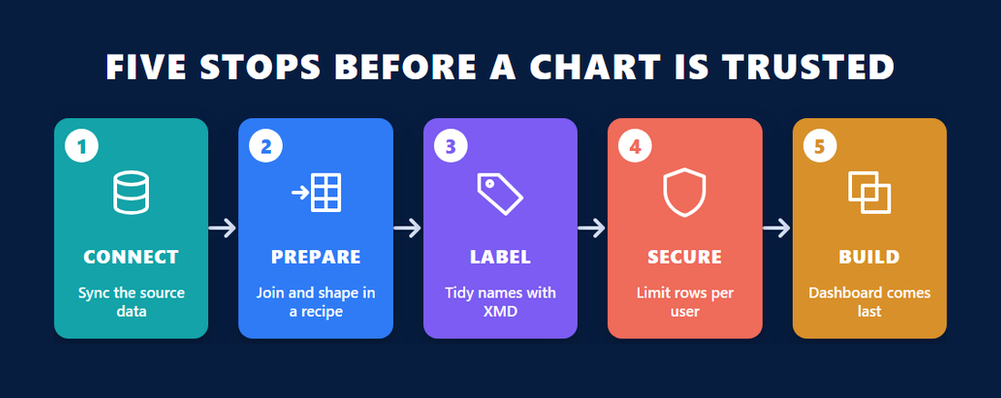
The Data Layer is the largest section of Analytics-Con-201 at 23 percent because every later decision depends on it. CRM Analytics does not query Salesforce records live. It works on datasets that are extracted, transformed and stored, so the exam tests how data gets in, how it is reshaped, how often it refreshes and how it is labelled.
Getting data in
Data Manager is the workspace for this section. Connections bring in Salesforce objects and data from outside Salesforce, and data sync stages that data on a schedule so that the jobs which build datasets read a prepared copy instead of extracting everything again. Salesforce’s study material for the section also covers bringing data from more than one Salesforce org and loading a CSV file, including how date values are handled on the way in.
Recipes and dataflows
Two tools turn staged data into datasets. Recipes are the visual data preparation tool, with joins, appends and transformations added as nodes. Dataflows are the older approach, defined as a set of transformation steps. The objectives name both in the same breath, and they add one item that reveals where the product is heading: delivery management strategies that include versioning and conversion. Expect scenarios that ask which tool fits, and how to refresh without colliding with platform limits.
Extended metadata
Dataset extended metadata, shortened to XMD, controls how fields appear to users: labels, value formats and colours. The objective is small on paper and frequent in practice. A dataset with raw API field names produces dashboards nobody trusts, and the exam treats fixing that at the dataset level, once, as the correct answer over patching each chart.
How is CRM Analytics security different from Salesforce sharing?
CRM Analytics security is separate from the sharing model on Salesforce records, and Analytics-Con-201 gives it 16 percent of the marks. A dataset does not inherit record access by default. Access is controlled in layers: who can use the product, who can open an app, and which rows of a dataset each person can see.
The first layer is permissions, which overlaps with Admin/Configuration: licenses and permission sets decide who can use CRM Analytics at all. The second is app sharing, where an app and the dashboards, lenses and datasets inside it are shared with users, roles or groups at a chosen access level. The third layer is the one from the opening scene, row-level security on the dataset itself.
Sharing inheritance and security predicates
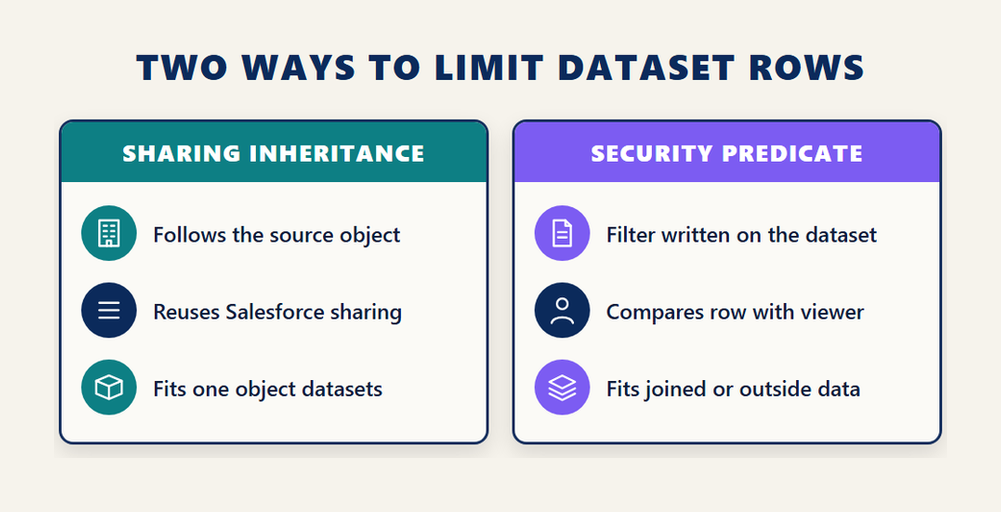
The objectives name two ways to restrict rows. Sharing inheritance lets a dataset follow the sharing settings of the Salesforce object it came from. A security predicate is a filter condition written on the dataset that compares a column in each row with something about the person running the query, such as their user ID or role. Scenarios usually turn on which one fits: predicates are the tool for data that did not come from a single supported Salesforce object, or for rules the Salesforce sharing model does not express.
Two habits help here. Read each security question for the level it is asking about, because an answer that fixes app access does nothing for row access. And remember that a dashboard query runs as the viewer, so a correct chart for the builder proves nothing about what a field sales user will see.
What do the two dashboard sections ask you to build?
The two dashboard sections of Analytics-Con-201 split the work into planning and construction. Analytics Dashboard Design, at 13 percent, covers scoping requirements, layout, UX principles and templated apps. Analytics Dashboard Implementation, at 19 percent, covers queries, widget settings, interactions, compare tables, embedding, performance and release management.
Design: requirements before widgets
The design objectives start with scoping, validating and prioritising what the business has asked for, which is consultant work, not chart work. They then cover building to CRM Analytics best practices and choosing a standard templated app when one already answers the requirement. Salesforce’s study references for this section include prebuilt apps and the Event Monitoring Analytics app, so know what a template gives you and what it needs in place before it can be installed.
Implementation: queries, interactions and SAQL
Implementation is the second largest section of the exam. Its objectives cover choosing the right query type, wiring selection and result interactions so that one widget drives another, and using windowing and time series functions inside compare tables. Salesforce’s candidate profile adds that you should be able to read and write Salesforce Analytics Query Language, called SAQL, and Salesforce Object Query Language, for the cases the visual editor cannot reach.
The profile also names JSON as required knowledge. Dashboards and several other CRM Analytics assets are stored as JSON documents, and advanced changes are made by editing that definition directly. If the format is unfamiliar, the short JSON data interchange standard defines the objects, arrays and value types you will be reading, and an hour with it pays off in every implementation scenario.
Performance and release
The last three implementation objectives are operational: making dashboards actionable and available inside Lightning pages, finding slow queries with Dashboard Inspector, and managing change with versioning and Dashboard Publisher. They are easy marks for anyone who has shipped a dashboard to real users and hard ones for anyone who has only built in a practice org.
What does Einstein Discovery add to the exam?
Einstein Discovery is the predictive part of Analytics-Con-201 and carries 12 percent. It asks you to build a model from a dataset by choosing one of three prediction types, numeric, binary or multi-classification, then to interpret the results, improve the model by changing the data, place predictions on Lightning record pages, and monitor the model through its Model Card.
The section rewards judgement over mathematics. A typical scenario gives you a model with weak results and asks what to change: remove a column that leaks the outcome, drop fields that carry no signal, add data that covers a missing group, or adjust how a variable is bucketed. Salesforce’s candidate profile asks for working knowledge of statistics and the data science lifecycle, which means recognising a poor model, not deriving an algorithm.
Why the Model Card objective matters
The final objective, monitoring and interpreting a Model Card, borrows a practice from machine learning research. The idea was set out in the paper Model Cards for Model Reporting, which argued that every trained model should ship with a short record of what it is for and how well it performs.
“Model cards are short documents accompanying trained machine learning models that provide benchmarked evaluation in a variety of conditions.”
In Einstein Discovery terms, that is the place a consultant looks to judge whether a deployed prediction is still fit for use, and the exam expects you to read it and act on it. One note on vocabulary: Salesforce’s free preparation modules still describe this section with the older word story, while the current objectives say model. They refer to the same work.
Who is this credential written for?
The CRM Analytics and Einstein Discovery Consultant credential is written for people who implement analytics on Salesforce for others: consultants, analytics developers and internal architects. Salesforce’s candidate profile assumes prior experience with business intelligence, data preparation and reporting tools, plus the ability to administer, configure and secure CRM Analytics itself.
The profile, published in Salesforce’s preparation module, is unusually specific. Rewritten as a checklist, a ready candidate can:
- Design dashboards for desktop and mobile with attention to user experience
- Read and write SAQL and SOQL
- Build data preparation processes that produce and maintain datasets
- Explain master data management and data modelling at a working level
- Build and improve predictions in Einstein Discovery, including writing results back to Salesforce
- Apply basic statistics and follow the data science lifecycle
- Lead a technical project and take requirements from stakeholders
Experience administering Salesforce itself is listed as optional, which surprises people. In practice it helps a great deal, because security and Lightning page questions assume you know what a profile, a role and a permission set are.
If your work sits closer to customer data unification than to dashboards, the neighbouring Salesforce data credential may suit you better, and our breakdown of the Data 360 Consultant exam shows how differently that one is weighted.
How should you prepare for Analytics-Con-201?
Prepare for Analytics-Con-201 in the order the data moves: enable and configure the product, load and prepare data, secure it, build dashboards, then add predictions. Salesforce publishes three free preparation modules that follow the six sections, each with scenario questions and flashcards, and a practice org is essential for every stage.
- Start with the first of Salesforce’s three modules, the official certification prep module, and note the six section weights before you study anything else.
- Set up a practice org with CRM Analytics enabled and assign the licenses and permission sets yourself, so the Admin/Configuration objectives are things you have done.
- Build one dataset three ways: from a synced Salesforce object, from a CSV file and from a recipe that joins two sources, then edit its extended metadata.
- Apply row-level security to that dataset with a security predicate, log in as a second user and confirm what that user can and cannot see.
- Build a dashboard with at least one selection interaction and one compare table, embed it in a Lightning page and check it with Dashboard Inspector.
- Create an Einstein Discovery model on the same data, remove a weak column, compare the two versions and read the Model Card.
- Finish with timed practice in the scenario style, and return to the section where your answers were slowest.
The sequence is deliberate. Each step produces the asset the next one needs, and security comes before dashboards because that is the order in which real projects go wrong. For a quick reference to the topic list while you work, the exam topics page on this site keeps the sections in one place under the product’s earlier name.
The syllabus page also lists two Salesforce courses as recommended training: Building Lenses, Dashboards, and Apps in CRM Analytics, coded ANC201, and Implement and Manage CRM Analytics, coded ANC301. They map neatly onto the dashboard sections and the data and security sections in turn.
Keeping the Certification Active
Passing Analytics-Con-201 is not the end of the commitment. Salesforce requires certified professionals to complete release maintenance modules for their credentials once per year, and a credential whose maintenance deadline is missed expires. The modules are completed on Trailhead and focus on what changed in the product since the last cycle.
For this credential that requirement is more than a formality. The product has been renamed twice, recipes have steadily taken over work that dataflows used to do, and the Einstein Discovery vocabulary has moved from stories to models. A consultant who passed two years ago and skipped the release notes would recognise the exam sections and misread several of the questions. Add the maintenance deadline to your calendar on the day you pass.
Frequently Asked Questions
What is the CRM Analytics certification called officially?
Its official name is Salesforce Certified CRM Analytics and Einstein Discovery Consultant, and the exam code is Analytics-Con-201. Older material calls it the Tableau CRM and Einstein Discovery Consultant or the Einstein Analytics and Discovery Consultant, after earlier names of the same product.
How many questions are on Analytics-Con-201?
The syllabus page used for this article lists 65 questions to be answered in 90 minutes. Salesforce’s exam guide is the place to confirm the current count when you book, because the public Salesforce pages readable for this article do not display it.
What is the passing score for the CRM Analytics exam?
The syllabus page gives a passing score of 65 percent. Some third-party pages quote other figures, and none of them is a visible Salesforce source, so use 65 percent as the published figure and confirm it in the exam guide.
How much does the Analytics-Con-201 exam cost?
Registration is USD 200 and a retake is USD 100, according to the syllabus page. Pearson VUE notes that the price of each Salesforce exam is shown on that certification’s detail page, and local taxes may apply.
Which section of the exam is the largest?
Data Layer is the largest at 23 percent, followed by Analytics Dashboard Implementation at 19 percent and Admin/Configuration at 17 percent. Security is 16 percent, Analytics Dashboard Design 13 percent and Einstein Discovery 12 percent.
Is the CRM Analytics certification the same as a Tableau certification?
No. CRM Analytics is built into the Salesforce platform and was once branded Tableau CRM, but the Tableau exams cover a separate product and carry their own codes. Analytics-Con-201 is the exam for CRM Analytics and Einstein Discovery.
Do you need to know SAQL to pass?
Yes, at a reading and writing level. Salesforce’s candidate profile lists competency in SAQL and SOQL, and the implementation section covers requirements the visual editor cannot meet. You also need to be comfortable reading JSON.
How much of the exam is Einstein Discovery?
Einstein Discovery is 12 percent of Analytics-Con-201. It covers choosing a numeric, binary or multi-classification prediction, interpreting and improving a model, enabling predictions on Lightning record pages and reading a Model Card.
Does the certification expire?
It stays active as long as you complete Salesforce’s release maintenance modules, which are required once per year. If the maintenance deadline is missed, the credential expires.
Conclusion
The CRM Analytics certification is an implementation exam that happens to end in a dashboard. Analytics-Con-201 puts 23 percent on the Data Layer, 17 on Admin/Configuration and 16 on Security before a single widget is placed, gives the two dashboard sections 32 percent between them, and reserves 12 percent for Einstein Discovery. The syllabus page lists 65 questions, 90 minutes, a 65 percent passing score and a USD 200 fee, and Salesforce’s own pages confirm the name, code and weights.
Study in the order the data moves, do every step in a practice org, and test your security as a second user before you trust any chart. When the sections feel familiar, time yourself on scenario questions, book the exam, and put the yearly maintenance date in your calendar the day you pass.


