Check which Talend screens fill your working week before you book this exam. The Talend Data Quality Certified Implementer credential, exam code TDQCI, is often assumed to be a Talend Studio test about profiling and matching components. Only two of its five topic areas sit in Studio. The other three belong to browser applications in Talend Cloud: Data Inventory, Data Preparation and Data Stewardship. A developer who has never opened those three will meet them on more than half of the published objectives.
This article follows the exam as Qlik and the money-site syllabus publish it. It covers the format and cost, the five topic areas and their 24 objectives, how the Talend Trust Score is built, what stewardship campaigns ask of people, what the Studio half expects, the experience Qlik recommends, the retake and expiry rules, and a preparation order that follows the official topic list.
Table of Contents
- What does the Talend Data Quality Certified Implementer badge prove?
- How long is the TDQCI exam, and what does it cost?
- Which five topic areas does the TDQCI exam cover?
- What is the Talend Trust Score, and why is it on the exam?
- How do Data Preparation and Data Stewardship share the cleanup work?
- What does the Talend Studio half of TDQCI expect?
- Who should sit TDQCI, and what experience does Qlik recommend?
- Retakes, results and the two year expiry
- How should you prepare for the TDQCI exam?
- Frequently Asked Questions
- Conclusion
What does the Talend Data Quality Certified Implementer badge prove?
The Talend Data Quality Certified Implementer badge shows that its holder passed Qlik’s TDQCI exam and can use cloud-based and on-premises Talend services to monitor and assess data quality, analyze and align data for accuracy, and identify and resolve data integrity issues. It is a product credential for people who implement quality projects, not a general data management qualification.
Three names circulate for the same exam, and it helps to know all of them before searching. Qlik’s own exam page calls it Talend Data Quality Certified Implementer. The money-site syllabus page lists it as Qlik Talend Data Quality Implementer with the code TDQCI. The description on the Credly badge page, where Qlik issues the badge, refers to passing the Talend Data Value Certified Implementer exam under a badge titled Data Quality. All three point at one exam with one topic list.
Credly rates the badge at the Advanced level and tags it with seven skills, among them Cloud Trust Score, Cloud Data Preparation, Cloud Data Stewardship, Data Quality Assessment and Data Quality Cleansing. That list is a fair summary of the exam’s shape: three cloud applications first, then the assessment and cleansing work that is done in Talend Studio.
Where it sits among the Qlik Talend exams
Qlik groups this exam with its Qlik Talend Data Integration certification exams, alongside the developer, administrator, data catalog and API services credentials. The others test how data is moved, deployed or documented. This one tests whether the data is fit to use once it arrives, which is why its syllabus spends as much time on people and rules as on components.
How long is the TDQCI exam, and what does it cost?
The TDQCI exam for the Talend Data Quality Certified Implementer credential has 45 questions, runs for 90 minutes and needs a passing score of 65 percent. Qlik’s exam details page and the money-site syllabus page agree on all three figures. The syllabus page lists the exam price as 250 US dollars.
| Exam detail | Published value |
|---|---|
| Credential | Talend Data Quality Certified Implementer |
| Exam code | TDQCI |
| Number of questions | 45 |
| Duration | 90 minutes |
| Passing score | 65 percent |
| Exam price | 250 US dollars |
| Attempts allowed | 3 per exam |
| Validity | 2 years from the pass date |
| Recommended experience | At least six months using Talend products |
Forty-five questions in 90 minutes is two minutes a question, which is comfortable for recall and tight for any item that describes a dataset and asks which tool or rule fits. Sixty-five percent of 45 is a little over 29, so plan on needing 30 correct answers and treat anything above that as margin.
Two caveats come straight from Qlik. The exam content is updated periodically, and the number and difficulty of questions may change, with the passing score adjusted to keep the standard consistent. Qlik’s exam page does not display a price and links to the purchase page instead, so confirm the amount there on the day you buy. Seeing real question wording early is the cheapest way to calibrate, and the free TDQCI sample questions show how an objective such as “describe the dimensions used to calculate data trust” turns into an item.
What the exam page leaves out
Qlik’s page for this exam does not display topic weightings, so nobody outside Qlik can say how the 45 questions are split across the five areas. Any percentage you see attached to a TDQCI topic is a guess. The honest way to plan is by objective count, which the next section sets out.
Which five topic areas does the TDQCI exam cover?
The TDQCI exam covers five topic areas: working with data in Talend Cloud Data Inventory, in Talend Cloud Data Preparation and in Talend Cloud Data Stewardship, an overview of data quality, and data quality cleansing and transformations. Qlik’s exam page and the money-site syllabus list the same 24 objectives under those five headings, word for word.
| Topic area | Objectives | Where the work happens |
|---|---|---|
| Work with data using Talend Cloud Data Inventory | 7 | Talend Cloud |
| Work with data using Talend Cloud Data Preparation | 4 | Talend Cloud, with components in Talend Studio |
| Work with data using Talend Cloud Data Stewardship | 5 | Talend Cloud |
| Overview of data quality | 4 | Talend Studio |
| Data quality cleansing and transformations | 4 | Talend Studio |
Sixteen of the 24 objectives belong to the three cloud applications, and eight to the Studio topics. That is a count of objectives, not a weighting, but it is the only published signal of where the syllabus puts its attention, and it runs against the common assumption that this is a components exam.
The objectives, area by area
The Data Inventory area asks you to define the application in context, differentiate between the supported connection types, access datasets using the data crawler and using an API, describe the advantages and disadvantages of applying semantic types across Data Preparation, Data Inventory and Data Stewardship, describe the dimensions used to calculate data trust, and use the Talend Trust Score.
The Data Preparation area covers defining the application in context, preparing data using Data Inventory and Data Preparation together, managing Data Preparation components in Talend Studio, and transforming raw data into a form suitable for analysis. The Data Stewardship area covers defining the application, differentiating between predefined roles and role-based access, managing campaigns and tasks, building resolution campaigns, and managing data quality rules.
The overview area asks you to define data quality in context, differentiate between the types of data quality analyses, monitor data movement and automate checks with business rules, and perform reconciliations between source and target. The cleansing area asks you to use the data quality components for profiling, standardization, matching and consolidation, implement data quality transformations, establish data auditing processes, and describe the use of data privacy components.
What is the Talend Trust Score, and why is it on the exam?
The Talend Trust Score is a single quality indicator in Talend Cloud Data Inventory that rates a dataset from 0 to 5 by combining several metrics. The TDQCI exam names it in two objectives, one on the dimensions used to calculate data trust and one on using the score, so it is the most directly examinable feature in the cloud half.
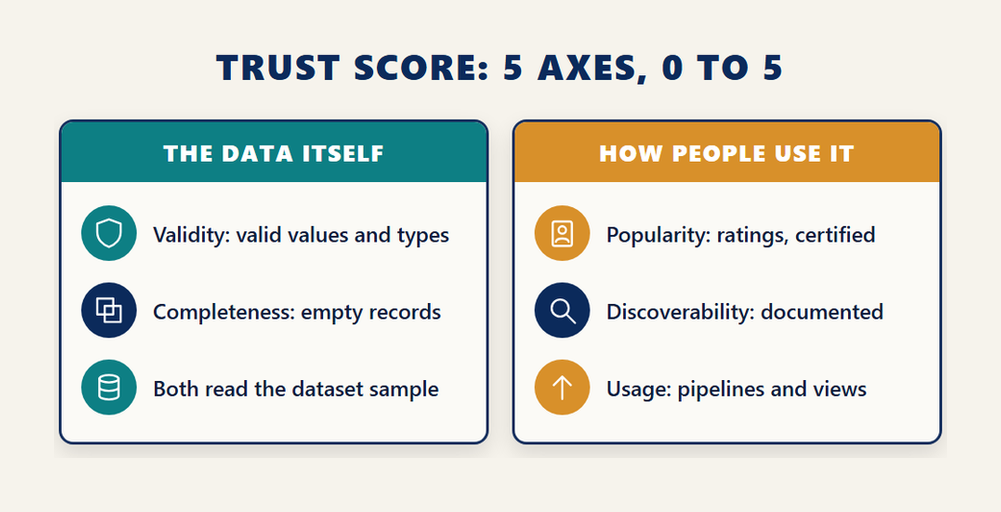
Qlik’s documentation groups the factors that raise or lower the score under five axes. Learn them as a set, because a question that describes a dataset and asks why its score is low can only be answered by knowing which axis each symptom belongs to.
| Axis | What it measures |
|---|---|
| Validity | Valid and invalid values across the dataset sample, and the use of semantic types |
| Completeness | The number of empty records in the dataset sample |
| Popularity | User ratings and the certification level of the dataset |
| Discoverability | How well documented the dataset is, through a description, tags or custom attributes |
| Usage | How much the dataset feeds pipelines or preparations, and how often it is viewed |
Notice that only two of the five axes describe the data itself. Popularity, discoverability and usage describe how people treat the dataset, which is a deliberate design choice: a clean table that nobody has documented, rated or used is still hard to trust. The Talend Trust Score documentation also describes the evolution view, which plots the score over the last 7, 30 or 90 days.
“Most companies still treat data trust like an IT hygiene issue. It’s not. It’s the foundation of every AI decision a business makes.”
Semantic types tie the three applications together
A semantic type tells Talend what a column means, such as an email address or a country, instead of only what data type it holds. The validity axis depends on it, since a value can only be judged invalid against a meaning. The syllabus asks for the advantages and disadvantages of applying semantic types across all three cloud applications, so expect questions on what happens when a type is assigned wrongly as well as when it is right.
Connections, the crawler and Data APIs
Three Data Inventory objectives concern access: the supported connection types, the data crawler and API access. On the API side, Qlik’s documentation describes Data Inventory generating an API from a dataset so that applications or business partners can consume the data it contains. Read the connection, crawler and Data API sections of the Data Inventory user guide with one question in mind: when would I pick each?
How do Data Preparation and Data Stewardship share the cleanup work?
On the TDQCI exam, Talend Cloud Data Preparation is where one person cleans and reshapes a dataset through a recipe of steps, and Talend Cloud Data Stewardship is where records that need a human decision are routed to named people as tasks. The first is self-service, the second is organised collaboration, and the syllabus tests both.
Data Preparation
The four Data Preparation objectives move from definition to practice. You are expected to explain where the application fits, prepare data that was first registered in Data Inventory, and turn raw data into something an analyst can use. The fourth objective is the one Studio developers recognise: managing Data Preparation components in Talend Studio, which is how a preparation built in the browser is applied inside a Job.
Data Stewardship
Qlik’s documentation describes campaigns and tasks as the core concepts of Data Stewardship. A campaign is the unit of work for a campaign owner, who decides what the tasks are about, what stewards must do to resolve them, who takes part and what workflow they follow. A task is the unit of work for a data steward. Campaign owners and data stewards are the two predefined roles.
| Campaign type | What the data steward does | Outcome |
|---|---|---|
| Arbitration | Chooses a label from a list set by the campaign owner | The arbitration choice |
| Resolution | Corrects one or several fields of a record | The curated record |
| Merging | Merges potential duplicate source records into one | The golden record |
| Grouping | Validates a relationship between pairs or groups of records | The list of associated records |
The syllabus singles out resolution campaigns by name with the objective “build resolution campaigns”, so know that type best. Be equally clear on the difference the exam draws between predefined roles and role-based access: the two built-in roles come ready to assign, while administrators can also create custom roles in Talend Management Console.
What does the Talend Studio half of TDQCI expect?
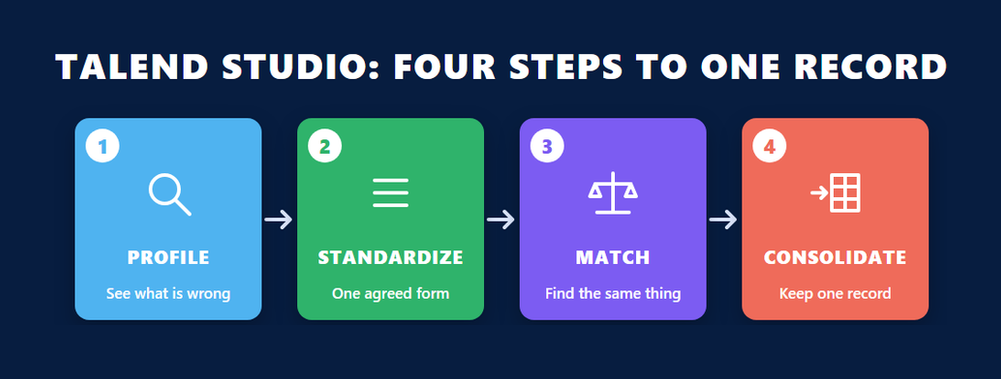
The Studio half of the TDQCI exam is two topic areas with four objectives each. The overview area tests whether you can pick the right kind of analysis and automate checks with business rules. The cleansing area tests the four component families Qlik names, profiling, standardization, matching and consolidation, plus auditing and data privacy.
Overview of data quality
Start with the phrase “types of data quality analyses”. Studio profiles data at different scopes, and a question will usually describe a need and ask which analysis answers it. Checking the fill rate of one column is a different job from checking that every order row points at a real customer. The remaining objectives are operational: monitoring data as it moves, turning checks into business rules that run without a person, and reconciling a source against its target after a load.
Cleansing and transformations
The four families form a natural order. Profiling shows what is wrong. Standardization puts values into one agreed form. Matching finds records that describe the same thing. Consolidation decides which values survive into the single record that is kept. An exam item that names a symptom, such as the same supplier spelled five ways, is asking which family addresses it.
The last two objectives are easy to skip and should not be. Establishing data auditing processes is about keeping evidence of what was checked and changed. Describing the use of data privacy components is about protecting sensitive values while the data stays usable. Neither needs deep build experience, and both are stated objectives.
The vocabulary in this half is not Talend’s alone. Validity, completeness and the other quality dimensions come from the wider data management discipline, and the DAMA body of knowledge is the vendor-neutral reference that treats data quality as one of its knowledge areas. Reading how the discipline frames the problem makes the “define data quality in context” objectives much easier to answer.
Who should sit TDQCI, and what experience does Qlik recommend?
Qlik recommends the TDQCI exam for people with at least six months of experience using Talend products, including experience with data preparation, data stewardship, data inventory and data analysis in Talend Cloud. It also asks for thorough knowledge of data processing and management, and familiarity with the data quality features in Talend Studio.
Those four lines describe a mixed profile. A pure Studio developer meets the last one and may miss the second. A data steward or analyst who lives in the cloud applications meets the second and may miss the last. The candidates who find the exam straightforward are usually the ones who have sat on both sides of a quality project.
The four learning paths and their length
Qlik points candidates to four learning paths, and the Credly badge page publishes a duration for each.
| Learning plan | Published duration |
|---|---|
| Talend Cloud Trust Score | 1 day course, 7 hours |
| Talend Cloud Data Preparation | 1 day course, 6 hours |
| Talend Cloud Data Stewardship | 1 day course, 7 hours |
| Talend Data Quality Essentials | 2 day course, 14 hours |
That is 34 hours of structured training, with 20 of them on the cloud applications and 14 on Studio. Qlik also lists a preparation training module for this exam and six documents to read: the Data Inventory user guide and its getting started guide, the Data Preparation and Data Stewardship user guides, the Talend Studio user guide, and a paper called 10 Best Practices for Successful Data Quality.
If you want the topic list and question style on one page of this site, the existing TDQCI topics and questions page is a compact companion to the official outline.
Retakes, results and the two year expiry
A Talend Data Quality Certified Implementer result is shown immediately after the TDQCI exam ends. Qlik permits three attempts per exam, each paid in full or covered by a new voucher, and every Qlik certification is valid for two years from the date of passing. Those rules are set out in Qlik’s certification policy and apply across its exams.
If you do not pass
After a first failed attempt you must wait 48 hours. After a second, the wait is 14 calendar days from the previous test date before the third and final attempt. A third failure blocks you from registering for that exam until a new version is released. Qlik enforces the waiting periods, so a retake cannot be scheduled inside them. The full wording is in the certificates and badges policy.
If you pass
Qlik no longer issues certificates. Within 24 to 48 hours of passing, Credly sends an invitation to claim the digital badge, and the result also appears in your Qlik Learning profile. Credly sends a reminder six months before the badge expires. To keep the certification you register for the current exam before the expiry date and pass it again. Qlik says exams are usually updated every three years, sooner after a major product update.
“The hardest part of AI is rarely the model. It’s trusting the data behind it. In our business, if we can’t stand behind the data, we can’t stand behind the decisions.”
Both quotations in this article come from Qlik’s Trust Score for AI announcement, which extends the score with AI-focused dimensions. The TDQCI topic list still names the original Talend Trust Score, so study the five axes above first.
How should you prepare for the TDQCI exam?
Prepare for the TDQCI exam by following the published topic list in order, cloud applications first and Talend Studio second, and by doing each objective once in the product instead of only reading about it. With 24 objectives and 45 questions, almost every objective is likely to be asked about, so there is no safe area to skip.
- Print the 24 objectives from Qlik’s exam page and mark each one as done at work, seen once or never touched.
- Take the Talend Cloud Trust Score learning path, then register a dataset in Data Inventory and explain its score axis by axis.
- Work through the Data Preparation path and apply one preparation from inside a Talend Studio Job.
- Complete the Data Stewardship path and build a resolution campaign with at least one data steward assigned.
- Finish the Talend Data Quality Essentials path, running one analysis and one Job for each of profiling, standardization, matching and consolidation.
- Sit timed sets at two minutes a question and trace every miss back to the objective it came from.
The first step matters more than it looks. Because Qlik publishes no weightings, your own gap list is the only sound basis for dividing study time. Most candidates find their gaps cluster in whichever half they do not use at work.
Keep the Qlik Talend Help Center open while you practise. Qlik says candidates should be comfortable searching it for documents that match the exam topics, and its Community knowledge base articles are on the recommended reading list too. The official exam details page is the place to recheck the topic list a week before you sit, since content is updated periodically.
Data quality and metadata management sit close together in real projects, and the next step for many holders is the catalog credential. The Talend Data Catalog exam page on this site outlines that syllabus.
Frequently Asked Questions
How many questions are on the TDQCI exam?
The TDQCI exam has 45 questions and a 90 minute time limit. Qlik notes that exam content is updated periodically and that the number and difficulty of questions may change.
What is the passing score for the Talend Data Quality Certified Implementer exam?
The passing score is 65 percent. On 45 questions that is a little over 29, so aim for at least 30 correct answers. Qlik adjusts the passing score when content changes to keep the standard consistent.
How much does the Talend data quality certification cost?
The money-site syllabus page lists the TDQCI exam price as 250 US dollars. Qlik’s exam page links to the purchase page without displaying a price, and each retake needs full payment or a new voucher.
Is TDQCI a Talend Studio exam?
Only in part. Two of the five topic areas, with 8 of the 24 objectives, are Talend Studio topics. The other three areas cover Talend Cloud Data Inventory, Data Preparation and Data Stewardship.
Does Qlik publish topic weightings for TDQCI?
No. Qlik’s exam page lists the five topic areas and their objectives without percentages. Plan your study by objective count and by your own gaps.
How long is the Talend Data Quality Certified Implementer badge valid?
Two years from the date you pass. To keep it, register for the current exam before the expiry date and pass again. Credly sends a notification six months before the badge expires.
How many times can you retake the TDQCI exam?
Qlik permits three attempts per exam. You wait 48 hours after the first failed attempt and 14 calendar days after the second. After a third failure you are blocked until a new exam is released.
What experience do you need before taking TDQCI?
Qlik recommends at least six months of experience using Talend products, experience with data preparation, stewardship, inventory and analysis in Talend Cloud, and familiarity with the data quality features in Talend Studio. These are recommendations, not entry requirements.
What are the five axes of the Talend Trust Score?
Validity, completeness, popularity, discoverability and usage. Together they produce a score from 0 to 5 for a dataset in Talend Cloud Data Inventory.
Conclusion
The Talend Data Quality Certified Implementer exam is 45 questions in 90 minutes with a 65 percent passing score, and its syllabus is wider than its reputation. Three of the five topic areas test Talend Cloud Data Inventory, Data Preparation and Data Stewardship, and two test profiling, rules, cleansing and privacy work in Talend Studio. Qlik publishes no weightings, so the 24 objectives are the plan. Learn the five Trust Score axes, build one resolution campaign, run one Job for each component family, and close the gaps in whichever half you do not use at work. Then check the topic list on Qlik’s exam page once more, book the exam on Qlik Learning, and keep the two year expiry date in your calendar from the day you pass.


