If you are the person a data team calls when a role grant goes wrong, when a warehouse burns credits overnight, or when a region fails and someone has to redirect every client connection, the SnowPro Advanced Administrator certification describes your job. It is Snowflake’s role-based exam for whoever runs the account itself: the roles, the logins, the network rules, the bill and the recovery plan. ADA-C02 is the current version, and almost a third of it is about who can reach what.
The exam has 65 questions in 115 minutes, costs $375 and is scored on a scale of 0 to 1000 with 750 needed to pass. Snowflake writes it for people with two or more years of hands-on experience as a Snowflake Administrator in a production environment. Below you will find who it suits, what each of the six domains weighs and asks you to do, where the administrator exam sits among the other SnowPro Advanced credentials, and a preparation order that follows the weightings.
Who Needs the SnowPro Advanced Administrator Certification?
The SnowPro Advanced Administrator certification is for people who already run a Snowflake account in production and want proof that they can do it well. Snowflake asks for two or more years of hands-on administration, and the ADA-C02 blueprint spends most of its weight on access control, monitoring, cost and governance rather than on writing queries.
On its official certification page, Snowflake lists five abilities the credential validates: managing and administering accounts, data security and governance; managing and maintaining database objects and virtual warehouses; database monitoring, tuning and optimization; data sharing and use of the Snowflake Marketplace; and disaster recovery, backups and replication. It adds that successful candidates may have fluency with ANSI and Snowflake advanced SQL.
Read that list as a job description and three kinds of people fit it well:
- Platform or database administrators who own a Snowflake account and hold the ACCOUNTADMIN or SECURITYADMIN role day to day
- Data platform engineers who manage warehouses, resource monitors and cost reporting for several teams
- Security and governance leads who set up single sign-on, network policies, masking policies and tagging
It suits analysts and developers less well. Someone who mostly writes transformations would find the Data Engineer exam closer to their work, and someone who mostly builds reports would find the Data Analyst exam closer. Snowflake added the Administrator credential to the Advanced series in June 2022, and its launch announcement carried a line from a practitioner on what SnowPro credentials do for a career.
“It has helped advance my career and also helped me develop a team of engineers who are also certified SnowPros to meet and exceed our clients’ expectations to deploy Snowflake environments.”
How Is ADA-C02 Run: Questions, Time, Score and Fee?
ADA-C02 has 65 questions and a 115 minute time limit, and it costs $375 per attempt. Results are scaled from 0 to 1000, and you need 750 to pass. The exam is scheduled through Pearson VUE, and the recommended course is Snowflake’s Administering Snowflake training. The fee matches the price Snowflake shows for every SnowPro Advanced exam.
| Detail | SnowPro Advanced: Administrator |
|---|---|
| Exam code | ADA-C02 |
| Questions | 65 |
| Time limit | 115 minutes |
| Passing score | 750 on a scaled score of 0 to 1000 |
| Fee | $375 per attempt |
| Scheduling | Pearson VUE |
| Recommended training | Administering Snowflake |
| Recommended experience | 2 or more years as a Snowflake Administrator in production |
Sixty-five questions in 115 minutes leaves a little under two minutes for each one, which is enough if you know the commands and tight if you have to reason from first principles. Most items describe a business requirement and ask which grant, policy, parameter or feature meets it. Working through the ADA-C02 sample questions before you book shows that style quickly, because the wrong answers are usually real Snowflake features applied to the wrong problem.
A scaled score means the 750 is not a simple percentage of 65. Treat it as a high bar and aim to be comfortable across all six domains rather than calculating how many questions you can miss.
What Do the Six ADA-C02 Domains Weigh?
The ADA-C02 blueprint has six domains. Security, role-based access control and user administration carries 31 percent, performance monitoring and tuning 20 percent, account management and data governance 18 percent, and data and object management 15 percent. Disaster recovery takes 9 percent and data sharing 7 percent, so the first four together make up 84 percent.
| Domain | Weight |
|---|---|
| Snowflake Security, Role-Based Access Control (RBAC), and User Administration | 31% |
| Account Management and Data Governance | 18% |
| Data and Object Management | 15% |
| Performance Monitoring and Tuning | 20% |
| Data Sharing and Snowflake Marketplace | 7% |
| Disaster Recovery, Backup, and Data Replication | 9% |
The weights matter for planning, but do not skip the small domains. Data sharing and disaster recovery have short weights and long objective lists, and their questions tend to be precise: which object types replicate, what a reader account needs, what happens to a policy after failover. A handful of questions there can decide a scaled result near the line.
Why Does Security and Access Control Carry 31 Percent?
Security carries 31 percent of ADA-C02 because an administrator’s first job is deciding who can reach what. The domain covers administrative roles, access control design, privileges and grants, authentication methods, network and private connectivity, and SCIM provisioning. It is the largest domain on the exam and the one with the most objectives.
Roles, grants and the access control framework
The blueprint starts with the administrative roles. You need to know when ORGADMIN and ACCOUNTADMIN are the right tool, how to secure ACCOUNTADMIN, and how organization-level changes affect objects in each account. From there it asks you to design an access control framework from business requirements, which means knowing the difference between discretionary, role-based and user-based access control and when each applies. Snowflake’s access control overview explains how those frameworks combine in practice.
The grant objectives are detailed. Expect questions on role inheritance when privileges are granted or revoked, database roles, primary and secondary roles, future grants and their restrictions, managed access schemas, warehouse privileges such as USAGE, OPERATE, MODIFY and MONITOR, and how cloning an object affects the privileges granted on it. Auditing sits here too, through the ACCOUNT_USAGE and ORGANIZATION_USAGE schemas, along with newer items on securing access to AI features and models.
Authentication and network controls
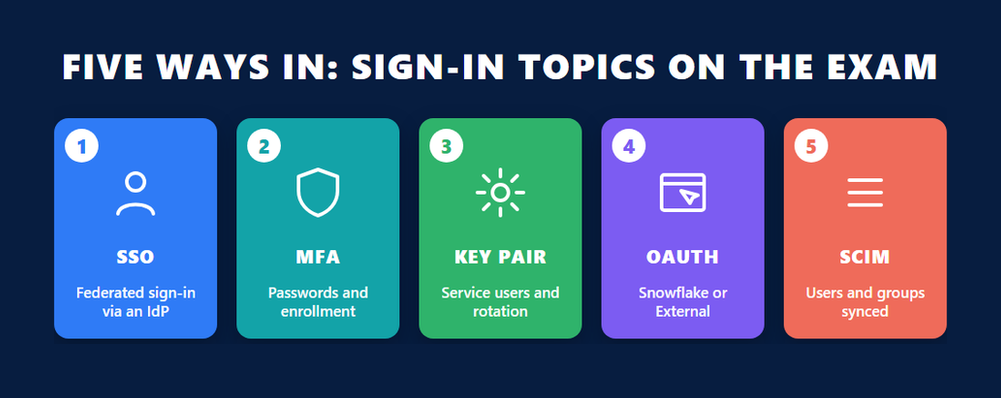
The second half of the domain is about how people and programs sign in. It covers federated authentication and single sign-on through an identity provider, password policies, MFA enrollment and reporting on users without MFA, user types (PERSON, NULL and SERVICE), key-pair authentication and rotation, and programmatic access tokens. OAuth gets its own objective: comparing Snowflake OAuth with External OAuth and configuring Snowflake OAuth for custom clients. The underlying flows are defined in the OAuth 2.0 specification, which is worth reading once so the grant types stop looking arbitrary.
Network rules and network policies follow, including how account-level and user-level rules interact, then private connectivity to internal stages and the Snowflake service, and securing the Snowflake SQL API. The domain ends with SCIM for user and group provisioning, service accounts and API integrations, and two account parameters that prevent data exfiltration through unload and stage creation.
What Sits in Account Management, Governance and Object Management?
Account Management and Data Governance (18 percent) covers organizations, accounts, encryption and data protection policies, while Data and Object Management (15 percent) covers virtual warehouses, tables, views, stages, tasks and queries. Together they make up a third of ADA-C02 and test whether you can build and protect the objects that everything else depends on.
Organizations, encryption and governance policies
On the account side, you need to weigh the benefits and costs of a Snowflake organization, create and name accounts, find which regions an organization can use, and tell account names from account locators and region groups. Encryption appears as Tri-Secret Secure, how Snowflake encrypts customer data, and key rotation with periodic rekeying. Governance is the larger part: masking policies for column-level security, external tokenization and when to choose it over masking, row access policies compared with secure views, the ACCESS_HISTORY views, tagging with tag-based masking, data classification, Trust Center, and Horizon Catalog with Universal Search and data lineage.
Warehouses, tables and tasks
Object management starts with virtual warehouses: sizing and types, auto-suspend and auto-resume, and multi-cluster warehouses with their scaling policies. Tables include external tables and Iceberg tables, with EXTERNAL_VOLUME and the Polaris Catalog named in the staging objectives. If you have not worked with the open table format before, the Apache Iceberg project is the clearest place to learn what Snowflake is integrating with. The domain also covers storage integrations, task scheduling and permissions, user-managed versus Snowflake-managed tasks, sequences, persisted query results, cancelling statements, query history filters and Snowsight dashboards.
How Do Performance Tuning and Cost Control Show Up on the Exam?
Performance Monitoring and Tuning is 20 percent of ADA-C02, the second largest domain. It asks you to read Query Profiles, troubleshoot slow queries, compare caches, choose performance features, manage DML concurrency, set up resource monitors, use event tables for logging and tracing, and manage costs across warehouses, serverless features and AI functions.
Reading a slow query
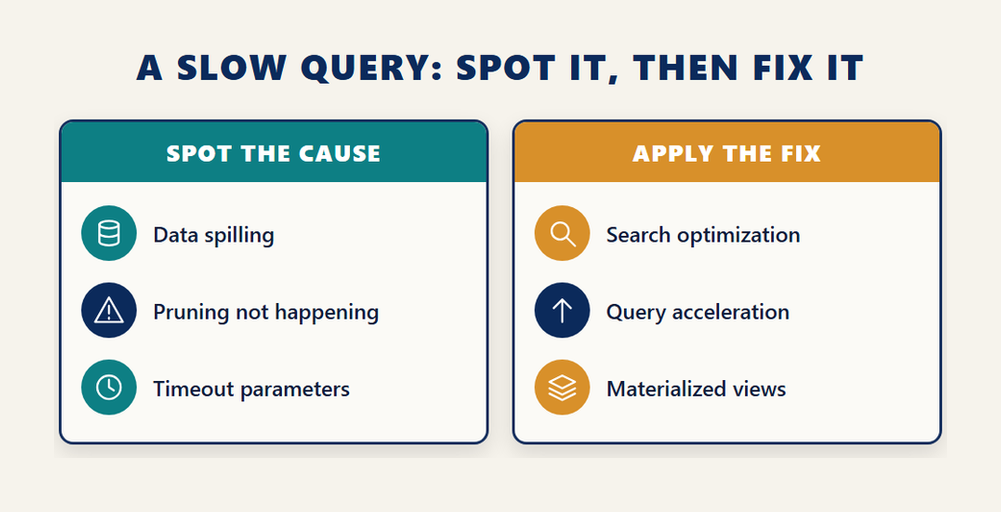
The tuning objectives begin with the Query Profile: steps, the operator tree, operator nodes and types, and the difference between compile-time and runtime optimization. The troubleshooting items are specific. You should recognise data spilling and what fixes it, notice when pruning is not happening, and know the timeout parameters. Caching is tested three ways: the result cache, the local disk cache of a warehouse and what suspending it does, and the metadata cache. The fixes the blueprint names are materialized views, the search optimization service, the query acceleration service and external tables.
Resource monitors, logging and the bill
Cost control is where administrators earn their keep. The blueprint asks you to create resource monitors from business requirements, build a cost dashboard, use Budgets and WAREHOUSE_MONITORING, calculate and reduce idle time cost, and monitor automatic clustering. It also covers how the cloud services layer consumes credits for features such as Snowpipe, materialized views and clustering, plus AI and ML function costs and Notebooks consumption. Event tables round out the domain: default versus custom tables, log, metric and trace levels, alerts, and using trace data for root cause analysis.
How Does the Administrator Exam Sit Among the Other SnowPro Advanced Credentials?
SnowPro Advanced is Snowflake’s role-based series, and the Administrator credential is one of seven alongside Architect, Security Engineer, Data Engineer, MLOps Engineer, Data Scientist and Data Analyst. Each assesses advanced skills for one job role, so the right choice depends on what you do in Snowflake every day, not on which exam looks easiest.
The Administrator exam overlaps most with Security Engineer and Architect, because all three care about access control and account design. It overlaps least with the data-facing roles. A data engineer’s day is pipelines, streams and transformations, which is why the DEA-C02 data engineer path centres on data movement and transformation rather than on grants and network policies.
If you hold several roles, start with the one that matches most of your working week. For an administrator that means ADA-C02 first, because a third of the exam is the access control work you already do. Architects who also run the account sometimes take both, but the two exams test different judgement: the architect exam asks how a platform should be designed, the administrator exam asks how it is run and kept within budget.
| If most of your week is | The closest SnowPro Advanced exam |
|---|---|
| Roles, logins, network policies and cost | Administrator (ADA-C02) |
| Pipelines, streams and transformations | Data Engineer |
| Analysis, modelling and presentation of data | Data Analyst |
| Platform design across accounts and clouds | Architect |
How Should You Prepare for ADA-C02?
Prepare for ADA-C02 in the order of its weights, and do every objective yourself in a Snowflake account rather than only reading about it. Start with security and access control, then performance and cost, then governance and object management, and finish with sharing and recovery. Two years of production administration is the baseline Snowflake expects.
- Read the current ADA-C02 objectives and mark every item you have not done yourself in a Snowflake account.
- Build a small role hierarchy with custom roles, database roles, future grants and a managed access schema, then audit it through ACCOUNT_USAGE.
- Set up key-pair authentication for a service user, a password policy, an MFA report and a network policy at account and user level.
- Apply a masking policy, a row access policy and a tag-based masking policy to one table and check the result as two different roles.
- Run a slow query, read its Query Profile, and try the search optimization service and query acceleration on it.
- Create a resource monitor and a budget, then calculate a warehouse’s idle time cost from the usage views.
- Create a share and a reader account, then set up a replication group and a failover group between two accounts.
- Finish with timed practice and reread the objectives to find anything you still have not touched.
Keep your notes organised by domain, and track the newer items separately. The current blueprint names Cortex AI features, Horizon Catalog, Trust Center, programmatic access tokens and the Polaris Catalog, all of which are recent enough that older study material may not cover them. For a sense of how another advanced Snowflake blueprint distributes its marks across domains, the DAA-C01 domain weights make a useful comparison.
Frequently Asked Questions
How many questions are on the ADA-C02 exam?
ADA-C02 has 65 questions with a time limit of 115 minutes.
What is the passing score for the SnowPro Advanced Administrator certification?
You need 750 on a scaled score that runs from 0 to 1000. Because the score is scaled, 750 is not a fixed number of correct answers.
How much does the SnowPro Advanced Administrator exam cost?
The fee is $375 per attempt, the same as every SnowPro Advanced exam, and each registration requires the full amount.
How much experience do I need before taking ADA-C02?
Snowflake describes the candidate as someone with two or more years of hands-on experience as a Snowflake Administrator in a production environment, who may also be fluent in ANSI and Snowflake advanced SQL.
Do I need the SnowPro Core certification first?
The ADA-C02 page shows a candidate profile rather than a formal prerequisite list. Check the registration terms on Snowflake’s certification site before you book, since that is where any requirement is applied.
What is the difference between ADA-C01 and ADA-C02?
ADA-C01 was the earlier version of the SnowPro Advanced Administrator exam. ADA-C02 is the only version in Snowflake’s current certification catalogue, so it is the one to prepare for.
Which ADA-C02 domain carries the most weight?
Snowflake Security, Role-Based Access Control (RBAC), and User Administration carries 31 percent, followed by Performance Monitoring and Tuning at 20 percent.
Does ADA-C02 cover Iceberg tables and AI features?
Yes. The blueprint names Iceberg tables, EXTERNAL_VOLUME and the Polaris Catalog, and it includes managing access to AI features and monitoring AI and ML function costs.
Where do I schedule the exam?
ADA-C02 is scheduled through Pearson VUE.
Conclusion
The SnowPro Advanced Administrator certification belongs to whoever runs the Snowflake account: the roles, the sign-in methods, the network rules, the cost reports and the failover plan. ADA-C02 has 65 questions in 115 minutes, costs $375 and needs a scaled 750 out of 1000. Security and access control carries 31 percent and performance and cost another 20, so those two domains decide most of the result, while governance, object management, sharing and recovery fill in the rest with precise, scenario-based questions. Snowflake expects two years of production administration, and the best preparation is doing every objective yourself in an account. Start with the sample questions to see the style, then work through the blueprint in the order of its weights.


